1,267 posters, 47 videos, 13 topics, 4 sessions, 853 authors
ePostersLive by SciGen Technologies S.A. All rights reserved.
SOHO 2026 Annual Meeting
September 9 - 12, 2026 | George R. Brown Convention Center, Houston, Texas

ABCL - 865
Post-CAR-T Relapse in DLBCL: Real-World Salvage Therapy Patterns and Outcomes at a Tertiary Academic Center
Poster Presenter
Authors
Part of Topic
Aggressive B-Cell Lymphoma (ABCL)
INTRODUCTION : Relapse after CD19-directed CAR-T therapy occurs inroughly half of patients with large B-cell lymphoma andcarries a poor prognosis, with historical median overallsurvival of only a few months after failure.
Despite the introduction of bispecific antibodies andantibody-drug conjugates, real-world outcomesfollowing CAR-T failure remain dismal and no standardsalvage sequence has been established, underscoringthe need to characterize contemporary post–CAR-Ttreatment patterns and their outcomes.
AIM : To characterize the clinical features, salvagetreatment patterns, and outcomes of patientswith relapsed/refractory DLBCL who progressafter CD19-directed CAR-T therapy, and todescribe overall CAR-T efficacy and safety in thisreal-world single-center cohort.
METHODS : We retrospectively identified all adults with relapsed/refractory DLBCL treatedwith CD19-directed CAR-T (axicabtageneciloleucel, lisocabtagenemaraleucel, oran institutional construct) at a single tertiary academic center between January2018 and May 2026, excluding non-DLBCL indications, patients managedelsewhere without longitudinal follow-up, and incomplete records.
Analyses included the full cohort (n=55) and a salvage cohort of 25 patients withpost–CAR-T progression. Response was assessed by Lugano 2014 criteria andCRS/ICANS by ASTCT grading; endpoints were ORR, CR, DOR, and OS/PFSmeasured from both infusion and progression. Time-to-event outcomes wereestimated by Kaplan–Meier (median follow-up by reverse Kaplan–Meier),response reported with 95% CIs, and subgroups compared by log-rank testing.
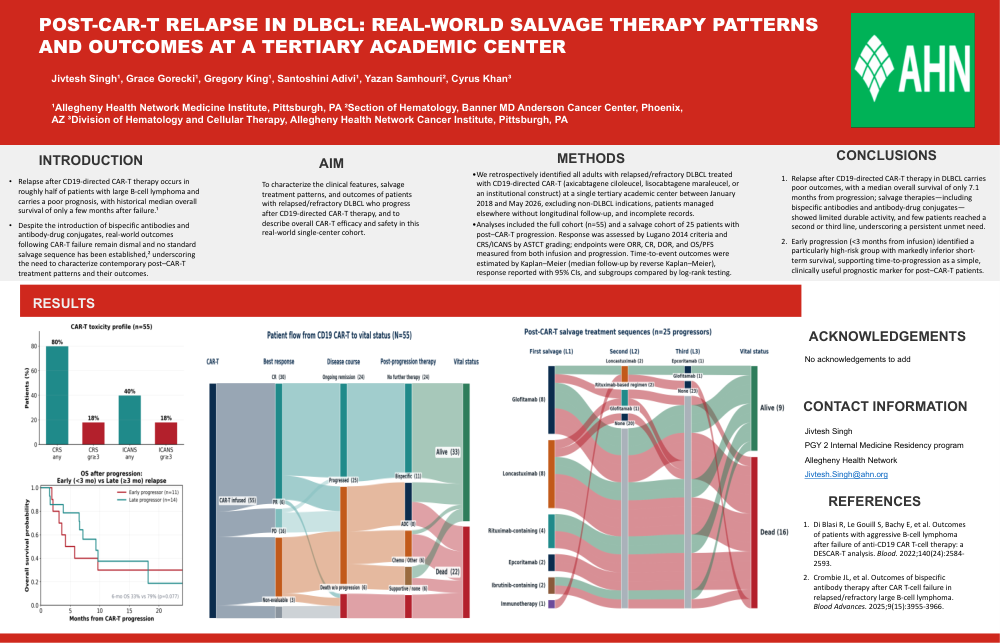
RESULTS: Among 55 patients (axicabtageneciloleucel n=44, lisocabtagenemaraleucel n=6, In house lentigen CD19 CAR-T n=5), median age was 63 years and 65% were male. DLBCL subtypes included NOS (n=43, 78%) and transformed DLBCL (n=12, 22%). Median prior lines were 2 (range 1–6). ORR to CAR-T was 69.2% (95% CI 54.9–81.3%), with CR rate 57.7% (95% CI 43.2–71.3%). Treatment-related mortality occurred in 4 patients (7.3%).
Among 25 patients with documented progression, median time to progression was 3.2 months; 40% (n=10) progressed within 3 months. Salvage therapies included bispecific antibodies (n=11), ADCs (n=7), chemoimmunotherapy (n=3), and other regimens (n=4). ORR to first salvage therapy was 48.0% (95% CI 27.8–68.7%), CR rate 24.0% (95% CI 9.4–45.1%), and median PFS 4.6 months (95% CI 1.7–24.4). Median OS from CAR-T progression was 7.1 months (95% CI 5.7–NR). Six-month OS was 70.0% for bispecifics and 42.9% for ADC recipients. Early progressors had inferior 6-month OS versus late progressors (33.3% vs 78.6%; p=0.077), with convergence at 12 months (22.2% vs 33.3%; p=0.659).
CONCLUSIONS : Relapse after CD19-directed CAR-T therapy in DLBCL carries poor outcomes, with a median overall survival of only 7.1 months from progression; salvage therapies—including bispecific antibodies and antibody-drug conjugates—showed limited durable activity, and few patients reached a second or third line, underscoring a persistent unmet need.
Early progression (<3 months from infusion) identified a particularly high-risk group with markedly inferior short-term survival, supporting time-to-progression as a simple, clinically useful prognostic marker for post–CAR-T patients.