1,267 posters, 47 videos, 13 topics, 4 sessions, 853 authors
ePostersLive by SciGen Technologies S.A. All rights reserved.
SOHO 2026 Annual Meeting
September 9 - 12, 2026 | George R. Brown Convention Center, Houston, Texas

MPN - 821
Cardiovascular Risk Burden and Thrombotic Outcomes in Essential Thrombocythemia: A 152-Patient Real-World Cohort with 8.6-Year Median Follow-Up
Poster Presenter
Authors
Part of Topic
Myeloproliferative Neoplasms (MPN)
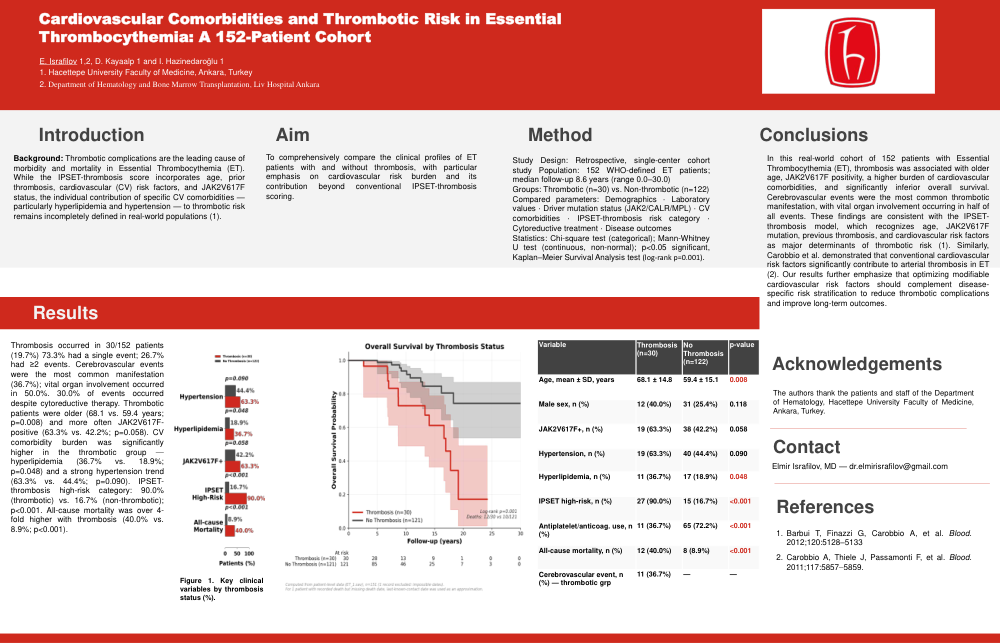
Cardiovascular Comorbidities and Thrombotic Risk in Essential Thrombocythemia: A 152-Patient Cohort
E. Israfilov 1,2, D. Kayaalp 1 and I. Hazinedaroğlu 1
1. Hacettepe University Faculty of Medicine, Ankara, Turkey
2. Department of Hematology and Bone Marrow Transplantation, Liv Hospital Ankara
Introduction
Background: Thrombotic complications are the leading cause of morbidity and mortality in Essential Thrombocythemia(ET). While the IPSET-thrombosis score incorporates age, prior thrombosis, cardiovascular (CV) risk factors, and JAK2V617F status, the individual contribution of specific CV comorbidities — particularly hyperlipidemia and hypertension — to thrombotic risk remains incompletely defined in real-world populations (1)
Aim
To comprehensively compare the clinical profiles of ET patients with and without thrombosis, with particular emphasis on cardiovascular risk burden and its contribution beyond conventional IPSET-thrombosis scoring.
Method
Study Design: Retrospective, single-center cohort study Population: 152 WHO-defined ET patients; median follow-up 8.6 years (range 0.0–30.0) Groups: Thrombotic (n=30) vs. Non-thrombotic (n=122) Compared parameters: Demographics · Laboratory values · Driver mutation status (JAK2/CALR/MPL) · CV comorbidities · IPSET-thrombosis risk category · Cytoreductive treatment · Disease outcomes Statistics: Chi-square test (categorical); Mann-Whitney U test (continuous, non-normal); p<0.05 significant, Kaplan–Meier Survival Analysis test (log-rank p=0.001).
Conclusions
In this real-world cohort of 152 patients with Essential Thrombocythemia (ET), thrombosis was associated with older age, JAK2V617F positivity, a higher burden of cardiovascular comorbidities, and significantly inferior overall survival. Cerebrovascular events were the most common thrombotic manifestation, with vital organ involvement occurring in half of all events. These findings are consistent with the IPSET-thrombosis model, which recognizes age, JAK2V617F mutation, previous thrombosis, and cardiovascular risk factors as major determinants of thrombotic risk (1). Similarly, Carobbio et al. demonstrated that conventional cardiovascular risk factors significantly contribute to arterial thrombosis in ET (2). Our results further emphasize that optimizing modifiable cardiovascular risk factors should complement disease-specific risk stratification to reduce thrombotic complications and improve long-term outcomes.
Results
Thrombosis occurred in 30/152 patients (19.7%) 73.3% had a single event; 26.7% had ≥2 events. Cerebrovascular events were the most common manifestation (36.7%); vital organ involvement occurred in 50.0%. 30.0% of events occurred despite cytoreductive therapy. Thrombotic patients were older (68.1 vs. 59.4 years; p=0.008) and more often JAK2V617F-positive (63.3% vs. 42.2%; p=0.058). CV comorbidity burden was significantly higher in the thrombotic group — hyperlipidemia (36.7% vs. 18.9%; p=0.048) and a strong hypertension trend (63.3% vs. 44.4%; p=0.090). IPSET-thrombosis high-risk category: 90.0% (thrombotic) vs. 16.7% (non-thrombotic); p<0.001. All-cause mortality was over 4-fold higher with thrombosis (40.0% vs. 8.9%; p<0.001).