1,267 posters, 47 videos, 13 topics, 4 sessions, 853 authors
ePostersLive by SciGen Technologies S.A. All rights reserved.
SOHO 2026 Annual Meeting
September 9 - 12, 2026 | George R. Brown Convention Center, Houston, Texas

ABCL - 736
Outpatient Treatment With Glofitamab Plus Gemcitabine and Oxaliplatin (Glofit-GemOx) in Relapsed/Refractory Diffuse Large B-Cell Lymphoma: Preliminary Safety Results From a Phase 2 Study
Poster Presenter
Authors
Part of Topic
Aggressive B-Cell Lymphoma (ABCL)
Video
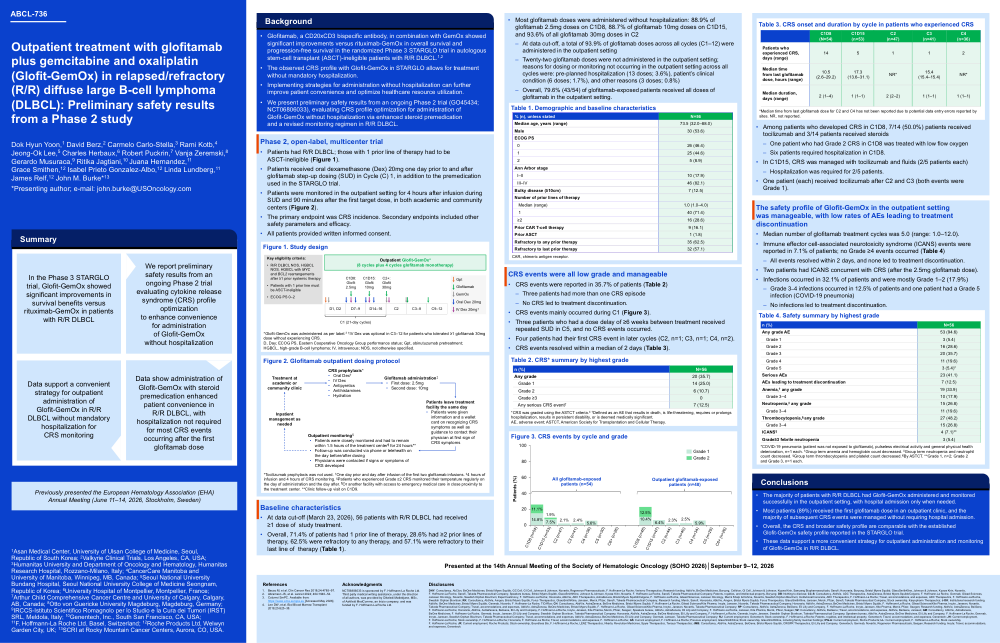
Background: The cytokine release syndrome (CRS) profile observed with Glofit-GemOx in the Phase 3 STARGLO trial allows for treatment without mandatory hospitalization. Implementing outpatient strategies can further improve patient convenience and optimize healthcare resource utilization.
Objective: Present preliminary safety results from an ongoing Phase 2 trial (NCT06806033) evaluating CRS profile optimization for outpatient Glofit-GemOx treatment via enhanced steroid premedication, and a revised monitoring regimen for treated patients with R/R DLBCL.
Methods: After obinutuzumab pretreatment, patients with R/R DLBCL received Glofit-GemOx (8 cycles plus 4 cycles glofitamab monotherapy), with glofitamab step-up dosing (SUD; 2.5/10mg) in Cycle (C) 1, then 30mg target dose from C2 (21-day cycles). Patients received oral dexamethasone 20mg one day prior to and after glofitamab SUD in C1, plus the premedication used in STARGLO. Patients were monitored in the outpatient setting for 4 hours during SUD and 90 minutes after the first target dose in both academic and community centers. The primary endpoint was CRS incidence.
Results: As of September 24, 2025, 25 patients had received ≥1 dose of study treatment. Most patients received glofitamab in the outpatient setting. CRS was reported in 44% of patients (Grade 1: 32%; Grade 2: 12%; no Grade ≥3) and mainly occurred after the 2.5mg and 10mg glofitamab doses. Two patients had their first CRS event (both Grade 1) in later cycles (C2 and C4). Serious CRS events were reported in 16% of patients. All CRS events resolved within a median of 2 days; no CRS led to treatment discontinuation. Infections occurred in 16% of patients (mostly Grade 1/2); none led to treatment discontinuation. One patient not exposed to glofitamab had Grade 5 COVID-19 pneumonia. Immune effector cell-associated neurotoxicity syndrome (ICANS) events were reported in 12% of patients (Grade 1, Grade 2, Grade 3: 4% each); all resolved within 2 days and none led to treatment discontinuation. Two patients had ICANS concurrent with CRS (after the 2.5mg glofitamab dose).
Conclusions: The rate and severity of CRS in patients receiving Glofit-GemOx in the outpatient setting were similar to those in STARGLO. Preliminary data are encouraging and support further optimization of outpatient Glofit-GemOx treatment.