1,267 posters, 47 videos, 13 topics, 4 sessions, 853 authors
ePostersLive by SciGen Technologies S.A. All rights reserved.
SOHO 2026 Annual Meeting
September 9 - 12, 2026 | George R. Brown Convention Center, Houston, Texas

HL - 686
Role of targeted Immune therapies in relapsed refractory hodgkins lymphoma -A Multicentre experience from various transplant centres in Pakistan . A Lower middle income country perspective
Poster Presenter
Authors
Part of Topic
Hodgkin Lymphoma (HL)
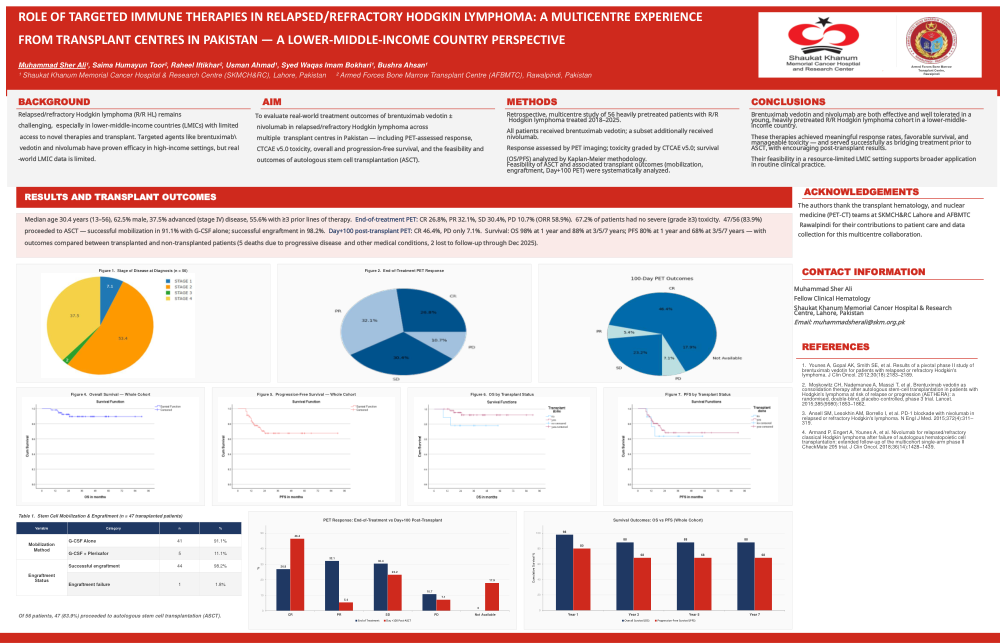
Title: Role of Targeted Immune Therapies in Relapsed/Refractory Hodgkin Lymphoma: A Multicentre Experience from Transplant Centres in Pakistan — A Lower-Middle-Income Country Perspective
Authors: Muhammad Sher Ali, Saima Humayun Toor, Raheel Iftikhar, Usman Ahmad, Syed Waqas Imam Bokhari, Bushra Ahsan
Affiliations: Shaukat Khanum Memorial Cancer Hospital & Research Centre (SKMCH&RC), Lahore, Pakistan; Armed Forces Bone Marrow Transplant Centre (AFBMTC), Rawalpindi, Pakistan
Background: Relapsed/refractory Hodgkin lymphoma (R/R HL) remains challenging, especially in lower-middle-income countries (LMICs) with limited access to novel therapies and transplant. Targeted agents like brentuximab vedotin and nivolumab have proven efficacy in high-income settings, but real-world LMIC data remain limited.
Aim: To evaluate real-world treatment outcomes of brentuximab vedotin ± nivolumab in R/R Hodgkin lymphoma across multiple transplant centres in Pakistan — including PET-assessed response, CTCAE v5.0 toxicity, overall and progression-free survival, and the feasibility and outcomes of autologous stem cell transplantation (ASCT).
Methods: This retrospective, multicentre study included 56 heavily pretreated patients with R/R Hodgkin lymphoma treated between 2018 and 2025. All patients received brentuximab vedotin; a subset additionally received nivolumab. Response was assessed by PET imaging, toxicity was graded using CTCAE v5.0, and survival (OS/PFS) was analyzed using Kaplan-Meier methodology. The feasibility of ASCT and associated transplant outcomes (mobilization, engraftment, Day+100 PET) were systematically analyzed.
Results: The cohort had a median age of 30.4 years (range 13–56), was 62.5% male, and 37.5% had advanced (stage IV) disease; 55.6% had received ≥3 prior lines of therapy. End-of-treatment PET showed CR in 26.8%, PR in 32.1%, SD in 30.4%, and PD in 10.7% (overall response rate 58.9%). Treatment was well tolerated, with 67.2% of patients experiencing no severe (grade ≥3) toxicity. Of 56 patients, 47 (83.9%) proceeded to ASCT — successful stem cell mobilization was achieved with G-CSF alone in 91.1%, and successful engraftment occurred in 98.2%. Day+100 post-transplant PET showed CR in 46.4%, with progressive disease in only 7.1%. Survival outcomes were favorable: OS was 98% at 1 year and 88% at 3, 5, and 7 years; PFS was 80% at 1 year and 68% at 3, 5, and 7 years. Outcomes were compared between transplanted and non-transplanted patients. Through December 2025, there were 5 deaths (due to progressive disease and other medical conditions) and 2 patients lost to follow-up.
Conclusions: Brentuximab vedotin and nivolumab are both effective and well tolerated in a young, heavily pretreated R/R Hodgkin lymphoma cohort in a lower-middle-income country. These therapies achieved meaningful response rates, favorable survival, and manageable toxicity, and served successfully as bridging treatment prior to ASCT with encouraging post-transplant results. Their feasibility in a resource-limited LMIC setting supports broader application in routine clinical practice.