1,267 posters, 47 videos, 13 topics, 4 sessions, 853 authors
ePostersLive by SciGen Technologies S.A. All rights reserved.
SOHO 2026 Annual Meeting
September 9 - 12, 2026 | George R. Brown Convention Center, Houston, Texas

MPN - 672
Venous Thrombotic Outcomes in Pregnant Patients With Myeloproliferative Neoplasms: A Propensity Score-Matched Analysis
Poster Presenter
Authors
Part of Topic
Myeloproliferative Neoplasms (MPN)
Context
Pregnant patients with Philadelphia-negative myeloproliferative neoplasms (MPNs) are associated with compounding thrombotic risk from both Janus kinase-signal transducer and activator of transcription signaling (JAK-STAT)-driven biology and the hypercoagulable state of pregnancy. Population-level data on the magnitude and timing of this risk are lacking, limiting evidence-based management decisions.
Objective
To quantify thrombotic outcomes in pregnant MPN patients compared with a matched normal pregnant population and to identify high-risk subgroups.
Methods
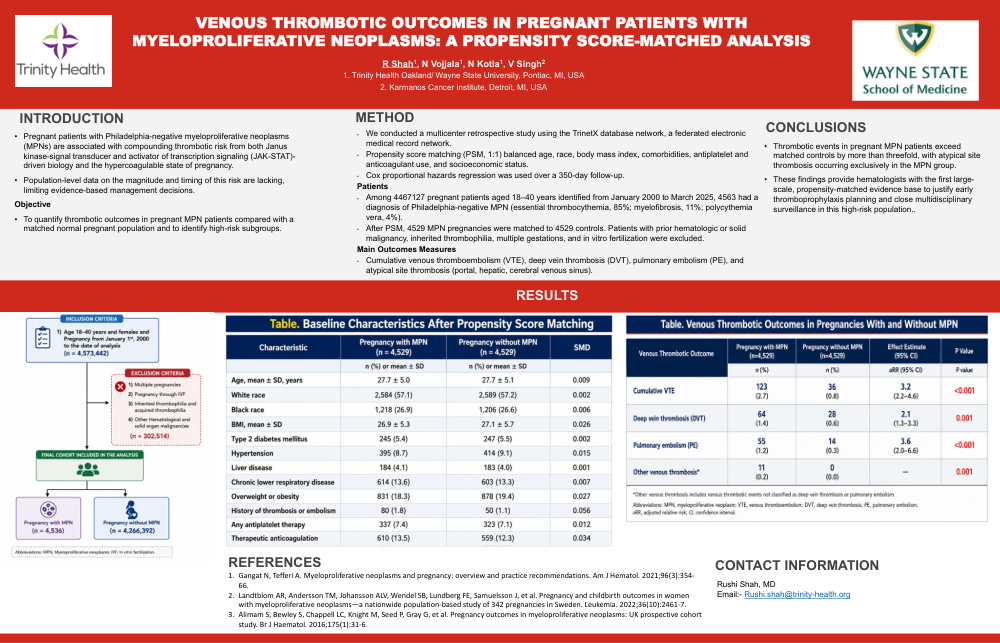
We conducted a multicenter retrospective study using the TrinetX database network, a federated electronic medical record network. Propensity score matching (PSM, 1:1) balanced age, race, body mass index, comorbidities, antiplatelet and anticoagulant use, and socioeconomic status. Cox proportional hazards regression was used over a 350-day follow-up.
Patients
Among 4467127 pregnant patients aged 18–40 years identified from January 2000 to March 2025, 4563 had a diagnosis of Philadelphia-negative MPN (essential thrombocythemia, 85%; myelofibrosis, 11%; polycythemia vera, 4%). After PSM, 4529 MPN pregnancies were matched to 4529 controls. Patients with prior hematologic or solid malignancy, inherited thrombophilia, multiple gestations, and in vitro fertilization were excluded.
Main Outcomes Measures
Cumulative venous thromboembolism (VTE), deep vein thrombosis (DVT), pulmonary embolism (PE), and atypical site thrombosis (portal, hepatic, cerebral venous sinus).
Results
Cumulative VTE events were significantly higher in the MPN cohort compared with the normal pregnancies (123 vs 36; P <0.001; adjusted hazard ratio [aHR], 3.2; 95% confidence interval [CI], 2.2–4.6). Similarly, individual DVT (64 vs 28; P =0.001; aHR, 2.1; 95% CI, 1.3–3.3) and PE (55 vs 14; P <0.001; aHR, 3.6; 95% CI, 2.0–6.6) were also significantly higher in the MPN cohort. The incidence of atypical site thrombosis (eg, hepatic vein thrombosis, portal vein thrombosis, and cerebral venous sinus thrombosis) was also higher in the MPN group (n=11 vs 0; P <0.001).
Conclusions
Thrombotic events in pregnant MPN patients exceed matched controls by more than threefold, with atypical site thrombosis occurring exclusively in the MPN group. These findings provide hematologists with the first large-scale, propensity-matched evidence base to justify early thromboprophylaxis planning and close multidisciplinary surveillance in this high-risk population