1,267 posters, 47 videos, 13 topics, 4 sessions, 853 authors
ePostersLive by SciGen Technologies S.A. All rights reserved.
SOHO 2026 Annual Meeting
September 9 - 12, 2026 | George R. Brown Convention Center, Houston, Texas

ABCL - 619
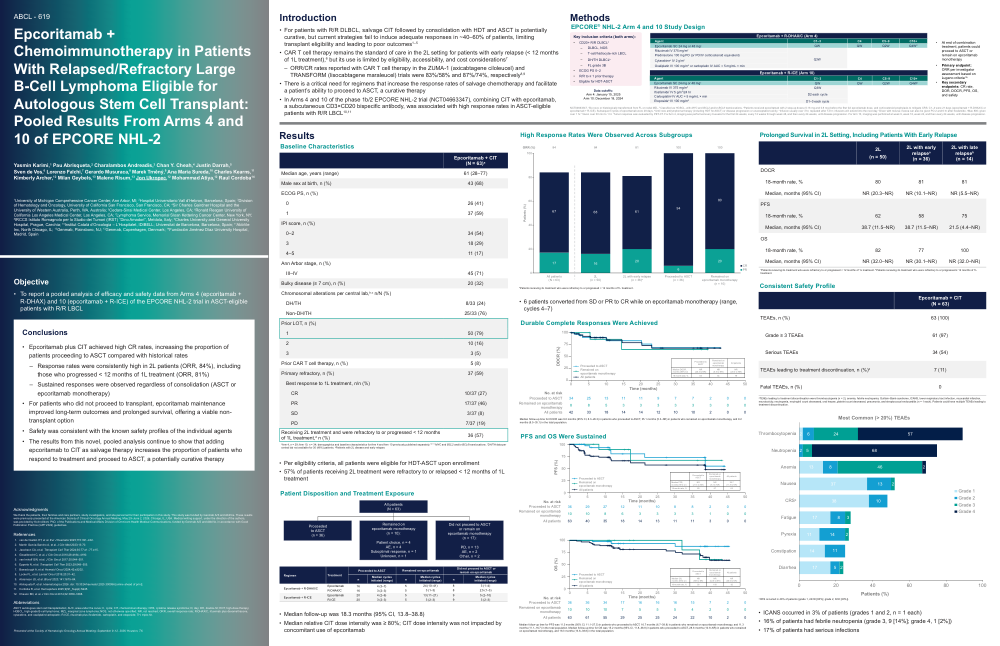
Epcoritamab + Chemoimmunotherapy in Patients With Relapsed/Refractory Large B-Cell Lymphoma Eligible for Autologous Stem Cell Transplant: Pooled Results From Arms 4 and 10 of EPCORE NHL-2
Poster Presenter
Authors
Part of Topic
Aggressive B-Cell Lymphoma (ABCL)
ABCL - 619
Epcoritamab + Chemoimmunotherapy in Patients With Relapsed/Refractory Large B-Cell Lymphoma Eligible for Autologous Stem Cell Transplant: Pooled Results From Arms 4 and 10 of EPCORE NHL-2
Yasmin Karimi,1 Pau Abrisqueta,2 Charalambos Andreadis,3 Chan Y. Cheah,4 Justin Darrah,5 Sven de Vos,6 Lorenzo Falchi,7 Gerardo Musuraca,8 Marek Trněný,9 Ana Maria Sureda,10 Charles Kearns,11 Kimberly Archer,12 Milan Geybels,13 Malene Risum,13 Jon Ukropec,12 Mohammad Atiya,12 Raul Cordoba14
1University of Michigan Comprehensive Cancer Center, Ann Arbor, MI; 2Hospital Universitario Vall d’Hebron, Barcelona, Spain; 3Division of Hematology and Oncology, University of California San Francisco, San Francisco, CA; 4Sir Charles Gairdner Hospital and the University of Western Australia, Perth, WA, Australia; 5Cedars-Sinai Medical Center, Los Angeles, CA; 6Ronald Reagan University of California Los Angeles Medical Center, Los Angeles, CA; 7Lymphoma Service, Memorial Sloan Kettering Cancer Center, New York, NY; 8IRCCS Istituto Romagnolo per lo Studio dei Tumori (IRST) “Dino Amadori”, Meldola, Italy; 9Charles University and General University Hospital, Prague, Czechia; 10Institut Català d’Oncologia – L’Hospitalet, IDIBELL; Universitat de Barcelona, Barcelona, Spain; 11AbbVie Inc, North Chicago, IL; 12Genmab, Plainsboro, NJ; 13Genmab, Copenhagen, Denmark; 14Fundación Jiménez Díaz University Hospital, Madrid, Spain
Objective
• To report a pooled analysis of efficacy and safety data from Arms 4 (epcoritamab + R-DHAX) and 10 (epcoritamab + R-ICE) of the EPCORE NHL-2 trial in ASCT-eligible patients with R/R LBCL
Introduction
• For patients with R/R DLBCL, salvage CIT followed by consolidation with HDT and ASCT is potentially curative, but current strategies fail to induce adequate responses in ~40–60% of patients, limiting transplant eligibility and leading to poor outcomes1–5
• CAR T cell therapy remains the standard of care in the 2L setting for patients with early relapse (< 12 months of 1L treatment),6 but its use is limited by eligibility, accessibility, and cost considerations7
– ORR/CR rates reported with CAR T cell therapy in the ZUMA-1 (axicabtagene ciloleucel) and TRANSFORM (lisocabtagene maraleucel) trials were 83%/58% and 87%/74%, respectively8,9
• There is a critical need for regimens that increase the response rates of salvage chemotherapy and facilitate a patient’s ability to proceed to ASCT, a curative therapy
• In Arms 4 and 10 of the phase 1b/2 EPCORE NHL-2 trial (NCT04663347), combining CIT with epcoritamab, a subcutaneous CD3×CD20 bispecific antibody, was associated with high response rates in ASCT-eligible patients with R/R LBCL10,11
Methods
EPCORE® NHL-2 Arm 4 and 10 Study Design: See Poster
Results
Baseline Characteristics: See poster for table
Patient Disposition and Treatment Exposure: See poster for figure
High Response Rates Were Observed Across Subgroups: See poster for figure
Durable Complete Responses Were Achieved: See poster for figure
PFS and OS Were Sustained: See poster for figures
Prolonged Survival in 2L Setting, Including Patients With Early Relapse: See poster for table
Consistent Safety Profile: See poster for table and figure
Conclusions
• Epcoritamab plus CIT achieved high CR rates, increasing the proportion of patients proceeding to ASCT compared with historical rates
– Response rates were consistently high in 2L patients (ORR, 84%), including those who progressed < 12 months of 1L treatment (ORR, 81%)
– Sustained responses were observed regardless of consolidation (ASCT or epcoritamab monotherapy)
• For patients who did not proceed to transplant, epcoritamab maintenance improved long-term outcomes and prolonged survival, offering a viable non-transplant option
• Safety was consistent with the known safety profiles of the individual agents
• The results from this novel, pooled analysis continue to show that adding epcoritamab to CIT as salvage therapy increases the proportion of patients who respond to treatment and proceed to ASCT, a potentially curative therapy
Acknowledgments
We thank the patients, their families and care partners, study investigators, and site personnel for their participation in this study. This study was funded by Genmab A/S and AbbVie. These results were previously presented at the American Society of Clinical Oncology Annual Meeting; May 29–June 2, 2026; Chicago, IL, USA. Medical writing support, under the direction of the authors, was provided by Korin Albert, PhD, of the Publications and Medical Affairs Division of Omnicom Health Medical Communications, funded by Genmab A/S and AbbVie, in accordance with Good Publication Practice (GPP 2022) guidelines.
References
1. van der Galiën HT, et al. Eur J Haematol 2025;115:391–402.
2. Martín García-Sancho A, et al. J Clin Med 2023;13:70.
3. Jacobson CA, et al. Transplant Cell Ther 2024;30:77.e1–77.e15.
4. Gisselbrecht C, et al. J Clin Oncol 2010;28:4184–4190.
5. van Imhoff GW, et al. J Clin Oncol 2017;35:544–551.
6. Epperla N, et al. Transplant Cell Ther 2023;29:548–555.
7. Barraclough A, et al. Hematol Oncol 2024;42:e3202.
8. Locke FL, et al. Lancet Oncol 2019;20:31–42.
9. Abramson JS, et al. Blood 2023;141:1675–84.
10. Abrisqueta P, et al. Haematologica 2026. doi: 10.3324/haematol.2025.300086 [online ahead of print].
11. Cordoba R, et al. Hemasphere 2025;9(S1_Suppl):S245.
12. Cheson BD, et al. J Clin Oncol 2014;32:3059–3068.
Abbreviations
ASCT, autologous stem cell transplantation; AUC, area under the curve; C, cycle; CIT, chemoimmunotherapy; CRS, cytokine release syndrome; D, day; DH, double-hit; HDT, high-dose therapy; HGBCL, high-grade B-cell lymphoma; MZL, marginal zone lymphoma; NOS, not otherwise specified; NR, not reached; ORR, overall response rate; R-DHAX/C, rituximab plus dexamethasone, cytarabine, and oxaliplatin/carboplatin; R-ICE, rituximab plus ifosfamide, carboplatin, and etoposide; TH, triple-hit.