1,267 posters, 47 videos, 13 topics, 4 sessions, 853 authors
ePostersLive by SciGen Technologies S.A. All rights reserved.
SOHO 2026 Annual Meeting
September 9 - 12, 2026 | George R. Brown Convention Center, Houston, Texas

HL - 618
Tumor Lysis Syndrome as a Major Driver of Mortality and Renal Failure in Hospitalized Lymphoma Patients: A National Inpatient Sample Analysis (2018-2023)
Poster Presenter
Authors
Part of Topic
Hodgkin Lymphoma (HL)
-
Tumor lysis syndrome (TLS) is an oncologic emergency resulting in rapid cell lysis and release of intracellular contents, leading to metabolic derangements. For example, these include hyperuricemia, hyperkalemia, hyperphosphatemia, hypocalcemia, and subsequent end organ dysfunction.
-
TLS is particularly common in aggressive lymphomas and high tumor burden disease, yet the real world national impact on inpatient outcomes is not well defined.
-
Understanding the burden of TLS and it’s downstream complications is critical for early identification, risk stratification, and implementation of preventative strategies to improve patient outcomes.
-
Design: Retrospective cohort study using the National Inpatient Sample Analysis (2018-2023)
-
Population: Adult hospitalizations (age > 18 years old) with lymphoma were identified using ICD-10 code of C81-C96.
-
TLS was defined using ICD-10 code of E88.3
-
Survey weighted analyses compared outcomes between hospitalizations with and without TLS.
-
Multivariable logistic regression adjusted for demographics, hospital characteristics, and comorbidities.
-
Primary outcome was in-hospital mortality
-
Secondary outcomes included major adverse inpatient events (MAIE), acute kidney injury (AKI), dialysis, mechanical ventilation and shock.
-
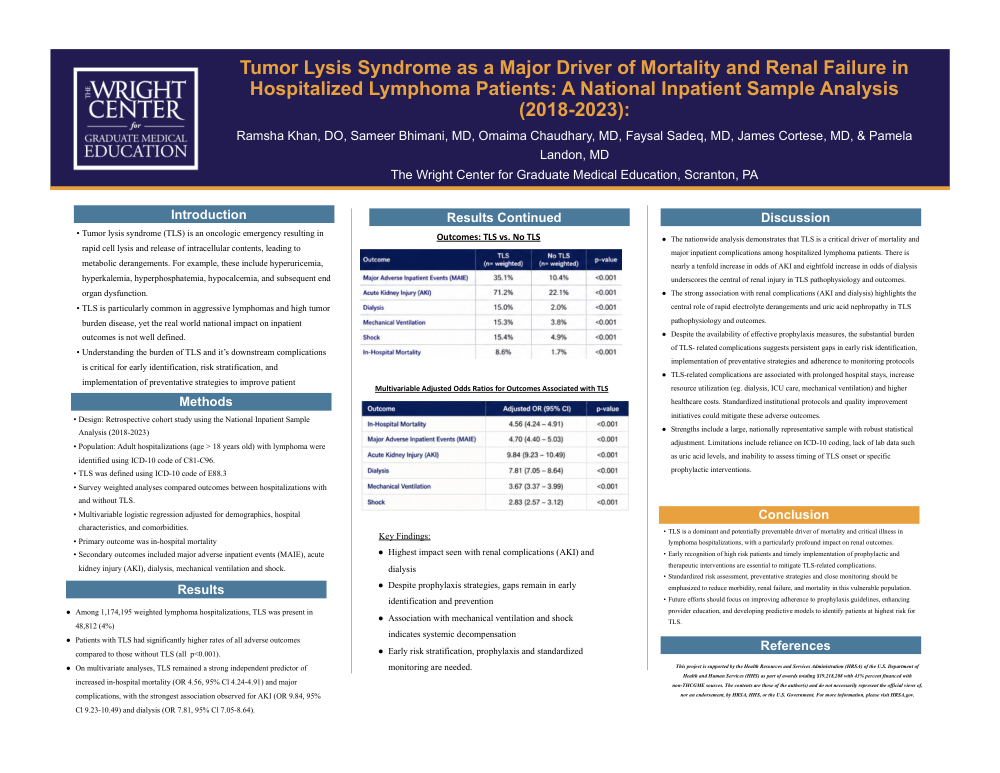
Among 1,174,195 weighted lymphoma hospitalizations, TLS was present in 48,812 (4%)
-
Patients with TLS had significantly higher rates of all adverse outcomes compared to those without TLS (all p<0.001).
-
On multivariate analyses, TLS remained a strong independent predictor of increased in-hospital mortality (OR 4.56, 95% Cl 4.24-4.91) and major complications, with the strongest association observed for AKI (OR 9.84, 95% Cl 9.23-10.49) and dialysis (OR 7.81, 95% Cl 7.05-8.64).
-
The nationwide analysis demonstrates that TLS is a critical driver of mortality and major inpatient complications among hospitalized lymphoma patients. There is nearly a tenfold increase in odds of AKI and eightfold increase in odds of dialysis underscores the central of renal injury in TLS pathophysiology and outcomes.
-
The strong association with renal complications (AKI and dialysis) highlights the central role of rapid electrolyte derangements and uric acid nephropathy in TLS pathophysiology and outcomes.
-
Despite the availability of effective prophylaxis measures, the substantial burden of TLS- related complications suggests persistent gaps in early risk identification, implementation of preventative strategies and adherence to monitoring protocols
-
TLS-related complications are associated with prolonged hospital stays, increase resource utilization (eg. dialysis, ICU care, mechanical ventilation) and higher healthcare costs. Standardized institutional protocols and quality improvement initiatives could mitigate these adverse outcomes.
-
Strengths include a large, nationally representative sample with robust statistical adjustment. Limitations include reliance on ICD-10 coding, lack of lab data such as uric acid levels, and inability to assess timing of TLS onset or specific prophylactic interventions.
-
TLS is a dominant and potentially preventable driver of mortality and critical illness in lymphoma hospitalizations, with a particularly profound impact on renal outcomes.
-
Early recognition of high risk patients and timely implementation of prophylactic and therapeutic interventions are essential to mitigate TLS-related complications.
-
Standardized risk assessment, preventative strategies and close monitoring should be emphasized to reduce morbidity, renal failure, and mortality in this vulnerable population.
-
Future efforts should focus on improving adherence to prophylaxis guidelines, enhancing provider education, and developing predictive models to identify patients at highest risk for TLS.
Key Findings:
-
Highest impact seen with renal complications (AKI) and dialysis
-
Despite prophylaxis strategies, gaps remain in early identification and prevention
-
Association with mechanical ventilation and shock indicates systemic decompensation
-
Early risk stratification, prophylaxis and standardized monitoring are needed.
-
-
-
-
-