1,267 posters, 47 videos, 13 topics, 4 sessions, 853 authors
ePostersLive by SciGen Technologies S.A. All rights reserved.
SOHO 2026 Annual Meeting
September 9 - 12, 2026 | George R. Brown Convention Center, Houston, Texas

ABCL - 568
Subcutaneous Mosunetuzumab in Combination With Polatuzumab Vedotin (Mosun-Pola) Shows a Sustained Progression-Free Survival Benefit Compared With Rituximab Plus Polatuzumab Vedotin (R-Pola) in Patients With Relapsed or Refractory Large B-Cell Lymphoma After Long-Term Follow-Up
Poster Presenter
Authors
Part of Topic
Aggressive B-Cell Lymphoma (ABCL)
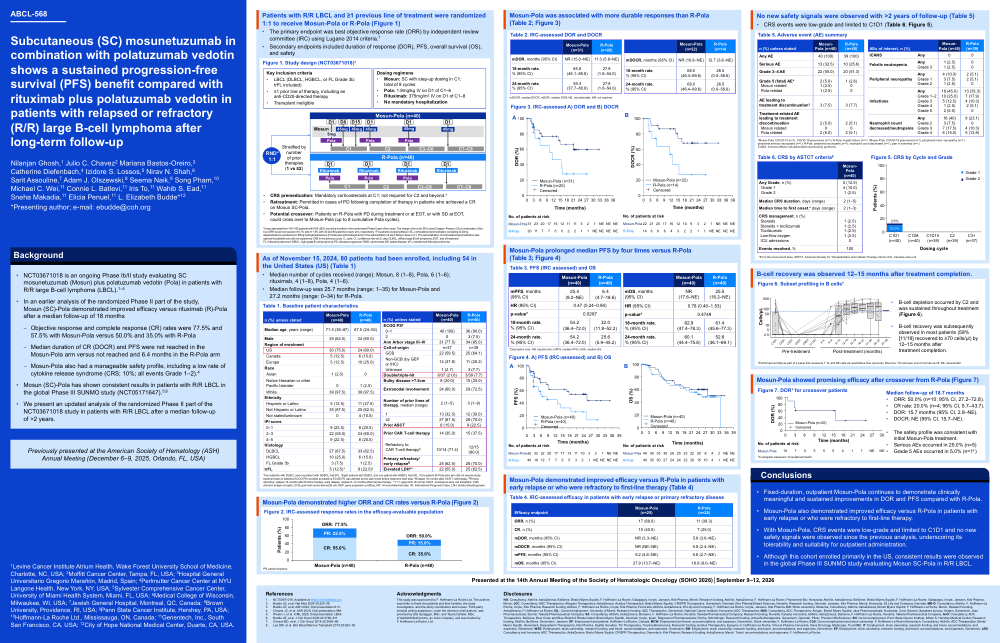
Context: In a Phase 1b/2 study (NCT03671018), Mosun-Pola showed promising durability of response and manageable safety versus R-Pola in patients with transplant-ineligible R/R LBCL (Chavez et al. ASH 2024).
Objective: Report an updated analysis with ≥2 years of follow-up.
Methods: Patients with R/R LBCL and ≥1 previous line of treatment were randomized 1:1 to receive Mosun-Pola or R-Pola. Patients who received R-Pola and had progressive disease during or at end of treatment (EOT), or stable disease at EOT, could cross over to Mosun-Pola. The primary endpoint was best overall response rate (ORR; Lugano 2014 criteria). Safety was a secondary endpoint. P-values are descriptive.
Results: As of November 15, 2024, 80 patients were enrolled (Mosun-Pola, n=40; R-Pola, n=40). Baseline characteristics were as previously reported (Chavez et al. ASH 2024). Median follow-up was 25.7 months (range: 1–35) in the Mosun-Pola arm versus 27.2 months (range: 0‒34) in the R-Pola arm. For Mosun-Pola versus R-Pola, best ORR and complete response (CR) rates were 78% (95% CI: 61.6–89.2) and 55% (95% CI: 38.5–70.7) versus 50% (95% CI: 33.8–66.2) and 35% (95% CI: 20.6–51.7), respectively. Median PFS was 25.4 months (95% CI: 9.2– not evaluable [NE]) for Mosun-Pola versus 6.4 months (95% CI: 4.7–18.6) for R-Pola (HR, 0.47 [95% CI: 0.2–0.9]; p=0.0287]). Median overall survival was not reached for Mosun-Pola (95% CI: 17.6–NE) versus 25.5 months (95% CI: 16.2–NE) for R-Pola (HR, 0.78 [95% CI: 0.4‒1.5]; p=0.4749). Median duration of response and duration of CR were not reached with Mosun-Pola (95% CI: 15.0–NE and 95% CI: 16.8–NE, respectively) versus 11.3 months (95% CI: 5.8–NE) and 12.7 months (95% CI: 3.6–NE), respectively, with R-Pola. No new safety signals were identified since the previous analysis (Chavez et al. ASH 2024). Cytokine release syndrome occurred in 13% (5/40) of patients in the Mosun-Pola arm; all events were low grade, occurred during Cycle 1 Days 1–7, and resolved.
Conclusions: After ≥2 years of follow-up, fixed-duration Mosun-Pola continues to demonstrate clinically meaningful and sustained improvements across efficacy endpoints with no new safety signals, supporting outpatient use.