1,267 posters, 47 videos, 13 topics, 4 sessions, 853 authors
ePostersLive by SciGen Technologies S.A. All rights reserved.
SOHO 2026 Annual Meeting
September 9 - 12, 2026 | George R. Brown Convention Center, Houston, Texas

ABCL - 484
A Real-World Study of the Effectiveness and Safety of Post-Tafasitamab Chimeric Antigen Receptor T-Cell (CAR-T) Therapy in Relapsed/Refractory Diffuse Large B-Cell Lymphoma (R/R DLBCL)
Poster Presenter
Authors
Part of Topic
Aggressive B-Cell Lymphoma (ABCL)
Video
CONTEXT: With the expanding landscape of CD19-directed therapies, theoretical concerns exist that prior exposure to anti-CD19 treatment may compromise effectiveness of subsequent CAR-T therapy in patients with DLBCL. However, several studies have demonstrated retention of CD19 expression post-tafasitamab, with limited evidence on efficacy and safety of subsequent CAR-T therapy.
OBJECTIVE: Assess effectiveness and safety of CAR-T post-tafasitamab among patients with R/R DLBCL.
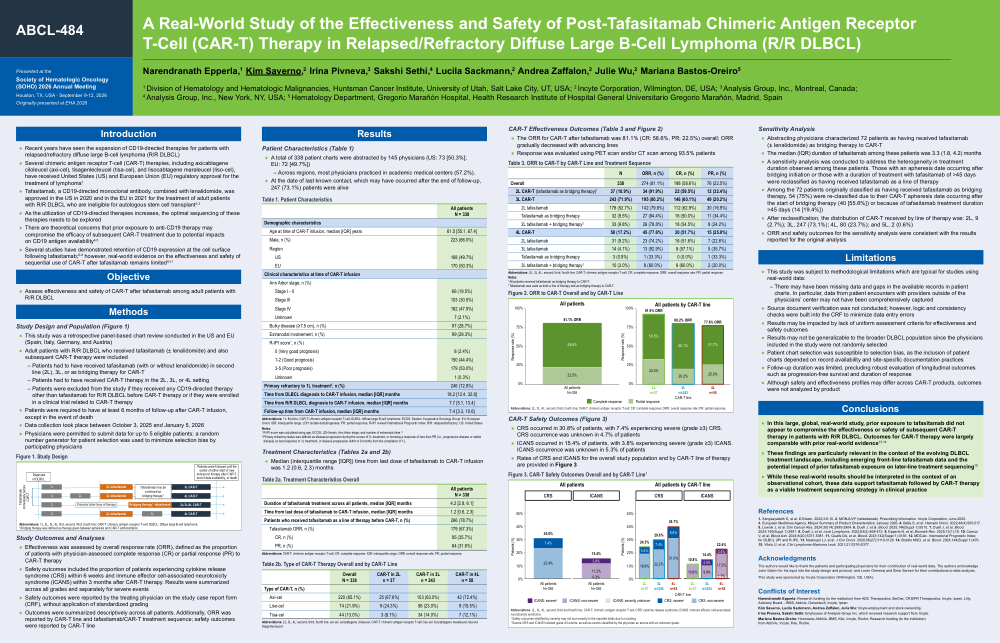
DESIGN: This retrospective, US and EU physician-abstracted medical chart review study collected data for adults with R/R DLBCL who received tafasitamab (±lenalidomide) and subsequent CAR-T in second line (2L), 3L or 4L. Patients had ≥6 months follow-up post-CAR-T (except in the event of death), and were followed until the start of new anticancer therapy, end of data availability, or death (whichever occurred first). Outcomes were overall response rate to CAR-T (ORR: proportion of patients with physician-assessed complete/partial response [CR/PR]), proportion of patients with cytokine release syndrome (CRS) within 6 weeks, and immune effector cell-associated neurotoxicity syndrome (ICANS) within 3 months after CAR-T.
RESULTS: In total, 338 patient charts (US: 168 [49.7%]; EU: 170 [50.3%]) were abstracted by 145 physicians (US: 73 [50.3%]; EU: 72 [49.7%]). Patients were 66.0% male with median (IQR) age 61.5 (55.1, 67.4) years at CAR-T infusion, 72.8% were primary refractory, and 53.0% had revised International Prognostic Index score ≥3.
CAR-T therapies administered were axicabtagene ciloleucel (65.1%), followed by lisocabtagene maraleucel (21.9%) and tisagenlecleucel (13.0%). Median (IQR) time from last tafasitamab dose until CAR-T was 1.2 (0.6, 2.3) months; follow-up time post-CAR-T was 7.4 (3.3, 10.6) months, and 73.1% were alive at time of last contact.
Overall, ORR for CAR-T was 81.1%, with CR and PR rates of 58.6% and 22.5%, respectively; ORR was 91.9% for 2L, 80.2% for 3L and 77.6% for 4L. CRS and ICANS occurred in 30.8% (severe [grade ≥3], 7.4%) and 15.4% (severe [grade ≥3], 3.8%) of patients, respectively.
CONCLUSIONS: This large, real-world study indicates that prior exposure to tafasitamab does not appear to compromise the effectiveness or safety of subsequent CAR-T therapy in patients with R/R DLBCL. These real-world study findings support the sequencing strategy of tafasitamab followed by CAR-T.