1,267 posters, 47 videos, 13 topics, 4 sessions, 853 authors
ePostersLive by SciGen Technologies S.A. All rights reserved.
SOHO 2026 Annual Meeting
September 9 - 12, 2026 | George R. Brown Convention Center, Houston, Texas

ABCL - 483
Glofitamab Plus Gemcitabine and Oxaliplatin (GemOx) Versus Rituximab Plus GemOx (R-GemOx) in Patients With Relapsed/Refractory (R/R) Diffuse Large B-Cell Lymphoma (DLBCL): Outcomes from the 3-Year Follow-Up of STARGLO
Poster Presenter
Authors
Part of Topic
Aggressive B-Cell Lymphoma (ABCL)
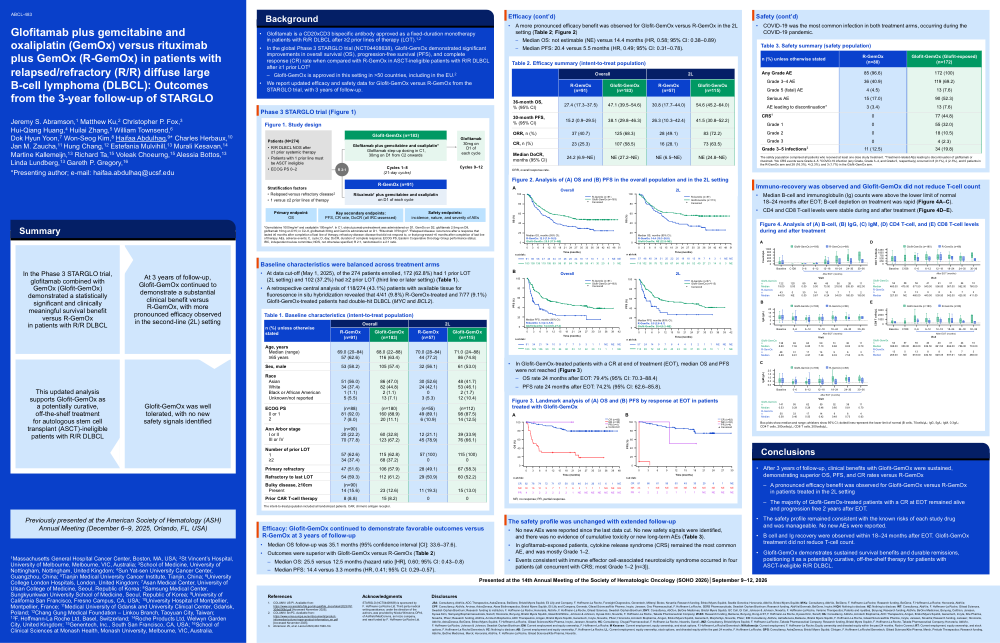
Context: Glofit-GemOx demonstrated survival benefits in patients with R/R DLBCL after ≥1 prior line of therapy (LOT) in the Phase 3 STARGLO trial (NCT04408638).
Objective: Report updated efficacy and safety with 3 years of follow-up.
Methods: Patients were randomized 2:1 to Glofit-GemOx (8 cycles; 4 cycles glofitamab monotherapy) or R-GemOx (8 cycles) and stratified by prior LOT (1 vs ≥2) and refractoriness to last therapy. Following obinutuzumab pretreatment, step-up doses of glofitamab were given (weekly, 2.5/10mg; Cycle 1), then 30mg (every 21 days from Cycle 2 Day 1). Primary endpoint: overall survival (OS). Secondary endpoints: IRC-assessed progression-free survival (PFS) and complete response (CR) rate.
Results: Of 274 (Glofit-GemOx, n=183; R-GemOx, n=91; intent-to-treat [ITT]) patients enrolled, 62.8% and 37.2% had 1 and ≥2 LOT, respectively; 55.8% had primary refractory disease. As of May 1, 2025 (median follow-up: 35.1 months), Glofit-GemOx showed sustained benefit versus R-GemOx in the ITT: median OS, 25.5 versus 12.5 months (HR 0.60, 95% CI: 0.43–0.83); median PFS, 14.4 versus 3.3 months (HR 0.41, 95% CI: 0.29–0.57); CR rate, 58.5% versus 25.3%; 36-month OS estimates, 47.1% versus 27.4%; 30-month PFS estimates, 38.1% versus 15.2%. Among patients who achieved CR at any time point, median duration of CR was not reached (95% CI: 27.2–not estimable [NE]; Glofit-GemOx, n=107) versus 24.2 months (95% CI: 6.9–NE; R-GemOx, n=23). Among Glofit-GemOx-treated patients with a CR at EOT, 24-month OS and PFS estimates were 79.4% and 74.2%, respectively. A more pronounced efficacy benefit was observed with Glofit-GemOx versus R-GemOx in patients with 1 prior LOT: median OS, not reached versus 14.4 months (HR 0.58, 95% CI: 0.38–0.89); median PFS, 20.4 versus 5.5 months (HR 0.49, 95% CI: 0.31–0.78); CR rate, 63.5% versus 28.1%. No new safety signals were identified. Cytokine release syndrome remained the most common adverse event (44.8%).
Conclusions: After 3 years of follow-up, Glofit-GemOx demonstrated sustained benefits, with superior OS, PFS and CR rates versus R-GemOx in patients with R/R DLBCL, and maintained a manageable safety profile. This analysis supports Glofit-GemOx as a potentially curative, off-the-shelf treatment for autologous stem cell transplant-ineligible R/R DLBCL.