1,267 posters, 47 videos, 13 topics, 4 sessions, 853 authors
ePostersLive by SciGen Technologies S.A. All rights reserved.
SOHO 2026 Annual Meeting
September 9 - 12, 2026 | George R. Brown Convention Center, Houston, Texas

MPN - 415
The Portal Hypertensive Phenotype of Splanchnic Vein Thrombosis in Myeloproliferative Neoplasms: A National Inpatient Sample Analysis, 2020-2023
Part of Topic
Myeloproliferative Neoplasms (MPN)
The Portal Hypertensive Phenotype of Splanchnic Vein Thrombosis in Myeloproliferative Neoplasms: A National Inpatient Sample Analysis, 2020-2023
T. Ren, F. Yin, S. Muddassir
Dana-Farber Cancer Institute / Beth Israel Deaconess Medical Center / Harvard Medical School, Boston, MA, USA; Florida Cancer Specialists & Research Institute, FL, USA; University of South Florida Morsani College of Medicine / HCA Florida Oak Hill Hospital, Brooksville, FL, USA
Introduction:
Myeloproliferative neoplasms (MPNs) are strongly associated with unusual-site venous thrombosis, including splanchnic vein thrombosis (SVT). SVT encompasses portal vein thrombosis, Budd-Chiari syndrome, and mesenteric or splenic vein thrombosis. MPN-associated SVT is clinically important because morbidity may extend beyond thrombosis itself to include portal hypertension, ascites, varices, variceal bleeding, hepatic encephalopathy, splenomegaly, and anticoagulation-bleeding complexity. National inpatient data characterizing the portal hypertensive phenotype and outcomes of MPN-associated SVT remain limited.
Aim:
To compare portal hypertensive complications, anticoagulation documentation, in-hospital mortality, and discharge disposition between hospitalized adults with MPN-associated SVT and MPN hospitalizations without SVT.
Methods:
We performed a retrospective analysis of the National Inpatient Sample from 2020-2023. Adult hospitalizations with any-listed ICD-10-CM diagnosis codes for MPNs were identified using D45, D47.1, D47.3, and D47.4. SVT was defined using any-listed ICD-10-CM codes I81, I82.0, I82.890, or I82.891. Outcomes included portal hypertensive complications, paracentesis, anticoagulation documentation, severe sepsis, in-hospital mortality, and discharge home. Survey-weighted analyses incorporated NIS weights, strata, and clustering.
Results:
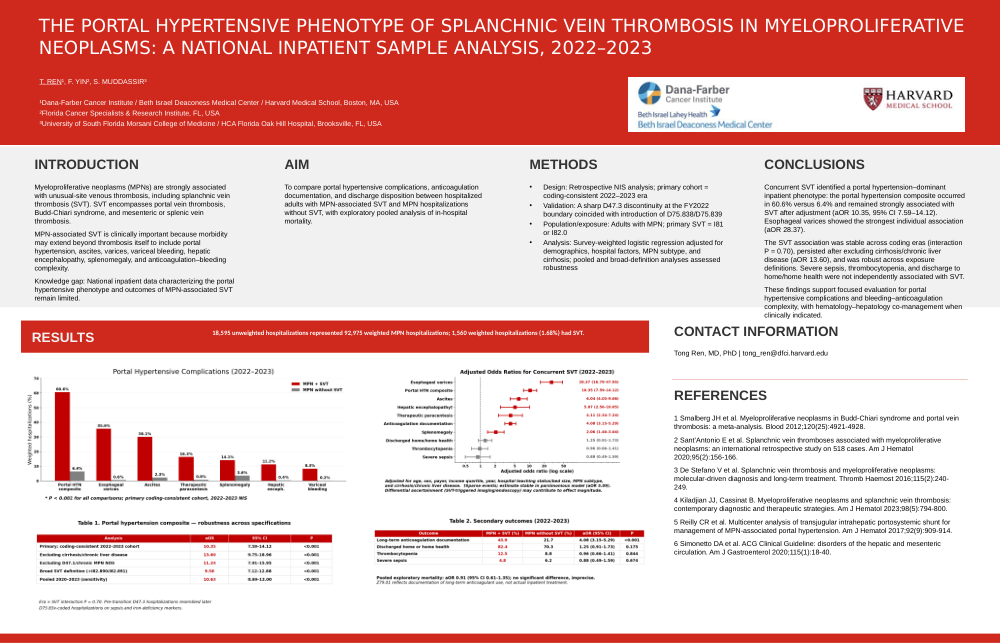
Among 377,255 weighted adult MPN hospitalizations, 3,830 had concurrent SVT. Portal hypertensive complications were significantly more frequent in MPN hospitalizations with SVT compared with MPN hospitalizations without SVT. Ascites occurred in 30.2% vs 2.8%, esophageal varices in 24.9% vs 0.4%, variceal bleeding in 5.9% vs 0.1%, hepatic encephalopathy in 8.5% vs 0.9%, hepatorenal syndrome in 2.0% vs 0.1%, splenomegaly in 10.8% vs 1.9%, therapeutic paracentesis in 16.6% vs 1.1%, and thrombocytopenia in 6.0% vs 3.0%. All portal hypertensive complications were significantly more frequent with SVT.
Long-term anticoagulation documentation was more frequent in MPN-SVT hospitalizations than in MPN hospitalizations without SVT, 37.1% vs 14.0%. Severe sepsis was less frequent, 5.4% vs 7.3%. In-hospital mortality was not significantly increased, 3.39% vs 3.75%. Discharge home was more common in MPN-SVT hospitalizations, 63.1% vs 50.6%.
Conclusions:
Among hospitalized adults with MPNs, concurrent SVT identified a portal hypertension-dominant inpatient phenotype characterized by markedly higher rates of ascites, esophageal varices, variceal bleeding, hepatic encephalopathy, hepatorenal syndrome, splenomegaly, and therapeutic paracentesis. In-hospital mortality was not significantly increased, and most MPN-SVT hospitalizations were discharged home. These findings support focused recognition of portal hypertensive morbidity and bleeding-anticoagulation complexity in MPN-associated SVT. Longitudinal studies are needed to determine whether earlier recognition or multidisciplinary management improves postdischarge outcomes.
Limitations:
Administrative ICD-10-CM coding may misclassify diagnoses. The NIS captures hospitalizations, not individual patients. The dataset does not include SVT chronicity, imaging, driver mutations, anticoagulant choice, or postdischarge outcomes.
Contact:
Tong Ren, MD, PhD
tong_ren@dfci.harvard.edu