1,267 posters, 47 videos, 13 topics, 4 sessions, 853 authors
ePostersLive by SciGen Technologies S.A. All rights reserved.
SOHO 2026 Annual Meeting
September 9 - 12, 2026 | George R. Brown Convention Center, Houston, Texas

MPN - 345
Ropeginterferon Alfa-2b in Polycythemia Vera: A PRISMA-Compliant Systematic Review and Meta-Analysis
Part of Topic
Myeloproliferative Neoplasms (MPN)
Introduction: Ropeginterferon alfa-2b, a novel monopegylated interferon with improved pharmacokinetics, has emerged as a promising cytoreductive agent for managing Polycythemia Vera (PV). Despite increasing adoption, evidence synthesis of its efficacy and safety compared to standard care remains limited.
Aims: To evaluate the efficacy of Ropeginterferon alfa-2b in comparison to standard treatment options, including hydroxyurea and phlebotomy, in achieving complete hematologic response, partial molecular response, and reducing JAK2V617F allele burden in patients with PV.
Method: A systematic search of four databases was conducted up to April 2025, following PRISMA 2020 guidelines. Randomized controlled trials (RCTs) comparing Ropeginterferon alfa 2b with standard therapies in PV patients were included. Meta-analyses were performed using random-effects models to derive odds ratios (OR) for dichotomous outcomes and mean differences (MD) for continuous outcomes. Sensitivity and subgroup analyses were conducted, and risk of bias was assessed using RoB 2.0.
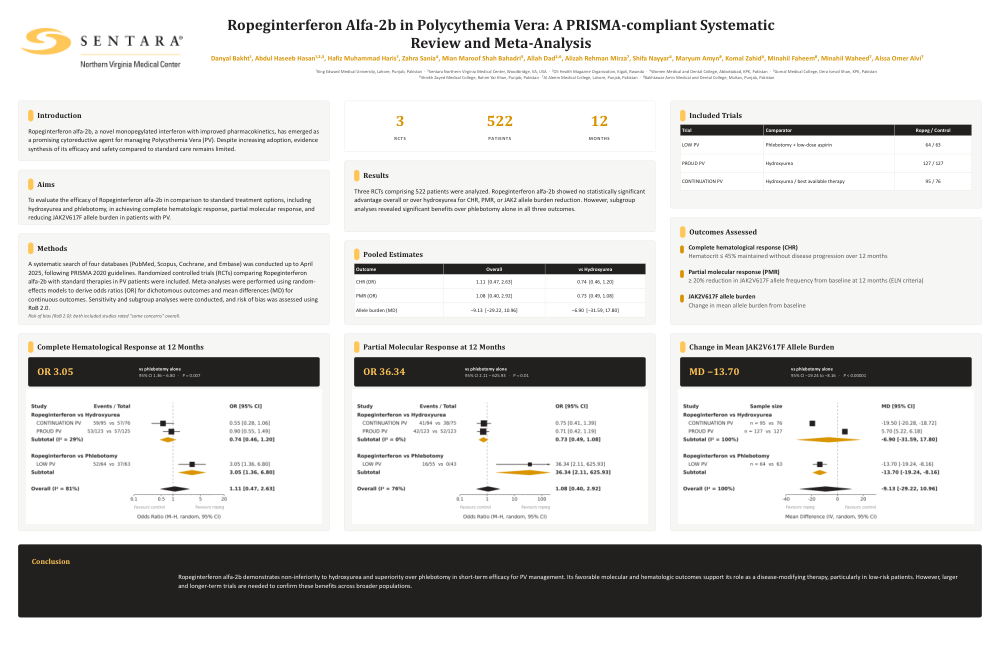
Results: Three RCTs comprising 522 patients were analyzed. Ropeginterferon alfa-2b showed no statistically significant advantage overall or over hydroxyurea for CHR, PMR, or JAK2 allele burden reduction. However, subgroup analyses revealed significant benefits over phlebotomy alone in all three outcomes: CHR (OR 3.05; 95% CI: 1.36–6.80; P = 0.007), PMR (OR 36.34; 95% CI: 2.11–625.93; P = 0.01), and allele burden reduction (Mean Difference -13.70; 95% CI: -19.24 to -8.16; P < 0.00001).
Conclusion: Ropeginterferon alfa-2b demonstrates non-inferiority to hydroxyurea and superiority over phlebotomy in short-term efficacy for PV management. Its favorable molecular and hematologic outcomes support its role as a disease-modifying therapy, particularly in low-risk patients. However, larger and longer-term trials are needed to confirm these benefits across broader populations.