1,267 posters, 47 videos, 13 topics, 4 sessions, 853 authors
ePostersLive by SciGen Technologies S.A. All rights reserved.
SOHO 2026 Annual Meeting
September 9 - 12, 2026 | George R. Brown Convention Center, Houston, Texas

HL - 247
Variant Histology in Pediatric NLPBL: Adverse Biology Mitigated by R-CHOP, Including Feasible Early-Stage De-Escalation
Poster Presenter
Authors
Part of Topic
Hodgkin Lymphoma (HL)
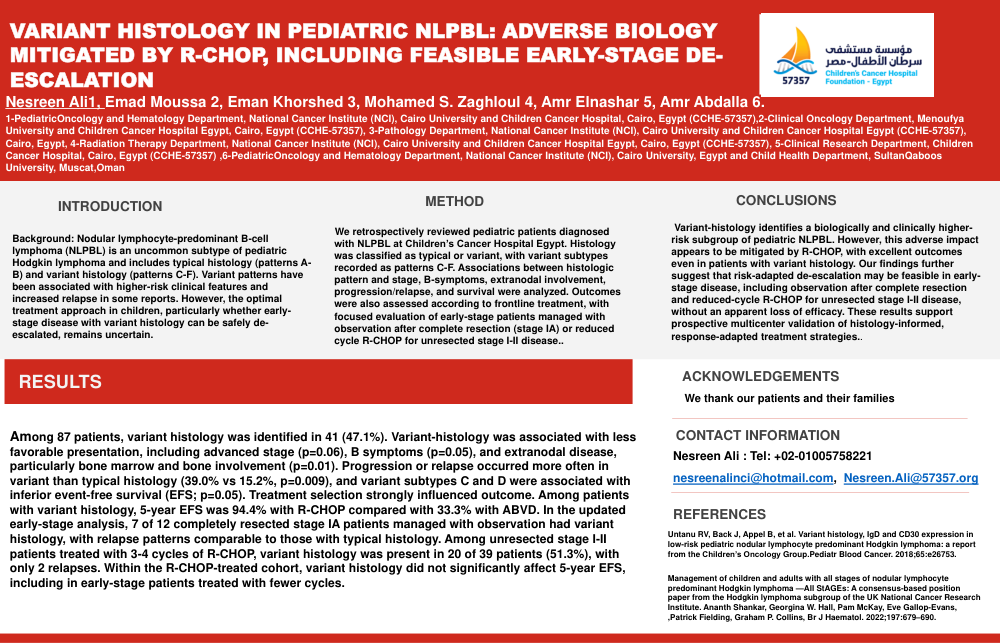
VARIANT HISTOLOGY IN PEDIATRIC NLPBL: ADVERSE BIOLOGY MITIGATED BY R-CHOP, INCLUDING FEASIBLE EARLY-STAGE DE-ESCALATION
Nesreen Ali1, Emad Moussa 2, Eman Khorshed 3, Mohamed S. Zaghloul 4, Amr Elnashar 5, Amr Abdalla 6.
1-PediatricOncology and Hematology Department, National Cancer Institute (NCI), Cairo University and Children Cancer Hospital, Cairo, Egypt (CCHE-57357),2-Clinical Oncology Department, Menoufya University and Children Cancer Hospital Egypt, Cairo, Egypt (CCHE-57357), 3-Pathology Department, National Cancer Institute (NCI), Cairo University and Children Cancer Hospital Egypt (CCHE-57357), Cairo, Egypt, 4-Radiation Therapy Department, National Cancer Institute (NCI), Cairo University and Children Cancer Hospital Egypt, Cairo, Egypt (CCHE-57357), 5-Clinical Research Department, Children Cancer Hospital, Cairo, Egypt (CCHE-57357) ,6-PediatricOncology and Hematology Department, National Cancer Institute (NCI), Cairo University, Egypt and Child Health Department, SultanQaboos University, Muscat,Oman
Background: Nodular lymphocyte-predominant B-cell lymphoma (NLPBL) is an uncommon subtype of pediatric Hodgkin lymphoma and includes typical histology (patterns A-B) and variant histology (patterns C-F). Variant patterns have been associated with higher-risk clinical features and increased relapse in some reports. However, the optimal treatment approach in children, particularly whether early-stage disease with variant histology can be safely de-escalated, remains uncertain.
Methods: We retrospectively reviewed pediatric patients diagnosed with NLPBL at Children’s Cancer Hospital Egypt. Histology was classified as typical or variant, with variant subtypes recorded as patterns C-F. Associations between histologic pattern and stage, B-symptoms, extranodal involvement, progression/relapse, and survival were analyzed. Outcomes were also assessed according to frontline treatment, with focused evaluation of early-stage patients managed with observation after complete resection (stage IA) or reduced-cycle R-CHOP for unresected stage I-II disease.
Results: Among 87 patients, variant histology was identified in 41 (47.1%). Variant-histology was associated with less favorable presentation, including advanced stage (p=0.06), B symptoms (p=0.05), and extranodal disease, particularly bone marrow and bone involvement (p=0.01). Progression or relapse occurred more often in variant than typical histology (39.0% vs 15.2%, p=0.009), and variant subtypes C and D were associated with inferior event-free survival (EFS; p=0.05). Treatment selection strongly influenced outcome. Among patients with variant histology, 5-year EFS was 94.4% with R-CHOP compared with 33.3% with ABVD. In the updated early-stage analysis, 7 of 12 completely resected stage IA patients managed with observation had variant histology, with relapse patterns comparable to those with typical histology. Among unresected stage I-II patients treated with 3-4 cycles of R-CHOP, variant histology was present in 20 of 39 patients (51.3%), with only 2 relapses. Within the R-CHOP-treated cohort, variant histology did not significantly affect 5-year EFS, including in early-stage patients treated with fewer cycles.
Conclusion: Variant-histology identifies a biologically and clinically higher-risk subgroup of pediatric NLPBL. However, this adverse impact appears to be mitigated by R-CHOP, with excellent outcomes even in patients with variant histology. Our findings further suggest that risk-adapted de-escalation may be feasible in early-stage disease, including observation after complete resection and reduced-cycle R-CHOP for unresected stage I-II disease, without an apparent loss of efficacy. These results support prospective multicenter validation of histology-informed, response-adapted treatment strategies.