1,267 posters, 47 videos, 13 topics, 4 sessions, 853 authors
ePostersLive by SciGen Technologies S.A. All rights reserved.
SOHO 2026 Annual Meeting
September 9 - 12, 2026 | George R. Brown Convention Center, Houston, Texas

ABCL - 231
A Rare Case of Mediastinal Gray Zone Lymphoma Presenting With Tracheoesophageal Fistula
Poster Presenter
Authors
Part of Topic
Aggressive B-Cell Lymphoma (ABCL)
A Rare Case of Mediastinal Gray Zone Lymphoma Presenting with Tracheoesophageal Fistula
Ritwik Dey, MD¹, Virali Gulla, MD¹, Eric Kawana, MD2, Ruben Delgado Cotarro, MD2, Javier Corral, MD3
¹ Department of Internal Medicine, Texas Tech University Health Science Center, El Paso, Texas
2 Department of Pathology, Texas Tech University Health Science Center, El Paso, Texas
3 Department of Hematology/Oncology, Texas Tech University Health Science Center, El Paso, Texas
KEYWORDS: Mediastinal gray zone lymphoma, Tracheoesophageal fistula, MGZL, mediastinal lymphoma, R-mini-CHOP
CONTEXT: Mediastinal gray zone lymphoma (MGZL) is an extremely rare B-cell lymphoma with features intermediate between nodular sclerosis Hodgkin lymphoma and primary mediastinal B-cell lymphoma, most commonly affecting young adult males. Tracheoesophageal fistula (TEF) as an initial presentation of MGZL has never been reported.
OBJECTIVE: To report the first documented case of MGZL presenting with TEF and discuss multidisciplinary management.
DESIGN AND SETTING: Case report at a tertiary academic medical center.
PATIENT: A 78-year-old woman with hypertension and hyperlipidemia presented with one week of productive cough, fevers, dyspnea, odynophagia, scant hemoptysis, and weight loss. She was hypertensive, tachycardic, tachypneic, and hypoxic (SpO₂ 88%) with bilateral crackles, requiring mechanical ventilation.
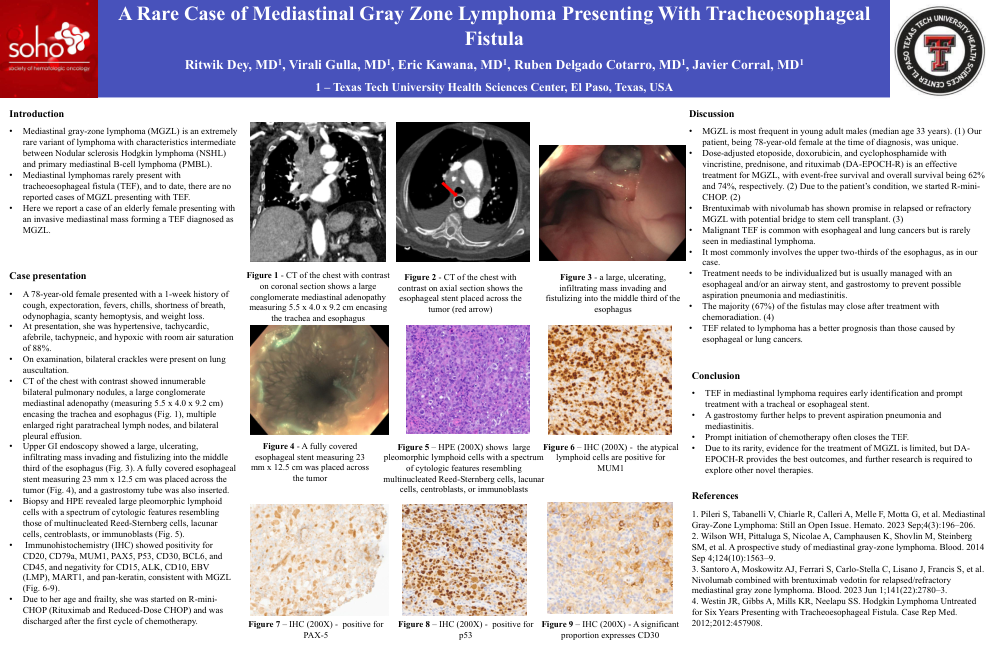
INTERVENTIONS: CT chest demonstrated a large conglomerate mediastinal mass (5.5 x 4.0 x 9.2 cm) encasing the trachea and esophagus, bilateral pulmonary nodules, and pleural effusions. Endoscopy revealed an ulcerating mass fistulizing into the mid-esophagus; a fully covered esophageal stent was placed, and a gastrostomy tube was inserted. Biopsy showed pleomorphic lymphoid cells positive for CD20, CD79a, PAX5, MUM1, P53, CD30, and BCL6, and negative for CD15, ALK, CD10, and EBV (LMP), consistent with MGZL. Due to age and frailty, systemic therapy with rituximab and reduced-dose CHOP (R-mini-CHOP) was initiated.
RESULTS: Following stenting, gastrostomy, and one cycle of R-mini-CHOP, the patient was successfully extubated, transitioned to low-flow oxygen, and discharged with home health. This elderly female presentation contrasts with the typical profile of young males (median age 33 years). Standard DA-EPOCH-R achieves event-free and overall survival of 62% and 74%, respectively; brentuximab vedotin plus nivolumab has shown promise in relapsed/refractory disease.
CONCLUSIONS: This is the first reported case of MGZL presenting with TEF. Prompt esophageal stenting and gastrostomy are essential for airway protection and nutritional support. Early chemotherapy may facilitate fistula closure, consistent with the approximately 67% closure rate seen with chemoradiation in other TEF-associated malignancies. TEF complicating lymphoma carries a more favorable prognosis than TEF from esophageal or lung cancer. DA-EPOCH-R remains the best-supported regimen for MGZL; further research into novel therapies is needed.