1,267 posters, 47 videos, 13 topics, 4 sessions, 853 authors
ePostersLive by SciGen Technologies S.A. All rights reserved.
SOHO 2026 Annual Meeting
September 9 - 12, 2026 | George R. Brown Convention Center, Houston, Texas

ABCL - 216
Effect of HIV Infection on Treatment Outcomes in Patients With Diffuse Large B-Cell Lymphoma
Poster Presenter
Authors
Part of Topic
Aggressive B-Cell Lymphoma (ABCL)
Video
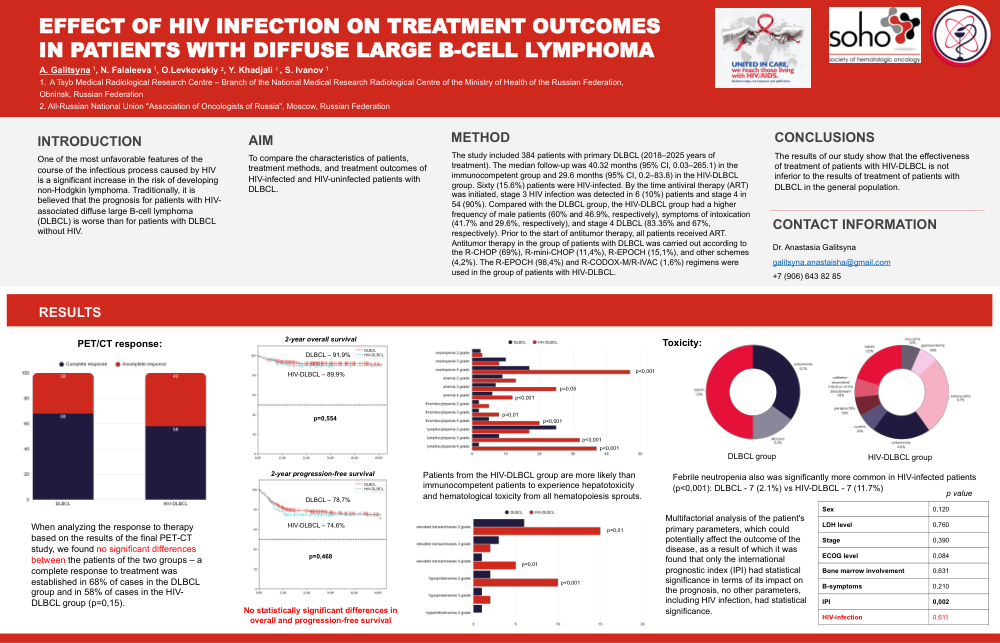
Introduction. One of the most unfavorable features of the course of the infectious process caused by the human immunodeficiency virus (HIV) is a significant increase in the risk of developing malignant neoplasms. Non-Hodgkin's lymphoma (NHL), remaining the most common type of ASD in HIV-infected people, poses a serious threat to their lives. Traditionally, it is believed that the prognosis for patients with HIV-DVCCL is worse than for uninfected DLBCL patients. The purpose of our work was to summarize the accumulated experience in the treatment of patients with HIV- DLBCL, to compare the characteristics of patients, treatment methods and treatment outcomes of HIV-infected and HIV-uninfected patients.
Materials and methods. The results of treatment of patients with DVCCL who received treatment at the A. Tsyb MRRC from 2018 to 2025 have been analyzed. The study included 384 primary DLBCL patients, including 60 (15.6%) patients with HIV infection.By the time antiviral therapy was initiated, stage 3 HIV infection was detected in 6 (10%), stage 4 in 54 (90%). Prior to the start of antitumor therapy, all patients received ART. Antitumor therapy in the group of patients with DLBCL was carried out according to the R-CHOP, R-mini-CHOP, R-EPOCH, and other schemes.The R-EPOCH and R-CODOX-M\R-IVAC regimens were used in the group of patients with HIV-DLBCL.
Results. In our study, the group of HIV-DLBCL patients differed, compared with the DLBCL group, in a higher frequency of male patients (60% and 46.9%, respectively), symptoms of intoxication (41.7% and 29.6%, respectively), stage IV of the disease (83.35 and 67%, respectively), increased LDH levels (68.3% and 53.4%, respectively), bone marrow tumor lesions (28.3% and 19.1%, respectively). Although extranodal lesions in both groups were recorded with the same frequency (81.7% and 82.7%), the multiplicity of extranodal foci (3 or more foci at the same time) was observed more often among patients with HIV- DLBCL. (31.7% and 12.9%). On the contrary, the more aggressive subtype of the tumor (non-GCB) was less common in patients with HIV- DLBCL (55.3% and 74.9%, respectively).The difference between the groups of patients with DLBCL and HIV- DLBCL in the frequency of complete responses to therapy recorded according to PET/CT data was not statistically significant (p=0.15).There was no significant difference between the DLBCL and HIV- DLBCL groups in terms of 2-year progression-free survival (78.7% and 74.6%, respectively, p=0.468) and 2-year overall survival (91.9% and 89.6%, respectively, p=0.554). Hematological toxicity from all hematopoiesis germs (p<0.001), hepatotoxicity (p<0.001), as well as febrile neutropenia and infectious complications (p<0.001) were statistically significantly more common in patients with HIV infection.
Conclusions. Thus, the results of our study show that the effectiveness of treatment of HIV-infected DLBCL patients is not inferior to the results of treatment of DLBCL patients in the general population. An essential condition for the success of antitumor therapy is its implementation against the background of adequate antiretroviral therapy with monitoring of drug interactions, as well as intensive prevention of infectious complications.