1,267 posters, 47 videos, 13 topics, 4 sessions, 853 authors
ePostersLive by SciGen Technologies S.A. All rights reserved.
SOHO 2026 Annual Meeting
September 9 - 12, 2026 | George R. Brown Convention Center, Houston, Texas

HL - 215
Autologous Stem Cell Transplantation for Relapsed/Refractory Hodgkin Lymphoma in a Resource-Limited Setting: A Real-World Study From Pakistan
Poster Presenter
Authors
Part of Topic
Hodgkin Lymphoma (HL)
Autologous Stem Cell Transplantation for Relapsed/Refractory Hodgkin Lymphoma in a Resource-Limited Setting: A Real-World Study from Pakistan
Hammad Javed¹, Tariq Ghafoor¹, Nighat Shahbaz¹, Mehreen Ali Khan¹, Raheel Iftikhar¹, Jahanzeb Liaqat¹
¹Armed Forces Bone Marrow Transplant Center, Rawalpindi, Punjab, Pakistan
KEYWORDS: Hodgkin lymphoma, autologous stem cell transplantation, relapsed/refractory, low- and middle-income countries
CONTEXT:
Management of relapsed or refractory classical Hodgkin lymphoma (RR-cHL) remains challenging in low- and middle-income countries (LMICs) due to limited access to advanced diagnostic facilities and novel therapies. High-dose therapy (HDT) followed by autologous stem cell transplantation (ASCT) remains the standard of care for chemosensitive disease; however, real-world data from LMICs are limited.
OBJECTIVE:
To evaluate real-world outcomes of ASCT in patients with RR-cHL in a resource-limited setting and to identify prognostic factors associated with survival outcomes.
DESIGN:
Retrospective cohort study of consecutive patients with RR-cHL undergoing ASCT between January 2010 and December 2023, with survival analysis performed using the Kaplan–Meier method and Cox proportional hazards modeling.
SETTING:
Single tertiary care transplant center in Pakistan.
PATIENTS OR OTHER PARTICIPANTS:
A total of 60 consecutive patients with RR-cHL were included. Median age was 26 years (IQR, 16.1–32.3), and 66.7% were male. At diagnosis, 79% had advanced-stage disease and 63% had B symptoms. High-risk features included primary refractory disease (23.3%) and early relapse (41.6%).
INTERVENTIONS:
Patients received salvage chemotherapy, including novel agent–based regimens in 68.3% of cases, followed by high-dose therapy and ASCT. At the time of transplant, 85% of patients were in complete remission.
MAIN OUTCOMES MEASURES:
Primary endpoints were progression-free survival (PFS) and overall survival (OS). Secondary outcomes included relapse incidence and non-relapse mortality.
RESULTS:
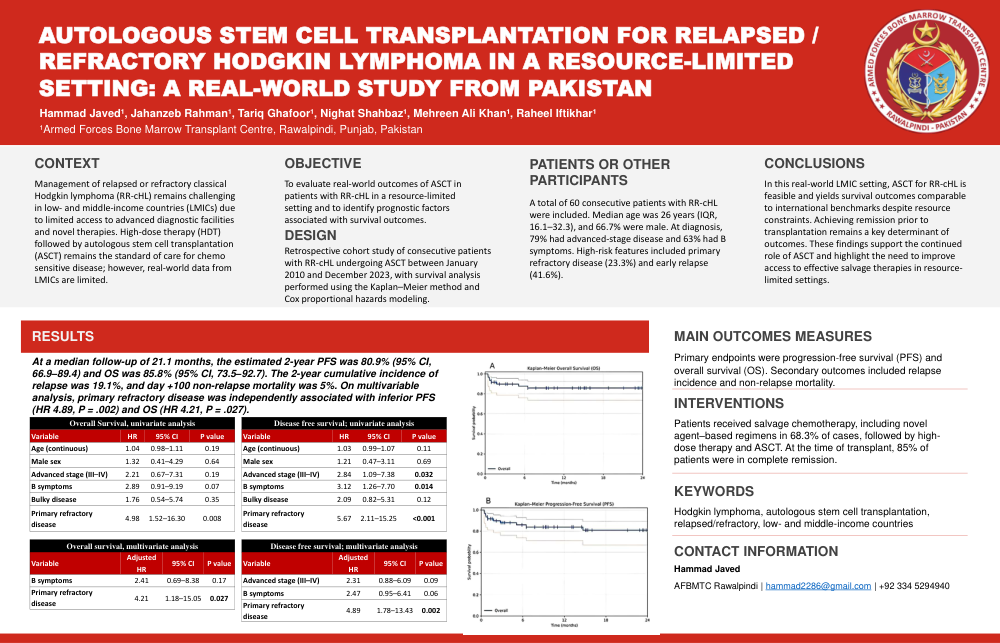
At a median follow-up of 21.1 months, the estimated 2-year PFS was 80.9% (95% CI, 66.9–89.4) and OS was 85.8% (95% CI, 73.5–92.7). The 2-year cumulative incidence of relapse was 19.1%, and day +100 non-relapse mortality was 5%. On multivariable analysis, primary refractory disease was independently associated with inferior PFS (HR 4.89, P = .002) and OS (HR 4.21, P = .027).
CONCLUSIONS:
In this real-world LMIC setting, ASCT for RR-cHL is feasible and yields survival outcomes comparable to international benchmarks despite resource constraints. Achieving remission prior to transplantation remains a key determinant of outcomes. These findings support the continued role of ASCT and highlight the need to improve access to effective salvage therapies in resource-limited settings.