516 posters, 59 topics, 63 sessions, 1,127 authors, 352 institutions
ePostersLive by SciGen Technologies S.A. All rights reserved.
2026 SOAP Annual Meeting
April 29 - May 3, 2026 | Montreal, Quebec Canada

2330544
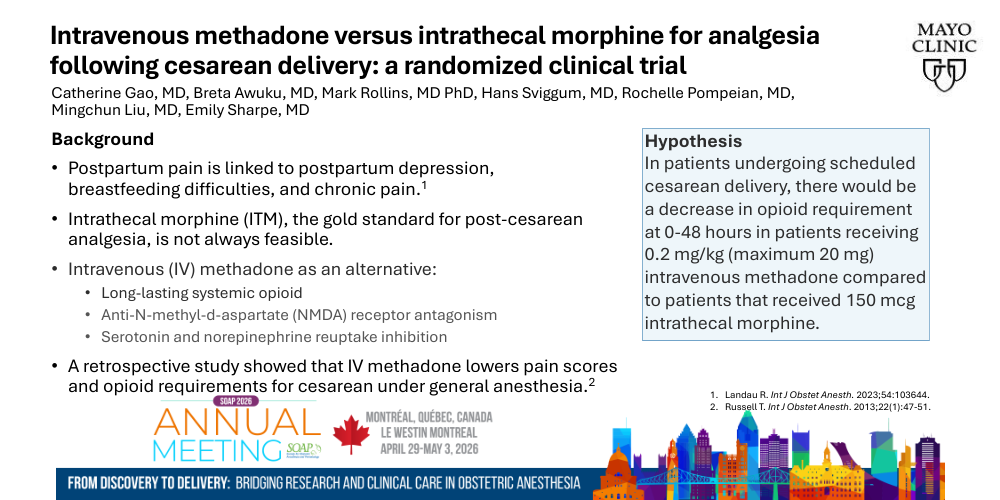
Intravenous methadone versus intrathecal morphine for analgesia following cesarean delivery: a randomized clinical trial
Poster Presenter
Authors
Catherine Gao, Breta Awuku, Mark Rollins, Hans Sviggum, Rochelle Pompeian, Mingchun Liu, Emily Sharpe
Affiliations
Part of Topic
Pain Control
Background
•
Postpartum pain is linked to with postpartum depression, breastfeeding difficulties, and chronic pain.1
•
Intrathecal morphine (ITM), the gold standard for post-cesarean analgesia, is not always feasible.
•
Intravenous (IV) methadone as an alternative:
•
Long-lasting systemic opioid
•
Anti-N-methyl-d-aspartate (NMDA) receptor antagonism
•
Serotonin and norepinephrine reuptake inhibition
•
A retrospective study showed that IV methadone lowers pain scores and opioid requirements for cesareansunder general anesthesia.2
Hypothesis
In patients undergoing scheduled cesarean delivery, there would be a decrease in opioid requirement at 0-48 hours in patients receiving 0.2 mg/kg (maximum 20 mg) intravenous methadone compared to patients that received150 mcg intrathecal morphine.
Study Design and Methods
•
Single-center prospective, randomized, double-blinded pilot
•
30 patients undergoing scheduled cesarean delivery
•
Exclusion criteria:
•
Chronic pain
•
Chronic opioid use
•
Substance use disorder
•
BMI > 50.0 kg/m²
Primary outcome: Total opioid consumption at 24-48 hours after delivery in the groups.
Secondary outcomes: NRS pain scores, obstetric quality of recovery (ObsQoR10), and side effects were assessed at12, 24, 36, 48hours in person and at one-week postpartum via textmessage.
Results
•
No significant difference in maternal demographic or obstetric factors
•
Patients in the methadone group required more opioids across all time points (Figure 1)
•
No significant difference in pain scores (Figure 2), ObsQoR10, or global health state scores
•
No significant difference inintra-operative andpost-operative respiratory depression at all time points
•
Patients in IV methadone group did report a significantly lower rate of pruritus across all timepoints (p<0.05, Figure 3)
Conclusion & Discussion
•
Patients who received ITM requiredless opioids in the first 48 hours aftercesarean delivery compared to those who received IV methadone.
•
Although IV methadonedid not appear to provide superior analgesia compared to ITM, it enabled comparable post-cesarean recovery with an acceptable side-effect profile.
•
In patients who do not receive ITM, consider using IV methadone for post-cesarean analgesia.