516 posters, 59 topics, 63 sessions, 1,127 authors, 352 institutions
ePostersLive by SciGen Technologies S.A. All rights reserved.
2026 SOAP Annual Meeting
April 29 - May 3, 2026 | Montreal, Quebec Canada

2340535
Puerperal Cerebrovascular Complications of Preeclampsia with Severe Features: A Case Series on Anesthetic Management
Poster Presenter
Authors
Victoria Brookshire, Marie-Louise Meng, Matthew Fuller, Jerome Federspiel, Andrea Ibarra, Ashraf Habib, Jennifer Dominguez
Affiliations
Vanderbilt University Medical Center, Department of Anesthesiology, Duke University, Department of Anesthesiology, Duke University, Department of Obstetrics and Gynecology, Stanford University, Department of Anesthesiology, Perioperative and Pain Medicine
Part of Topic
Preeclampsia
Title: Puerperal Cerebrovascular Complications of Preeclampsia with Severe Features: Insights from a Case Series on Anesthetic Management
Authors: Victoria M.K. Brookshire, MD, MPH; Marie-Louise Meng, MD; Matthew Fuller, MS; Jerome J. Federspiel, MD, PhD; Andrea J. Ibarra, MD, MS; Ashraf S. Habib, MBBCh; Jennifer Dominguez, MD, MHS
Affilitation: Duke University, Department of Anesthesiology
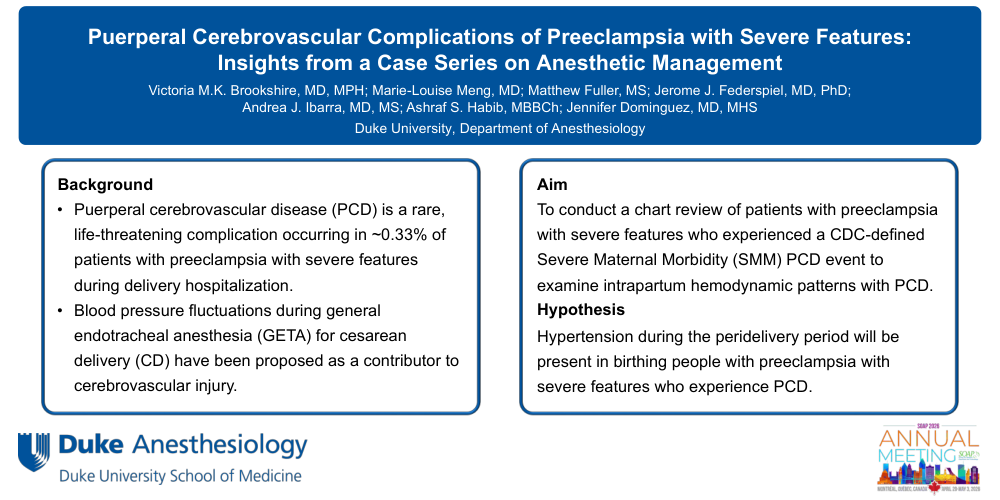
Background
Hypothesis: Hypertension during the peridelivery period will be present in birthing people with preeclampsia with severe features who experience PCD.
Study Design & Methods
Study Period: Delivery hospitalizations from 2016–2020 were reviewed.
Hemodynamic Definitions:
Significant anesthesia-related hemodynamic changes were defined as:
(1) severe pre-induction hypertension (SBP ≥160 mm Hg and/or DBP ≥110 mm Hg)
(2) intraoperative hypotension (25–50% reduction from baseline SBP)
(3) severe rebound hypertension on emergence (SBP ≥160 mm Hg and/or DBP ≥110 mm Hg)
Inclusion Criteria: Patients with preeclampsia with severe features and an ICD-10-CM code for a CDC SMM PCD event.
Results
Among 24,946 deliveries, 1,365 (5.47%) had preeclampsia with severe features. Of these patients, nine patients had a PCD diagnosis code with seven confirmed PCD events.
Figure 1. Overview of nine patients with PCD codes.
Figure 2: Anesthetic Records requiring GETA demonstrate large hemodynamic fluctuations. Top panel: Case 1. Middle panel: Case 2. Bottom panel: Case 3.
Conclusion & Discussion
In this case series, we identify a relationship between PCD and large blood pressure fluctuations that occurred only in patients requiring GETA.
Key Finding: Vigilant BP management, minimizing hemodynamic fluctuations, and preventing rebound hypertension are critical in this scenario. Anesthesiologists should be aware patients demonstrating large BP fluctuations are high risk for neurological complications or worsening existing cerebrovascular injury.
Unexpected Finding: All patients with large blood pressure fluctuations who received GETA also experienced PPH.
Framework for Future Research: These findings offer a framework for studying cardiovascular vulnerability and anesthesia-related hemodynamic changes in preeclampsia. Poor coding for PCD in pregnancy—often due to misclassification or missing data—may underestimate risk. Future research should assess coding practices and evaluate absolute PCD risk through prospective and retrospective studies.
