516 posters, 59 topics, 63 sessions, 1,127 authors, 352 institutions
ePostersLive by SciGen Technologies S.A. All rights reserved.
2026 SOAP Annual Meeting
April 29 - May 3, 2026 | Montreal, Quebec Canada

2341314
Pain-Selective Epidural Analgesia:Isobolographic Analysis of Lidocaine and Chloroprocaine
Poster Presenter
Part of Topic
Labor Analgesia Challenges and Tips
Introduction
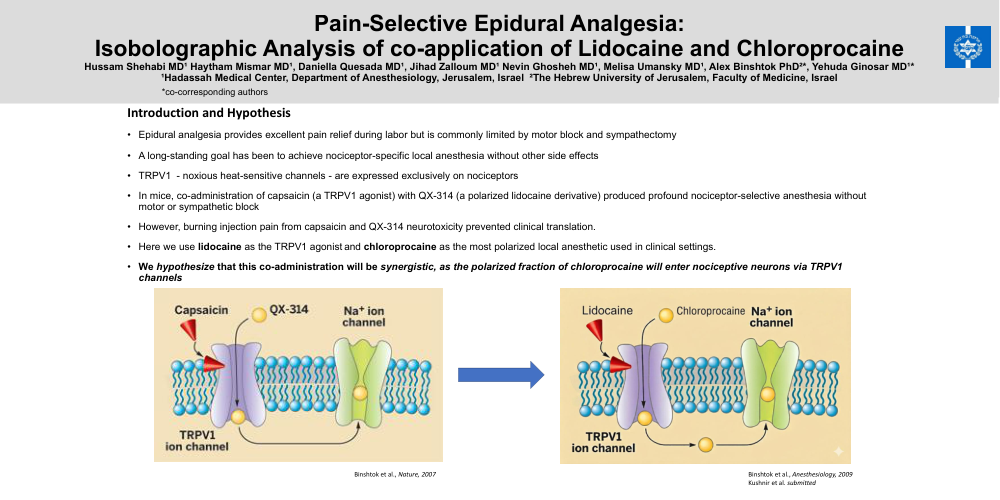
Epidural analgesia provides excellent pain relief during labor but is commonly limited by motor block and sympathectomy. A long-standing goal has been to achieve nociceptor-specific local anesthesia without other side effects. TRPV1 channels are expressed exclusively on nociceptors and have been exploited to selectively deliver polarized local anesthetics into nociceptors. In mice, co-administration of capsaicin (TRPV1 agonist) with QX-314 (polarized lidocaine derivative) produced profound nociceptor-selective anesthesia without motor or sympathetic block.However, burning injection pain from capsaicin and QX-314 neurotoxicity prevented clinical translation. Here we use lidocaine as the TRPV1 agonist2 and chloroprocaine as the most polarized local anesthetic in clinical use. We hypothesize that this co-administration will be synergistic.
Methods
We designed an isobolographic study design to assess synergism between epidural chloroprocaine and lidocaine. 1st stage: We determined success of epidural lidocaine and chloroprocaine at 20min using a 5-point Likert scale and used this to determine ED50 by the Dixon–Massey up–down sequential method, with probit regression. 2nd stage: We used individual ED50s to assess the ED50 of drug combinations (ED50 of lidocaine co-administered with ½ED50 chloroprocaine; ED50 of chloroprocaine co-administered with ½ED50 lidocaine, and the ED50 of a 1:1 fixed dose ratio). We determined synergy using the interaction index3, where γ=(a/A)+(b/B). If γ< 1 the combination is synergistic; if y=1 the combination is additive. Women were eligible if they were in active labor, VAS ≥30mm, dilation ≤5cm, ≤4 previous deliveries, no prior cesarean.
Results
Conclusions
This is the first clinical study to attempt combining a TRPV1agonist with a polarized local anesthetic with the aim of attaining nociceptor-selective anesthesia without motor block. If the TRPV1 agonist interaction with polarized local anesthetic would be as hypothesized, we would have expected synergism between chloroprocaine and lidocaine; this was not observed.