516 posters, 59 topics, 63 sessions, 1,127 authors, 352 institutions
ePostersLive by SciGen Technologies S.A. All rights reserved.
2026 SOAP Annual Meeting
April 29 - May 3, 2026 | Montreal, Quebec Canada

2341792
Peripartum Anesthetic Management of a Patient with Pacemaker-Induced Cardiomyopathy
Poster Presenter
Authors
Affiliations
Part of Topic
ARRHYTHMIAS, AICDS, AND PACEMAKERS
Peripartum Anesthetic Management of a Patient with Pacemaker-Induced Cardiomyopathy
Simran Patel, MD, Xinhao Liu, MD/PhD, Jay J. Im, MD
Montefiore Medical Center
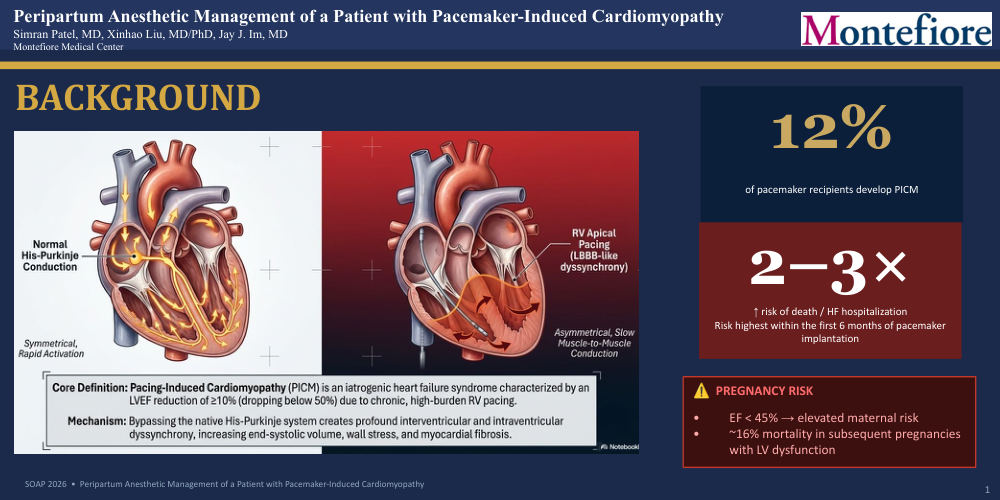
2–3× ↑ risk of death / HF hospitalization
Risk highest within the first 6 months of pacemaker implantation
Age: 23 years old
Obstetric: G2P1001, 38+5 wks
Indication: Decreased fetal movement → IOL
Cardiac Dx: Congenital CHB (Mobitz I)
Pacemaker: Dual-chamber (implanted 2017, re-implanted 2023)
PM Status: PACEMAKER-DEPENDENT
Echo: EF 45%, paradoxical septal motion✓ Continuous telemetry
✓ Peripheral IV access
✓ Strict intake/output monitoring
✓ External defibrillation pads
✓ Magnet AVAILABLE — NOT applied
✓ Fetal monitoring throughout
✓ MDT: OB Anesthesia, MFM, Cardiology, EP
Technique: Dural Puncture Epidural (DPE)
Initial infusion:
0.0625% bupivacaine
+ fentanyl 2 mcg/mL
Breakthrough pain:
10 mL 0.25% bupivacaine bolus
No neuraxial opioid adjuncts required
No hemodynamic compromise observed
Teaching Points
THE PICM PARADOX
Unlike DCM or PPCM, the cardiomyopathy is iatrogenic from RV pacing — yet the device cannot be discontinued in pacemaker-dependent patients. Management targets loading conditions, not device removal and this case illustrates a relatively rare instance of peripartum management in patients with PICM.
NEURAXIAL CHOICE: DPE
The choice of dural puncture epidural (DPE) over standard epidural or CSE optimizes both analgesia quality and hemodynamic stability in cardiac patients. DPE offers faster onset and superior sacral coverage, while avoiding the dense sympathectomy of CSE/spinal. In ↓EF, preserving preload and SVR is essential.
EMI & MAGNET STRATEGY
Vaginal delivery without electrocautery = minimal EMI risk. Magnet should be available but NOT routinely applied — magnet mode (asynchronous) can be deleterious. Reprogramming reserved for planned cesarean w/ monopolar cautery.
TEMPORARY PACING
Prophylactic transvenous pacing was not indicated in this hemodynamically stable, device-functional patient. Transcutaneous pads + defibrillation capability suffice as backup.
MULTIDISCIPLINARY PLANNING
This case demonstrates that successful pregnancy is achievable in young women with cardiomyopathy and reduced ejection fraction, but requires expert multidisciplinary care and carries significant maternal risk. Together, OBGyn, anesthesia, cardiology, and electrophysiology coordination resulted in seamless care for this patient.