516 posters, 59 topics, 63 sessions, 1,127 authors, 352 institutions
ePostersLive by SciGen Technologies S.A. All rights reserved.
2026 SOAP Annual Meeting
April 29 - May 3, 2026 | Montreal, Quebec Canada

2338997
Maternal Outcomes by Mode of Delivery in Pregnant Patients with Valvular Heart Disease: A Retrospective Cohort Study
Poster Presenter
Part of Topic
High Risk and Crisis Management
Maternal Outcomes by Mode of Delivery in Pregnant Patients with Valvular Heart Disease: A Retrospective Cohort Study
- Heather Acuff, MD, PhD; University of Michigan
- Jerome Federspiel, MD, PhD; Duke University
- Johanna Quist-Nelson, MD; University of North Carolina
- Matthew Fuller, MS; Duke University
- Ashraf S Habib, MB, BCh; Duke University
- Marie-Louise Meng, MD; Vanderbilt University
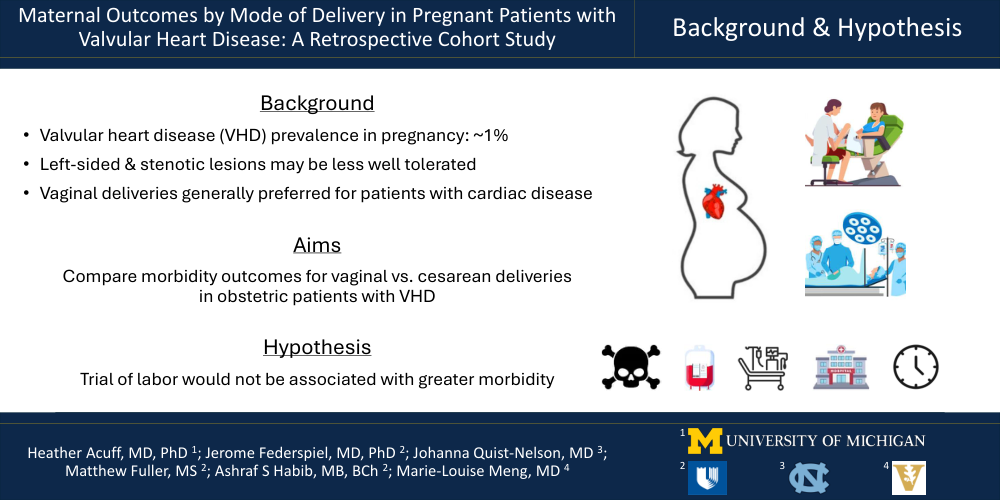
Background & Hypothesis
Background
- Valvular heart disease (VHD) prevalence in pregnancy: ~1%
- Left-sided & stenotic lesions may be less well tolerated
- Vaginal deliveries generally preferred for patients with cardiac disease
Aims
- Compare morbidity outcomes for vaginal vs. cesarean deliveries
in obstetric patients with VHD
Hypothesis
- Trial of labor would not be associated with greater morbidity
Study Design & Methods
Cohort
- Obstetric patients 12-55y
- Delivery 1/1/16 – 9/30/20
- Valvular heart disease
Outcomes
- Severe maternal morbidity
- Blood transfusion
- ICU admission
- 90-day readmission
- Hospitalization duration
Analyses
- Intention-to-treat: intended deliveries
- As-treated: actual deliveries
Results
Outcomes with greater morbidity for scesarean vs. vaginal deliveries
- Adjusted odds ratio (95% CI): severe maternal morbidity, blood transfusion, ICU admission, 90-day readmission
- Mean difference (95% CI): hospitalization duration
Intended Deliveries
- Left stenotic: ICU admission
- Left regurgitant: blood transfusion, ICU admission
- Right regurgitant: ICU admission
Actual Deliveries
- Left stenotic: ICU admission, hospitalization duration
- Left regurgitant: severe maternal morbidity, blood transfusion, ICU admission, 90-day readmission, hospitalization duration
- Right stenotic: hospitalization duration
- Right Regurgitant: severe maternal morbidity, blood transfusion, ICU admission
Conclusions & Discussion
Conclusions
- Greater morbidity: cesarean deliveries > vaginal deliveries, actual cesarean > intended cesarean
- Most common morbidity among all lesions for both analyses: ICU admission
- Morbidity by VHD lesions:
--- Left Regurgitant: severe maternal morbidity, blood transfusion, ICU admission, 90-day readmission, hospitalization duration
--- Right Regurgitant: severe maternal morbidity, blood transfusion, ICU admission
--- Left Stenotic: ICU admission, hospitalization duration
--- Right Stenotic: hospitalization duration
Discussion
- Trial of labor not associated with greater morbidity
- Intrapartum cesarean deliveries at higher risk
- Supports vaginal deliveries for patients with VHD when clinically feasible
- Patients may benefit from delivering in care center with ICU capabilities
- Importance of individualized, lesion-specific delivery planning
References
- Curr Treat Options Cardiovasc Med 2023; 25(10):587-604
- Cardiol Clin 2021; 39:151-61
- Obstet Gynecol 2019; 133(5):e320-56
- Anesth Analg 2023; 136(4):728-37