516 posters, 59 topics, 63 sessions, 1,127 authors, 352 institutions
ePostersLive by SciGen Technologies S.A. All rights reserved.
2026 SOAP Annual Meeting
April 29 - May 3, 2026 | Montreal, Quebec Canada

2339685
A single-center retrospective analysis of inadequate neuraxial anesthesia for postpartum tubal ligation
Poster Presenter
Authors
Mindy Kim, Matthew Fuller, MS, Ashraf S. Habib, MBBCh, MSc, MHSc, FRCA
Affiliations
Duke University School of Medicine, Division of Biostatistics and Bioinformatics, Duke University School of Medicine, Department of Anesthesiology, Division of Women's Anesthesia, Duke University School of Medicine
Part of Topic
Potpourri
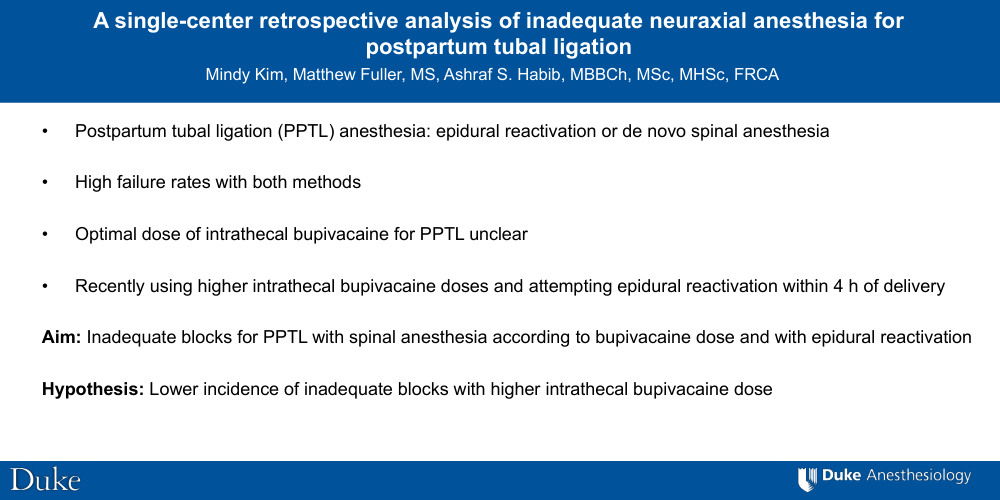
Postpartum tubal ligation (PPTL) anesthesia: epidural reactivation or de novo spinal anesthesia
• High failure rates with both methods
• Optimal dose of intrathecal bupivacaine for PPTL unclear
• Recently using higher intrathecal bupivacaine doses and attempting epidural reactivation within 4 h of delivery
Aim: Inadequate blocks for PPTL with spinal anesthesia according to bupivacaine dose and with epidural reactivation
Hypothesis: Lower incidence of inadequate blocks with higher intrathecal bupivacaine dose
Methods:
Population
• PPTLs with epidural reactivation or de novo spinal anesthesia between 2003-2025
• Spinal anesthesia bupivacaine dose groups: low (7.5-9.75 mg), middle (10.5-12 mg), high (>13.5 mg)
Outcomes
• Inadequate block: need for IV analgesic/sedative supplementation (morphine, hydromorphone, propofol, ketamine, fentanyl>100µg , dexmedetomidine>20µg, midazolam>2mg) or failed block (repeat neuraxial block or conversion to general anesthesia)
Statistical Analysis
• Kruskal-Wallis test and Fisher's exact test
• Multivariable logistic regression for factors associated with inadequate blocks
Conclusion
• Higher bupivacaine doses (>13.5 mg) associated with significantly lower odds of inadequate blocks than middle doses (10.5-12 mg)
• Failure rate of epidural reactivation (13.0%) comparable to high dose spinal group (13.9%)
– Larger sample size needed to confirm these findings
• Higher rates of inadequate blocks in spinal anesthesia associated with:
– Fewer years since start of study
– Increased surgical duration
– Higher IT fentanyl doses