516 posters, 59 topics, 63 sessions, 1,127 authors, 352 institutions
ePostersLive by SciGen Technologies S.A. All rights reserved.
2026 SOAP Annual Meeting
April 29 - May 3, 2026 | Montreal, Quebec Canada

2338726
Critical Care Obstetrics (CCOB) Program Year One: Risk Stratification and Outcomes for Patients who Received Care on Labor and Delivery (L&D) and Those Transferred to an Intensive Care Unit (ICU)
Poster Presenter
Part of Topic
Patient Voices 2
\
Critical Care Obstetrics (CCOB) Program Year One: Risk Stratification and Outcomes for Patients
who Received Care on Labor and Delivery (L&D) and Those Transferred to an Intensive Care
Unit (ICU)
James Conwell, DO;Ralph Alberto; Yael Sarig; Ashley Munoz RN; Jessica Morgan MD; Jean-Ju Sheen MD; and
Ruth Landau MD
Department of Anesthesiology, Columbia University Medical Center, New York
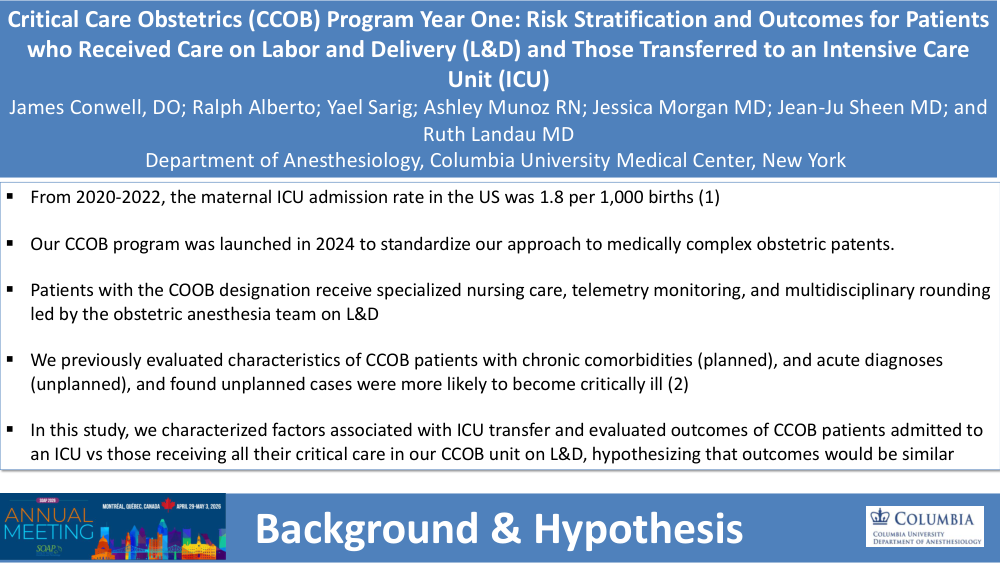
▪ From 2020-2022, the maternal ICU admission rate in the US was 1.8 per 1,000 births (1)
▪ Our CCOB program was launched in 2024 to standardize our approach to medically complex obstetric patents.
▪ Patients with the COOB designation receive specialized nursing care, telemetry monitoring, and multidisciplinary rounding
led by the obstetric anesthesia team on L&D
▪ We previously evaluated characteristics of CCOB patients with chronic comorbidities (planned), and acute diagnoses
(unplanned), and found unplanned cases were more likely to become critically ill (2)
▪ In this study, we characterized factors associated with ICU transfer and evaluated outcomes of CCOB patients admitted to
an ICU vs those receiving all their critical care in our CCOB unit on L&D, hypothesizing that outcomes would be similar
Background & Hypothesis▪ Starting in 2023, a working group of nurses, obstetricians
and anesthesiologists defined criteria for CCOB designation
at our institution. (figure 1)
▪ The CCOB designation was added to our electronic
medical record, EPIC, in May 2024, allowing all patients
meeting criteria to be reviewed.
▪ Characteristics and outcomes between CCOB patients
transferred to an ICU and those cared for only in the CCOB
unit on L&D were reviewed.
▪ Maternal outcomes included a vasoactive infusion
requirement, quantitative blood loss, hemorrhage, blood
product transfusion, hospital length of stay and CCOB unit
length of stay
Fig 1: Conditions for CCOB Monitoring
Study Design and MethodsResults
Figure 2: ICU location and admission indication▪ There were no significant differences in outcomes between CCOB patients transferred to the
ICU at any time point and those who were not, though confounding by indication was possible.
▪ Some patients were admitted to an ICU before receiving CCOB care.
▪ Patients transferred to an ICU were more likely to be unplanned CCOB and had a septic,
respiratory or neurological CCOB indication.
▪ Future work should focus critical care resources and specialized teams to care for acutely ill
patients on L&D.
▪ This care system can serve as a model for other institutions.
1. NCHS Data Brief, no 485 2023.
2. SOAP Annual Meeting 2025; Abstract ID 2045267
Discussion