Loading...

516 posters, 59 topics, 63 sessions, 1,127 authors, 352 institutions

ePostersLive by SciGen Technologies S.A. All rights reserved.

2026 SOAP Annual Meeting

April 29 - May 3, 2026 | Montreal, Quebec Canada

2026 SOAP Annual Meeting banner

2337480

Association of Patient Anxiety and Time of Delivery with Duration of Urinary Catheterization Following Cesarean Delivery Under Neuraxial Anesthesia: A Prospective Cohort Study
Part of Topic

Recovery: Morbidity, Depression

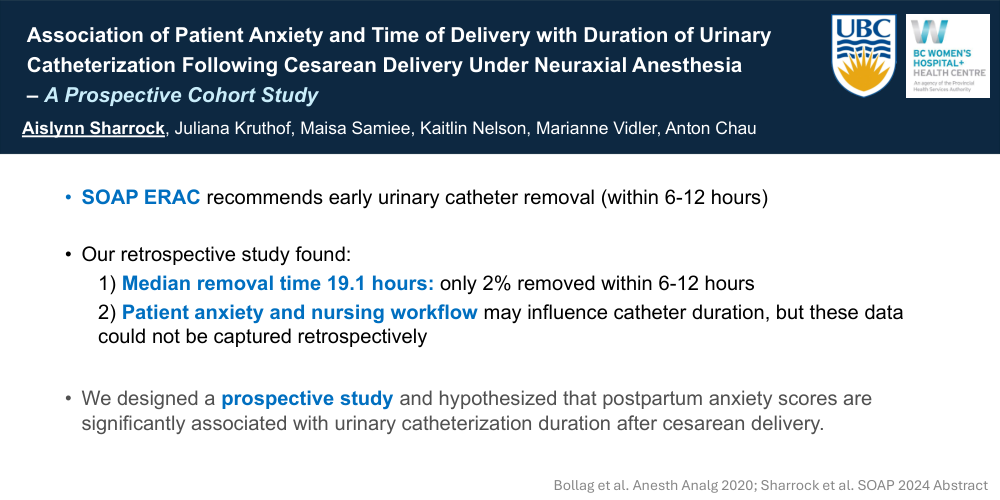
Association of Patient Anxiety and Time of Delivery with Duration of Urinary Catheterization Following Cesarean Delivery Under Neuraxial Anesthesia

– A Prospective Cohort Study

Aislynn Sharrock, Juliana Kruthof, Maisa Samiee, Kaitlin Nelson, Marianne Vidler, Anton Chau

•SOAP ERAC recommends early urinary catheter removal (within 6-12 hours)
•Our retrospective study found:

1) Median removal time 19.1 hours: only 2% removed within 6-12 hours

2) Patient anxiety and nursing workflow may influence catheter duration, but these data could not be captured retrospectively

•We designed a prospective study and hypothesized that postpartum anxiety scores are significantly associated with urinary catheterization duration after cesarean delivery.
Bollag et al. Anesth Analg 2020; Sharrock et al. SOAP 2024 Abstract

Methods

•Prospective mixed-methods design:
•300 women cesarean deliveries under neuraxial anesthesia
226 corresponding postpartum nurse surveys
•Primary Outcome: Association between anxiety score and catheter duration
•State Trait Anxiety Inventory (STAI-S): patient anxiety at 24 hours
•Covariates in multivariable model: Time to ambulation, time to motor block recovery, pain severity, time of delivery, mode of anesthesia, neuraxial dose, surgical complications
•Secondary Outcomes:
1.Temporal distribution of catheter removal times
2.Nursing reported barriers to earlier catheter removal.
 
Results

Primary Outcome:

•Patient anxiety was not significantly associated with catheter duration (p = .823)

Mean STAI-S score: 33 (low/minimal anxiety)

Significant predictors: Time to ambulation, motor block recovery, pain severity, time of deliveries

Nursing-reported barriers: fatigue (47%), pain (41%), difficulty mobilizing/voiding (26%), patient request to keep catheter (23%); references to a “16-hour standard” despite no official guideline.

Discussion

•Patient anxiety was not a significant barrier to early catheter removal
•Practical targets for quality improvement:
•Promote early ambulation
•Optimize postpartum pain management
•Redesign workflows in partnership with nursing teams
•Study Limitations:
•Limited variability in anxiety scores
•Residual confounding
•Anxiety and pain scores recorded at 24h, may not reflect status at earlier time window when catheter removal decision was made.
soap2026 banner
Copyright © 2015-2026, ePostersLive® SciGen is a registered trademark of SciGen Technologies S.A. Patent pending.

This website and third-party tools we use rely on cookies for the best user experience. By selecting "I agree", you agree to cookie usage as described in our Privacy Policy.