516 posters, 59 topics, 63 sessions, 1,127 authors, 352 institutions
ePostersLive by SciGen Technologies S.A. All rights reserved.
2026 SOAP Annual Meeting
April 29 - May 3, 2026 | Montreal, Quebec Canada

2340467
Early Recognition and Anesthetic Implications of Pericardial Effusion in Pregnancy
Poster Presenter
Authors
Affiliations
Part of Topic
CARDIO OBSTETRIC CHALLENGES
Early Recognition and Anesthetic Implications of Pericardial Effusion in Pregnancy
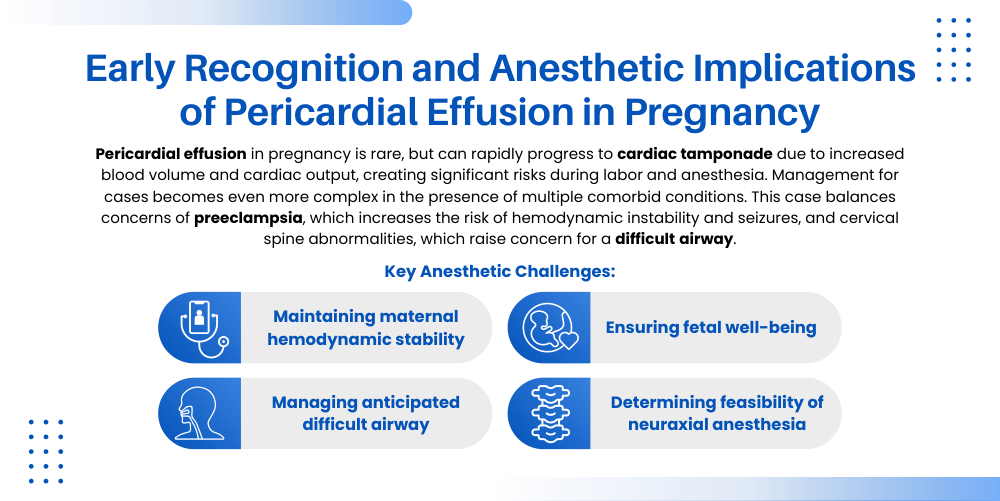
Pericardial effusion in pregnancy is rare, but can rapidly progress to cardiac tamponade due to increased blood volume and cardiac output, creating significant risks during labor and anesthesia. Management for cases becomes even more complex in the presence of multiple comorbid conditions. This case balances concerns of preeclampsia, which increases the risk of hemodynamic instability and seizures, and cervical spine abnormalities, which raise concern for a difficultairway.
Key Anesthetic Challenges:
- Maintaining maternal hemodynamic stability
- Ensuring fetal well-being
- Managing anticipated difficult airway
- Determining feasibility of neuraxial anesthesia
The Case
This case describes a 27-year-old G1P0 patient at 34 weeks and 5 days who was found to have new-onset preeclampsia and a large circumferential pericardial effusion with early tamponade physiology.
Relevant History:
- Congenital platybasia with prior C1–C2 fusion
- Cervical syringomyelia → limited neck extension → predicted difficult airway
- Cochlear implants → required ASL interpreter
- Urgent pericardiocentesis:
- 600 mL serosanguinous fluid removed
- Drain placed
- Suspected viral pericarditis
- Post-procedure
- Severe chest pain → no re-accumulation on repeat imaging
- Given
- Magnesium sulfate for seizure prophylaxis
Delivery Planning:
- Multidisciplinary decision to proceed with delivery
- Anesthetic plan:
- Early epidural placement
- Avoid general anesthesia if possible
- Prepare for awake intubation if needed
- Outcome:
- Successful delivery without airway compromise
- Postpartum:
- Treated with colchicine
Teaching Points
- Early Recognition & Cardiac Management
- Pericardial effusion in pregnancy can rapidly progress to tamponade physiology
- TTE findings (RV collapse + respirophasic variation) should prompt urgent drainage before delivery
- Treatment for viral pericarditis (colchicine) should be deferered until postpartum
- Plan Anesthesia Proactively
- Competing risks: preeclampsia, early tamponade physiology, difficult airway
- Early epidural to avoid emergent anesthesia
- Continuous hemodynamic and cardiac monitoring
- Anticipate a Difficult Airway
- Platybasia + cervical fusion = limited neck extension
- Pregnancy = edema, rapid desaturation, aspiration risk
- Prepare for awake intubation or backup airway strategies
Key Considerations
Multidisciplinary Approach: Considering the complexity, it is important to implement early coordination of OB anesthesia, cardiology, neurosurgery, and NICU teams
Patient Education & Communication: Patient education about importance of an early epidural to avoid emergent general ensthesia. Additionally, ASL interpreter was required