516 posters, 59 topics, 63 sessions, 1,127 authors, 352 institutions
ePostersLive by SciGen Technologies S.A. All rights reserved.
2026 SOAP Annual Meeting
April 29 - May 3, 2026 | Montreal, Quebec Canada

2341236
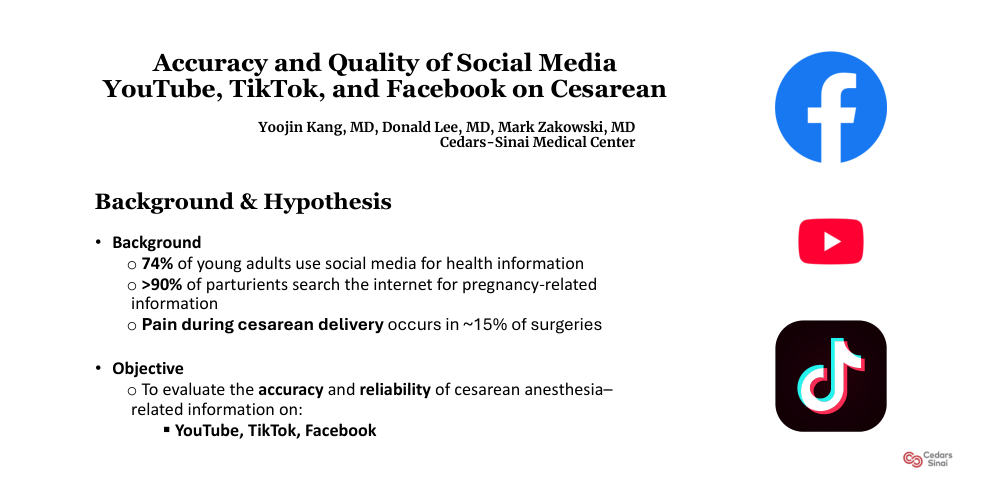
Accuracy and Quality of Social Media YouTube, TikTok, and Facebook on Cesarean Anesthesia
Poster Presenter
Authors
Affiliations
Part of Topic
Efficiency, Education, Access
Abstract Summary:
The public very commonly uses social media as a source of health information. Our study investigates the accuracy, understandability and readability of information on cesarean anesthesia posted to the social media platforms YouTube, TikTok and Facebook.
Introduction
Over 74% of 18-29 year olds use social media to find health information.1 Over 90% of parturients use the internet for health information.2 Pain during cesarean delivery occurs in ~15% of surgeries, with public awareness growing.3 We measured the accuracy and reliability of information on social media about cesarean anesthesia.
Methods
This study is IRB exempt. The social media platforms YouTube (YT), TikTok (TT) and Facebook (FB) were queried with 7 terms for cesarean anesthesia in November 2025. Videos were limited to English-language, audio-visual content, cesarean anesthesia (neuraxial or general). Primary outcomes examined the quality of content. Answers were graded for accuracy and quality (understandability and actionability) using the AHRQ Patient Education Materials Assessment Tool (PEMAT-A/V) and reliability with mDISCERN.2,4,5 Readability level was measured using widely validated indices.2 Secondary outcomes included video uploader type and AI generation.Videos were screened for potential AI generation.6 Statistics were performed using ANOVA for independent measures and Chi-Square, interrater reliability with Krippendorfs Alpha, P<.05 significant.
Results
Videos meeting criteria and analyzed by authors were YT=60, TT=44, FB=40. Health care providers were the uploader in >70% of videos across platforms, P=NS. The average video length was YT(2.4 min), TT (1.8 min) and FB (1.6 min), P=NS. PEMAT understandability scores were moderate and similar in all platforms (YT 48.3; TT 45.2; FB 46.4), while actionability was consistently low (4.7, 4.2, 4.6), P=NS. mDISCERN showed low reliability, similar in all platforms (YT 1.2; TT 1.2; FB 1.1), P=NS. Readability grade level was above college graduate for all platforms. Content accuracy was surprisingly high (YT 96.1%, TT95.9%, FB 97.3%), P=NS. See Table. Videos flagged as AI generated were YT17%, TT18%, FB 5%, P=NS. Interrater reliability was 98%. Pain during cesarean was mentioned in YT 18%, TT 18% and FB 20%, P=NS.
Discussion
Social media platforms are rapidly evolving and are used by a majority of people as a major source of medical information. A surprisingly high number of healthcare professionals provided information on cesarean anesthesia on YT, TT and FB. The information on cesarean anesthesia was accurate, although of low understandability and reliability. For patients to make better informed decisions, medical information requires accuracy, quality, and readability to meet standards set by AHRQ.2 As social media evolves, companies providing these platforms should help address the accuracy, quality and readability of information. We need better quality information about cesarean anesthesia on social media.
References
1. KFF Health Information and Advice on Social Media 2025
2. Lee IJOA 2025 PMID39754839
3. Zakowski Anesthesiology 2024 PMID38597801
4. Shoemaker 2014 PMID24973195
5. Bak IJOA 2025 PMID39955843