516 posters, 59 topics, 63 sessions, 1,127 authors, 352 institutions
ePostersLive by SciGen Technologies S.A. All rights reserved.
2026 SOAP Annual Meeting
April 29 - May 3, 2026 | Montreal, Quebec Canada

2329231
Recurrent Severe Postpartum Abdominal Complications After Cesarean Delivery
Part of Topic
COMPLEX CESAREAN
Recurrent Severe Postpartum Abdominal Complications After Repeat Cesarean Delivery
Background:
•Cesarean delivery is associated with postoperative adhesions
•Small bowel obstruction (SBO) after cesarean is rare (~0.1%)
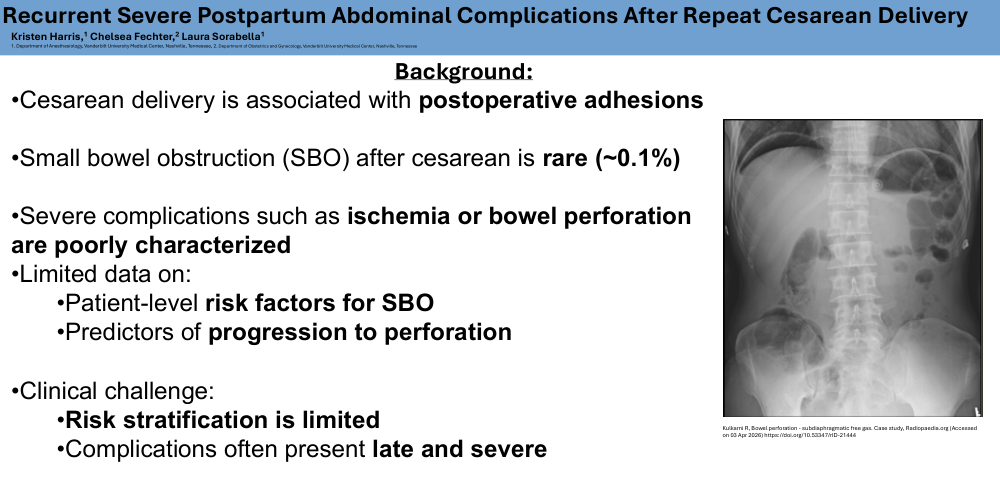
•Severe complications such as ischemia or bowel perforation
are poorly characterized
•Limited data on:
•Patient-level risk factors for SBO
•Predictors of progression to perforation
•Clinical challenge:
•Risk stratification is limited
•Complications often present late and severeKulkarni R, Bowel perforation - subdiaphragmatic free gas. Case study, Radiopaedia.org (Accessed
on 03 Apr 2026) https://doi.org/10.53347/rID-21444
Kristen Harris,1 Chelsea Fechter,2 Laura Sorabella1
1. Department of Anesthesiology, Vanderbilt University Medical Center, Nashville, Tennessee, 2. Department of Obstetrics and Gynecology, Vanderbilt University Medical Center, Nashville, TennesseeCase: 31-year-old G3P3003 at 39w0d undergoing repeat cesarean delivery
• History:
•Two prior cesarean deliveries
•Both complicated by postoperative SBO requiring surgery
•Intraoperative finding:
•Small bowel adhesion to anterior abdominal wall
•Postoperative day 1:
•Abdominal distension, tachycardia, worsening pain
•Imaging: free intraperitoneal air
•Emergent laparotomy:
•Small bowel perforation at adhesion site
•Intact hysterotomy
•Underwent bowel resection and washout
•Course:
•ICU admission + acute kidney injury
•Discharged POD 8 Tulandi et al., Gynecol Surg, 2011 (Fig. 3)Teaching Points
• No clinical guidelines exist for risk stratification of SBO or delayed perforation after
cesarean delivery
• Limited risk stratification increases the likelihood of undetected clinical
progression to ischemia or perforation
• Cesarean-associated SBO may present with advanced pathology, requiring early
recognition and high postoperative vigilance