516 posters, 59 topics, 63 sessions, 1,127 authors, 352 institutions
ePostersLive by SciGen Technologies S.A. All rights reserved.
2026 SOAP Annual Meeting
April 29 - May 3, 2026 | Montreal, Quebec Canada

2335186
Cost awareness of common neuraxial anesthesia medications and materials among obstetric anesthesia providers: A cross-sectional survey-based pilot study
Part of Topic
Leadership: Operations and Research
I conducted a cross-sectional survey-based pilot study on the cost awareness of common neuraxial anesthesia medications and materials among obstetric anesthesia providers.
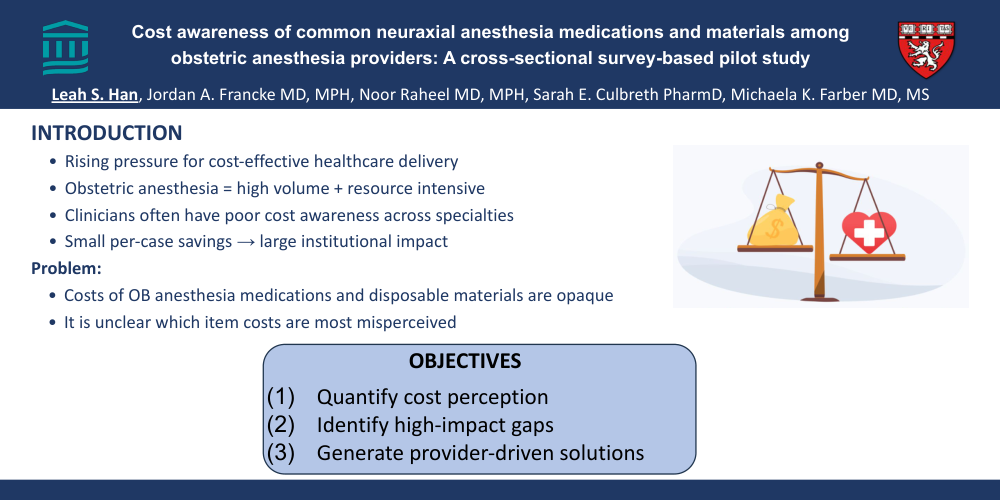
Recently, there has been rising pressure for cost-effective healthcare delivery in the US as well as across the world. Given the high volume and resource intensive nature of the practice of obstetric anesthesia, this cost-effective care has been a greater subject of interest. However, previous research shows that clinicians often have poor cost awareness across various specialties. Therefore, with the record high number of healthcare services being provided universally, even small per-case savings can lead to large institutional impacts.
The problems I sought to address through my study were the costs of OB anesthesia medications and disposable materials remaining opaque, as well as how unclear which item costs are the most misperceived.
The objectives of the study were to (1) quantify cost perception, (2) identify high-impact gaps, and (3) generate provider-driven solutions.
We started by designing the study. The cross-sectional anonymous survey was completed by 23 obstetric anesthesiologists and fellows amongst BWH, a single quaternary hospital with over 7000 deliveries/ year.
The survey was designed with 46 commonly used items in OB anesthesia including medications and supplies. The survey was divided into 3 sections: the spinal procedure, the epidural procedure, and additional medications and materials. We asked two questions for each material. (1) to indicate cost perception as higher than expected meaning they had underestimated the cost, about expected, or lower than expected meaning they had overestimated the cost.
(2) The frequency of use of the material for every time they perform the corresponding procedure as all the time, sometimes, or never.
Data was collected and analyzed using descriptive statistics focusing on item-level aggregation, and % underestimated v. overestimated rankings per item.
Of the total responses collected, 27% underestimated the cost while 52% overestimated the cost. Commonly cost underestimated items included a 17G Weiss epidural needle with 83% underestimating the cost, ephedrine with 78% and phenylephrine with 74%. Commonly cost overestimated items included the BD Spinal Anesthesia Tray with 65% overestimating the cost, the 22G x 1.5” injection needle with 63% followed by the 25G x ⅝” injection needle with 61%. Provider driven suggestions were commonly split between clinical and educational suggestions. Some clinical suggestions included substituting povidone-iodine for chlorhexidine, introducing a “lean” kit with only frequently used items and “expanded” kit for complex cases, eliminating rarely used kit contents, stocking items at unit level rather than kits, as well as looking into the possible reuse of kit components. Educationally, regular departmental sessions presenting item costs, and an accessible electronic dashboards for real-time price lookup were suggested.
The main findings from this study were that (1) experienced OB anesthesiologists had substantially variable cost awareness and (2) taking the survey generated interest and ideas in cost-effective solutions.
Our next steps begin with iterative testing of provider-driven suggestions. Beginning with developing a transparent pricing dashboard, hosting educational sessions and creating lean procedural kits, we hope to make significant clinical impacts. These low-risk changes can make meaningful cost savings without compromising patient safety.