516 posters, 59 topics, 63 sessions, 1,127 authors, 352 institutions
ePostersLive by SciGen Technologies S.A. All rights reserved.
2026 SOAP Annual Meeting
April 29 - May 3, 2026 | Montreal, Quebec Canada

2340568
Neuraxial Anesthesia for Cesarean Delivery in a Parturient with Spinal Epidural Lipomatosis and Chiari I Malformation: A Case Report
Poster Presenter
Part of Topic
CHIARI and OTHER NEURAXIAL CHALLENGES
Neuraxial Anesthesia for Cesarean Delivery in a Parturient with Spinal Epidural Lipomatosis(SEL) and Chiari I Malformation: A Case Report
Usman Hyder MD, Muhammad Waseem Athar MD, Jonathan Aronson MD, Paulina Blanc DO
Background
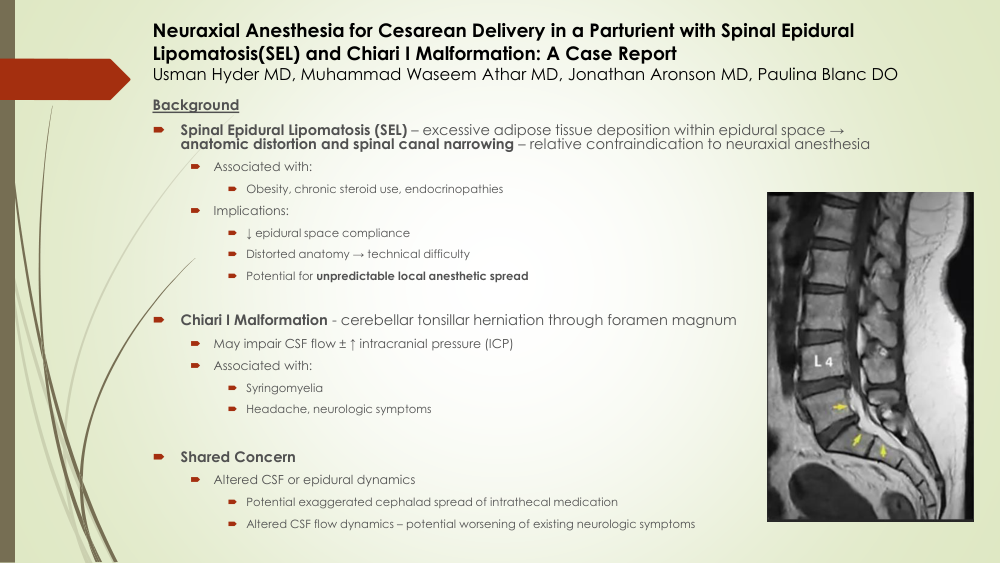
´Spinal Epidural Lipomatosis (SEL) – excessive adipose tissue deposition within epidural space → anatomic distortion and spinal canal narrowing – relative contraindication to neuraxial anesthesia
´Associated with:
´Obesity, chronic steroid use, endocrinopathies
´Implications:
´↓ epidural space compliance
´Distorted anatomy → technical difficulty
´Potential for unpredictable local anesthetic spread
´Chiari I Malformation - cerebellar tonsillar herniation through foramen magnum
´May impair CSF flow ± ↑ intracranial pressure (ICP)
´Associated with:
´Syringomyelia
´Headache, neurologic symptoms
´
´Shared Concern
´Altered CSF or epidural dynamics
´Potential exaggerated cephalad spread of intrathecal medication
´Altered CSF flow dynamics – potential worsening of existing neurologic symptoms
Case:
´24-year-old G2P1 admitted for non-reassuring fetal testing and scheduled for cesarean delivery.
´
´The patient had a prior workup for headaches and visual changes that prompted an MRI
´
´The MRI demonstrated prominent epidural fat throughout the thoracic and lumbar spine with mild-to-moderate thecal sac narrowing extending from L2 to S1, consistent with SEL. A concurrent Chiari I malformation was also noted.
´
´Pre-procedural ultrasound was used to map spinal anatomy and identify interspaces.
´
´Combined spinal-epidural (CSE) technique was planned using a reduced intrathecal dose. Despite three distinct losses of resistance, CSF could not be obtained. Epidural catheter was threaded at the L3–4 level.
´
´A subsequent single-injection spinal was performed one level below (L4–5) with 1.6cc of hyperbaric 0.75% bupivacaine
´
´Surgical anesthesia was achieved with the spinal dose, supplemented with one epidural top-up (5 mL of 2% lidocaine with epinephrine and bicarbonate).
´
´The patient remained hemodynamically stable, and the intraoperative and postoperative courses were uneventful.
Teaching Points:
´Spinal Epidural Lipomatosis (SEL)
´No high-quality data → case-by-case decision
´Risks include unpredictable block height and possible worsening compression
´Consider:
´Imaging review prior to neuraxial
´Ultrasound use to delineate anatomy (midline)
´Incremental dosing (epidural)
´Low threshold for general anesthesia
´
´Chiari I Malformation
´Current evidence: neuraxial generally safe in selected patients
´Reasonable if:
´No ↑ ICP
´No progressive neurologic deficits
´Caution with:
´Syringomyelia
´Symptomatic patients – may lead to worsening of symptoms. Theoretical risk of worsening of cerebellar herniation
´
References:
1.Gelman S, et al. Management of anesthesia and delivery in women with Chiari I malformations. Anesth Analg. 2018;127(5):1187–1193.Patel R, et al.
2.Epidural analgesia in a patient with spinal epidural lipomatosis: a case report and review of the literature. A A Pract. 2019;13(5):147–150.