816 posters, 24 topics, 3,314 authors, 1,012 institutions
ePostersLive by SciGen Technologies S.A. All rights reserved.
SAGES 2026 Annual Meeting Emerging Technology Session
March 25-28, 2026 | Tampa, FL, USA

P097
Efficacy and Safety of OviTex® Reinforced Tissue Matrix for Ventral Hernia Repair: A Systematic Review and Meta-Analysis
Poster Presenter
Authors
DIego L Lima, Maria Clara Morais, Mariana Torves, Augusto G Sousa, Lorraine M Silva de Almeida, Leticia H Graciolli, Raquel Nogueira, Salvador Morales-Conde, Eduardo Parra-Davila, Flavio Malcher
Affiliations
Montefiore Medical Center, Lenox Hill Hospital, Northwell, Federal University of Sao Paulo, Vale do Rio dos Sinos University, Centro Universitário de Anápolis, Jundiai Medical School, Department of Surgery. University Hospital Virgen Macarena, Good Samaritan Medical Center West Palm Beach, Florida
Part of Topic
Abdominal Wall Hernias
Efficacy and Safety of OviTex® Reinforced Tissue Matrix for Ventral Hernia Repair: A Systematic Review and Meta-Analysis
Authors:
Maria Clara Morais1
Mariana de Macedo Torves2
Augusto Graziani e Sousa3
Lorraine Michelle da Silva de Almeida4
Leticia Hanna Moura da Silva Gattas Graciolli5
Raquel Nogueira6
Diego L Lima6
Affiliations:
1Department of Surgery, Lenox Hill Hospital, New York, NY, USA.
2Vale do Rio dos Sinos University, São Leopoldo, Brazil.
3Centro Universitário de Anápolis, Anápolis, Brazil.
4Federal University of São Paulo, São Paulo, Brazil.
5Faculty of Medicine of Jundiaí, Jundiaí, Brazil.
6Department of Surgery, Montefiore Medical Center, Bronx, NY, USA.
ABSTRACT
Introduction: OviTex (OviTex®, TELA Bio) mesh is a reinforced tissue matrix that combines biologic and synthetic components, aiming to reduce inflammatory response while providing durable abdominal wall support. Comparative analyses indicate that biosynthetic meshes like OviTex perform similarly to synthetic mesh regarding hernia recurrence and surgical site infection rates, and may be preferable in patients with increased risk factors or prior mesh infection. This systematic review and meta-analysis evaluated the efficacy and safety profile of OviTex, particularly in patients undergoing ventral wall hernia repair (VHR).
Methods: Following PRISMA guidelines, we searched PubMed, Embase, Scopus, and ClinicalTrials.gov from inception to September 2025. Studies comparing the use of Ovitex mesh following VHR were included. The primary endpoint was recurrence rates. Secondary outcomes were surgical site occurrences (SSO) and hospital length of stay (LOS). Statistical analysis was performed with Review Manager 5.4 using a random-effects model.
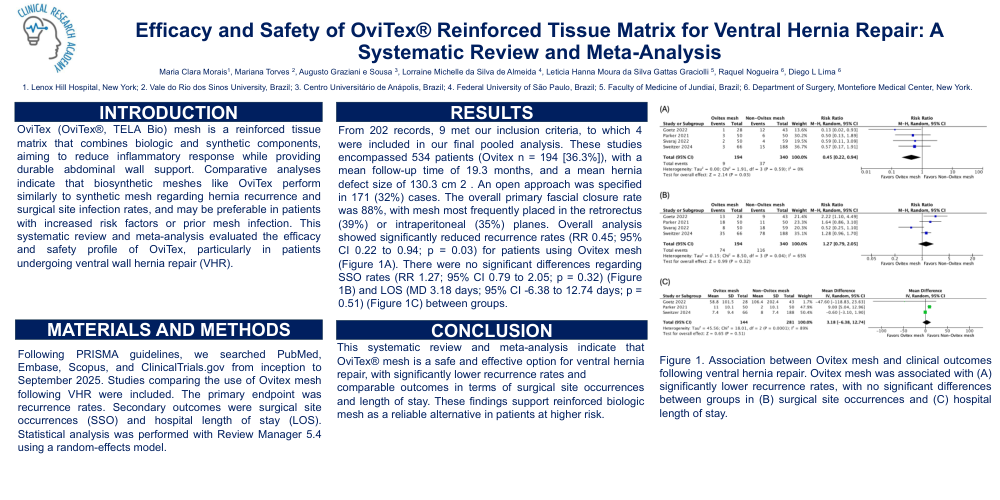
Results: From 202 records, 9 met our inclusion criteria, to which 4 were included in our final pooled analysis. These studies encompassed 534 patients (Ovitex n = 194 [36.3%]), with a mean follow-up time of 19.3 months, and a mean hernia defect size of 130.3 cm2. An open approach was specified in 171 (32%) cases. The overall primary fascial closure rate was 88%, with mesh most frequently placed in the retrorectus (39%) or intraperitoneal (35%) planes. Overall analysis showed significantly reduced recurrence rates (RR 0.45; 95% CI 0.22 to 0.94; p = 0.03) for patients using Ovitex mesh (Figure 1A). There were no significant differences regarding SSO rates (RR 1.27; 95% CI 0.79 to 2.05; p = 0.32) (Figure 1B) and LOS (MD 3.18 days; 95% CI -6.38 to 12.74 days; p = 0.51) (Figure 1C) between groups.
Conclusion: This systematic review and meta-analysis indicate that OviTex® mesh is a safe and effective option for ventral hernia repair, with significantly lower recurrence rates and comparable outcomes in terms of surgical site occurrences and length of stay. These findings support reinforced biologic mesh as a reliable alternative in patients at higher risk.