816 posters, 24 topics, 3,314 authors, 1,012 institutions
ePostersLive by SciGen Technologies S.A. All rights reserved.
SAGES 2026 Annual Meeting Emerging Technology Session
March 25-28, 2026 | Tampa, FL, USA

P087
Laparoscopic IPOM-Plus Using Synthetic Dual Mesh for Mid-Sized Ventral Hernias: Early Functional Recovery and Quality-of-Life Gains in a Prospective Cohort
Poster Presenter
Authors
Jyoti Singh, Awanish Kumar, Akshay Anand, Pankaj Kumar, Abhinav Arun Sonkar
Affiliations
Part of Topic
Abdominal Wall Hernias
Laparoscopic IPOM-Plus Using Synthetic Dual Mesh for Mid-Sized Ventral Hernias: Early Functional Recovery and Quality-of-Life Gains in a Prospective Cohort
Authors: Jyoti Singh¹, Awanish Kumar¹, Akshay Anand¹, Pankaj Kumar¹, Abhinav Arun Sonkar¹
¹Department of General Surgery, King George’s Medical University, Uttar Pradesh, India
Introduction
Ventral hernias (2–20% after abdominal surgery) impair core function and quality of life (QoL). The laparoscopic intraperitoneal onlay mesh with primary defect closure (IPOM-Plus) may enhance abdominal wall function while minimising morbidity. We prospectively evaluated peri-operative outcomes, objective abdominal wall function, and hernia-specific QoL after IPOM-Plus using synthetic dual mesh in mid-sized defects.
Methods
Single-centre prospective study of adults with primary/incisional ventral hernia, 2–8 cm defects, ASA I–II, undergoing laparoscopic IPOM-Plus with dual mesh. Outcomes: operative events, abdominal wall strength (double-leg-lowering, trunk-raising composite), Carolinas Comfort Scale (CCS), and EuraHS-QoL (lower is better) pre-op and POD1, POD3, 1 month, and 6 months. Primary endpoint: change in EuraHS-QoL at 6 months; secondary endpoints: functional scores and complications.
Results
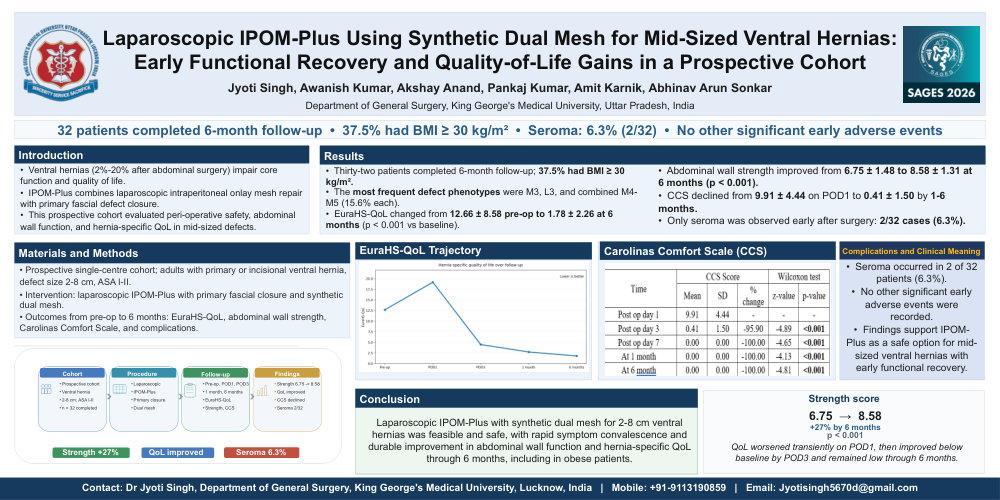
Thirty-two patients completed 6-month follow-up; 37.5% had BMI ≥ 30 kg/m². Defect phenotypes were commonly M3 (15.6%), L3 (15.6%), and combined M4–M5 (15.6%). Abdominal wall strength improved from 6.75 ± 1.48 pre-op to 8.58 ± 1.31 at 6 months (p < 0.001). Mean EuraHS-QoL changed from 12.66 ± 8.58 pre-op to 19.16 ± 5.85 (POD1), 4.47 ± 3.43 (POD3), 2.72 ± 2.34 (1 month), and 1.78 ± 2.26 (6 months) (p < 0.001 vs. baseline). CCS decreased from 9.91 ± 4.44 (POD1) to 0.41 ± 1.50 by 1–6 months, reflecting minimal pain, mesh awareness, and movement limitation. Early complications were low: seroma in 2/32 (6.3%); no other significant adverse events were recorded.
Conclusion
Laparoscopic IPOM-Plus with synthetic dual mesh for 2–8 cm ventral hernias is feasible and safe, delivers rapid symptom convalescence, and achieves durable improvements in abdominal wall function and hernia-specific QoL at 6 months—including in obese patients. Findings support IPOM-Plus with dual-mesh as a pragmatic, minimally invasive option for mid-sized defects; comparative trials versus retromuscular repairs and alternative meshes are warranted.