816 posters, 24 topics, 3,314 authors, 1,012 institutions
ePostersLive by SciGen Technologies S.A. All rights reserved.
SAGES 2026 Annual Meeting Emerging Technology Session
March 25-28, 2026 | Tampa, FL, USA

MSS850
Building a Shared Mental Model of the Critical View of Safety: A Prospective Educational Quality-Improvement Initiative
Part of Topic
Quality Improvement (QI)/Process Improvement (PI) Projects
Building a Shared Mental Model of the Critical View of Safety:
A Prospective Educational Quality-Improvement Initiative
The Problem: The Critical View of Safety (CVS) is the gold standard for safe laparoscopic cholecystectomy, but trainee conceptualization and assessment variability remain unstudied.
Objectives:
-
Improve the accuracy and consistency of CVS knowledge across all postgraduate levels.
-
Standardize the evaluation of intraoperative CVS images.
The "Shared Mental Model": Aligning operative
expectations across the program to promote safer surgery.
Design: Prospective educational quality-improvement (QI) initiative at a single academic military medical center.
Implementation: Weekly academic sessions utilizing QR code–based surveys for data collection (began July 2025).
Conceptual Component: Respondents provide free-text descriptions of the definition of the CVS, scored by independent raters on a 3-point scale.
Applied Component: Participants (Medical Students, Residents, and Staff) review intraoperative video and answer binary (Yes/No) questions regarding the achievement of the three CVS elements.
Results
Knowledge Gaps: Out of 63 conceptual responses, the greatest variability concerned the clearance of fibrofatty tissue from the hepatocystic triangle.
Training Disconnect: Resident accuracy for triangle clearance (0%–80%) did not correlate with higher training levels (p=0.15).
Staff Findings: Only 22.2% of staff correctly identified that the hepatocystic triangle must be cleared of both fatty and fibrous tissue.
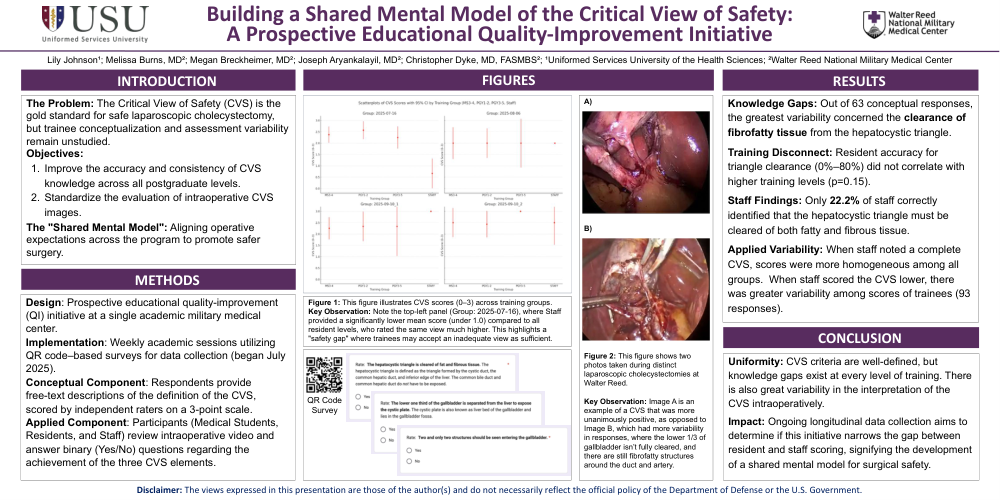
Applied Variability: When staff noted a complete CVS, scores were more homogeneous among all groups. When staff scored the CVS lower, there was greater variability among scores of trainees (93 responses).
Uniformity: CVS criteria are well-defined, but knowledge gaps exist at every level of training. There is also great variability in the interpretation of the CVS intraoperatively.
Lily Johnson¹; Melissa Burns, MD²; Megan Breckheimer, MD²; Joseph Aryankalayil, MD²; Christopher Dyke, MD, FASMBS²; ¹Uniformed Services University of the Health Sciences; ²Walter Reed National Military Medical Center