816 posters, 24 topics, 3,314 authors, 1,012 institutions
ePostersLive by SciGen Technologies S.A. All rights reserved.
SAGES 2026 Annual Meeting Emerging Technology Session
March 25-28, 2026 | Tampa, FL, USA

P084
SYNTHETIC MESH IS NOT ASSOCIATED WITH WORSE OUTCOMES FOLLOWING VENTRAL HERNIA REPAIR IN TRANSPLANT PATIENTS: AN ANALYSIS OF THE ACHQC DATABASE
Poster Presenter
Part of Topic
Abdominal Wall Hernias
Synthetic Mesh is not Associated with Worse Outcomes following Repair of Large Ventral Hernias in Transplant Patients: An Analysis of the ACHQC Database
G.E. Volk BA, P.J. Nguyen-Lee MD, C. Hennessy MS, V. Heh, T.N. Tanner MD, V.M. Kothari MD, I.N. Haskins MD
Introduction:
- Transplant patients are a unique ventral hernia repair patient population
- Current debate surrounding ideal mesh type for ventral hernia repair in transplant patients
- Limited data investigating the association of mesh type and ventral hernia repair outcomes in transplant patients
Objective:
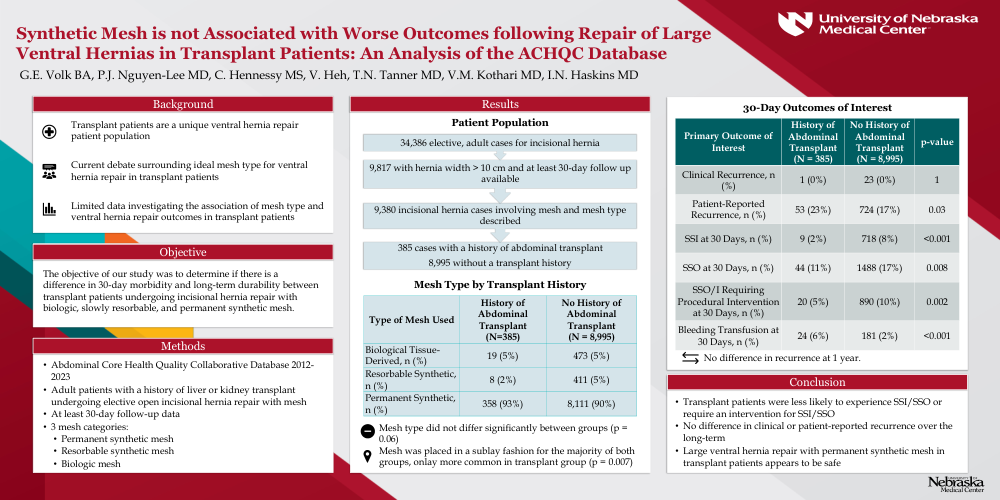
The objective of our study was to determine if there is a difference in 30-day morbidity and long-term durability between transplant patients undergoing incisional hernia repair with biologic, slowly resorbable, and permanent synthetic mesh.
Methods:
- Abdominal Core Health Quality Collaborative Database 2012-2023
- Adult patients with a history of liver or kidney transplant undergoing elective open incisional hernia repair with mesh
- At least 30-day follow-up data
- 3 mesh categories:
• Permanent synthetic mesh
• Resorbable synthetic mesh
• Biologic mesh
Results and Conclusion:
- Mesh type did not differ significantly between groups (p = 0.06)
- Mesh was placed in a sublay fashion for the majority of both groups, onlay more common in transplant group (p = 0.007)
- Transplant patients were less likely to experience SSI/SSO or require an intervention for SSI/SSO
- No difference in clinical or patient-reported recurrence over the long-term
- Large ventral hernia repair with permaanent synthetic mesh in transplant patients appears to be safe