816 posters, 24 topics, 3,314 authors, 1,012 institutions
ePostersLive by SciGen Technologies S.A. All rights reserved.
SAGES 2026 Annual Meeting Emerging Technology Session
March 25-28, 2026 | Tampa, FL, USA

P839
RE-EVALUATING THE 8MM ROBOTIC PORT SITE. SHOULD WE CLOSE 8MM FASCIAL DEFECTS?
Poster Presenter
Authors
Affiliations
Part of Topic
Robotics / Advanced Technologies
INTRODUCTION: Robotic 8mm trocar site hernias (TSH) are rare– reported to occur in 1.7% of patients undergoing robotic surgery– however occur more frequently than their 5mm laparoscopic counterparts1. As the number of robotic cases continues to rise, complications such as TSH have also increased. We report a case of a right lower quadrant trocar site hernia following robotic cholecystectomy.
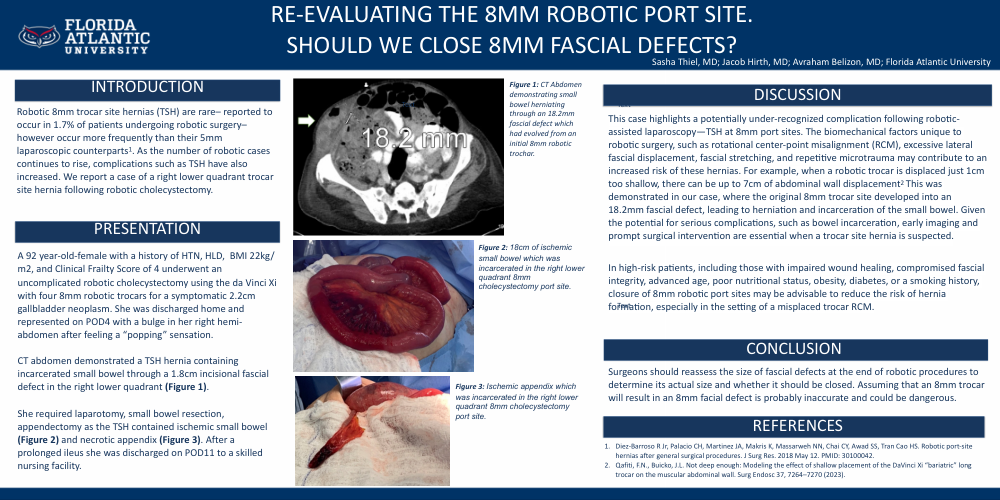
PRESENTATION: A 92 year-old-female with a history of HTN, HLD, BMI 22kg/m2, and Clinical Frailty Score of 4 underwent an uncomplicated robotic cholecystectomy using the da Vinci Xi with four 8mm robotic trocars for a symptomatic 2.2cm gallbladder neoplasm. She was discharged home and represented on POD4 with a bulge in her right hemi-abdomen after feeling a “popping” sensation. CT abdomen demonstrated a TSH hernia containing incarcerated small bowel through a 1.8cm incisional fascial defect in the right lower quadrant (Figure 1). She required laparotomy, small bowel resection, appendectomy as the TSH contained ischemic small bowel (Figure 2) and necrotic appendix (Figure 3). After a prolonged ileus she was discharged on POD11 to a skilled nursing facility.
DISCUSSION: This case highlights a potentially under-recognized complication following robotic-assisted laparoscopy—TSH at 8mm port sites. The biomechanical factors unique to robotic surgery, such as rotational center-point misalignment (RCM), excessive lateral fascial displacement, fascial stretching, and repetitive microtrauma may contribute to an increased risk of these hernias. For example, when a robotic trocar is displaced just 1cm too shallow, there can be up to 7cm of abdominal wall displacement2 This was demonstrated in our case, where the original 8mm trocar site developed into an 18.2mm fascial defect, leading to herniation and incarceration of the small bowel. Given the potential for serious complications, such as bowel incarceration, early imaging and prompt surgical intervention are essential when a trocar site hernia is suspected.
In high-risk patients, including those with impaired wound healing, compromised fascial integrity, advanced age, poor nutritional status, obesity, diabetes, or a smoking history, closure of 8mm robotic port sites may be advisable to reduce the risk of hernia formation, especially in the setting of a misplaced trocar RCM.
CONCLUSION: Surgeons should reassess the size of fascial defects at the end of robotic procedures to determine its actual size and whether it should be closed. Assuming that an 8mm trocar will result in an 8mm facial defect is probably inaccurate and could be dangerous.