816 posters, 24 topics, 3,314 authors, 1,012 institutions
ePostersLive by SciGen Technologies S.A. All rights reserved.
SAGES 2026 Annual Meeting Emerging Technology Session
March 25-28, 2026 | Tampa, FL, USA

P834
PATIENTS' WILLINGNESS TO UNDERGO HYPOTHETICAL SEMI-AUTONOMOUS ROBOT-ASSISTED SURGERY
Poster Presenter
Part of Topic
Robotics / Advanced Technologies
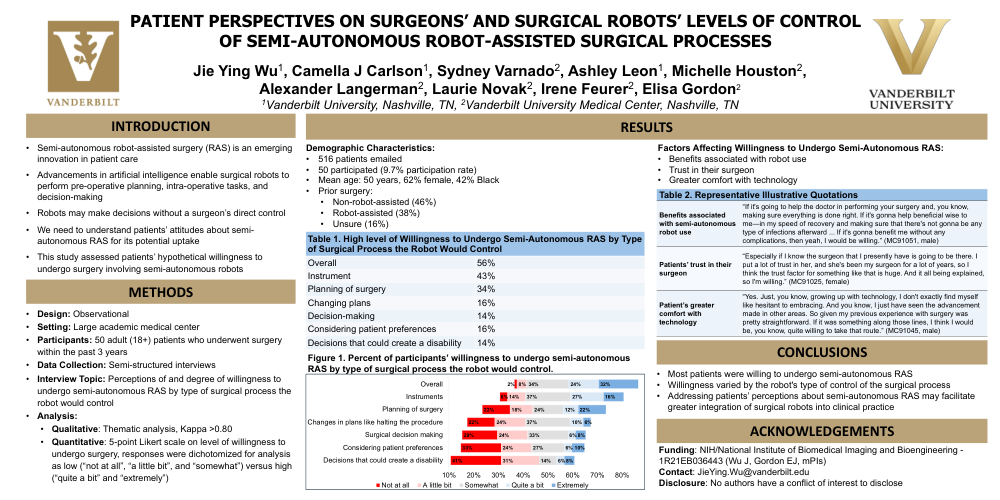
Title: PATIENT PERSPECTIVES ON SURGEONS’ AND SURGICAL ROBOTS’ LEVELS OF CONTROL OF SEMI-AUTONOMOUS ROBOT-ASSISTED SURGICAL PROCESSES
Objective: Although most current surgical robots are fully controlled by the surgeon, semi-autonomous surgical robots present an emerging innovation in patient care. The increasing level of control semi-autonomous robots may have over various surgical processes may affect patient acceptance of this innovation. This study assessed patients’ hypothetical willingness to undergo surgery involving semi-autonomous robots.
Methods: We conducted semi-structured interviews with adult patients who underwent robot-assisted or non-robot-assisted surgery at Vanderbilt University Medical Center within the past three years. Interviews quantitatively and qualitatively assessed overall willingness to undergo semi-autonomous robot-assisted surgery, and quantitatively assessed willingness to undergo such surgery across six types of control over surgery: 1) planning, 2) decision-making, 3) instrument handling, 4) incorporating patient preferences, 5) responding to intraoperative changes, and 6) making decisions with the potential to create disability. Quantitative questions were assessed via a 5-point Likert scale, and responses were dichotomized for analysis as: low willingness (“not at all willing”, “a little bit willing”, and “somewhat willing”) versus high willingness (“quite a bit willing” and “extremely willing.”)
Results: Of the 516 patients emailed, fifty patients participated (9.7% participation rate). Most were female (62%) and had an average age of 50 years. Participants reported undergoing surgery that was: not robot-assisted (46%), robot-assisted (38%), or were unsure (16%). The majority of participants (56%) were highly willing to undergo semi-autonomous robot-assisted surgery (Figure 1). Participants’ willingness to undergo semi-autonomous robot-assisted surgery also varied by the type of control the semi-autonomous robot would have over the surgery. Participants would be highly willing when the robot had control over: instruments (43%); the planning of surgery (35%); carrying out patient preferences (16%); the change in plans (16%); surgical decision-making (14%); and decisions that could create a disability (14%). Factors affecting participants’ greater willingness to undergo semi-autonomous robot-assisted surgery included: 1) benefits associated with the use of semi-autonomous robots including lower perceived risk and successful prior robot-assisted surgery; 2) patient’s trust in their surgeon driven by the surgeon’s thorough discussion about robot-assisted surgery and recommendations; 3) and patient’s greater comfort with technology driven by greater understanding of the process of robot-assisted surgery.
Conclusions: Our findings suggest that the majority of surgical patients are willing to undergo semi-autonomous robot-assisted surgery. Patients’ willingness also varied by the robot's type of control of the surgical process. Addressing patients’ perceptions about semi-autonomous robot-assisted surgery will likely facilitate greater integration of surgical robots into clinical practice.