816 posters, 24 topics, 3,314 authors, 1,012 institutions
ePostersLive by SciGen Technologies S.A. All rights reserved.
SAGES 2026 Annual Meeting Emerging Technology Session
March 25-28, 2026 | Tampa, FL, USA

P811
Novel Application of Validated Suturing Assessment Tool to Robotic Hiatal Hernia Repair
Part of Topic
Robotics / Advanced Technologies
Novel Application of Validated Suturing Assessment Tool to Robotic Hiatal Hernia Repair
Jeanine Kim1, Miguel A Burch1, Carter Prentice2, Noah Kim1, Rikke G Olsen3, Peter Wager1, Steven Cen4, Andrew J Hung1
1. Cedars-Sinai 2. University of California-Los Angeles 3. Copenhagen Academy for Medical Education and Simulation & Copenhagen Prostate Cancer Center 4. University of Southern California
Introductions and Objectives
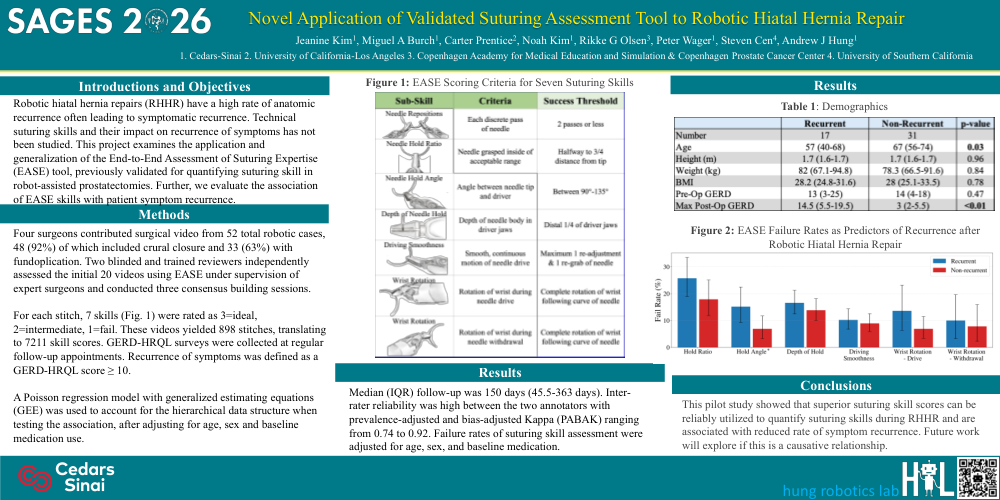
Robotic hiatal hernia repairs (RHHR) have a high rate of anatomic recurrence often leading to symptomatic recurrence. Technical suturing skills and their impact on recurrence of symptoms has not been studied. This project examines the application and generalization of the End-to-End Assessment of Suturing Expertise (EASE) tool, previously validated for quantifying suturing skill in robot-assisted prostatectomies. Further, we evaluate the association of EASE skills with patient symptom recurrence.
Methods
Four surgeons contributed surgical video from 52 total robotic cases, 48 (92%) of which included crural closure and 33 (63%) with fundoplication. Two blinded and trained reviewers independently assessed the initial 20 videos using EASE under supervision of expert surgeons and conducted three consensus building sessions.
For each stitch, 7 skills (Fig. 1) were rated as 3=ideal, 2=intermediate, 1=fail. These videos yielded 898 stitches, translating to 7211 skill scores. GERD-HRQL surveys were collected at regular follow-up appointments. Recurrence of symptoms was defined as a GERD-HRQL score ≥ 10.
A Poisson regression model with generalized estimating equations (GEE) was used to account for the hierarchical data structure when testing the association, after adjusting for age, sex and baseline medication use.
Results
Median (IQR) follow-up was 150 days (45.5-363 days). Inter-rater reliability was high between the two annotators with prevalence-adjusted and bias-adjusted Kappa (PABAK) ranging from 0.74 to 0.92. Failure rates of suturing skill assessment were adjusted for age, sex, and baseline medication.
Conclusions
This pilot study showed that superior suturing skill scores can be reliably utilized to quantify suturing skills during RHHR and are associated with reduced rate of symptom recurrence. Future work will explore if this is a causative relationship.