816 posters, 24 topics, 3,314 authors, 1,012 institutions
ePostersLive by SciGen Technologies S.A. All rights reserved.
SAGES 2026 Annual Meeting Emerging Technology Session
March 25-28, 2026 | Tampa, FL, USA

P810
Impact of Robotic-Assisted Surgery on Right Colectomy Outcomes at a High-Volume Canadian Centre: A Retrospective Cohort Study
Poster Presenter
Authors
Joseph F Bellissimo, Megan Roth, Priya Thethi, Katrina Knight, Hugh MacDonald, Sunil Patel, Ameer Farooq
Affiliations
Part of Topic
Robotics / Advanced Technologies
Impact of Robotic-Assisted Surgery on Right Colectomy Outcomes: A Retrospective Cohort Study
Authors: Joseph Bellissimo, Megan Roth, Priya Theti, Katrina Knight, Hugh Macdonald, Sunil Patel, Ameer Farooq
Affiliations: Queen's University, Department of Surgery, Kingston, ON, Canada, Kingston Health Sciences Centre, Kingston, ON, Canada
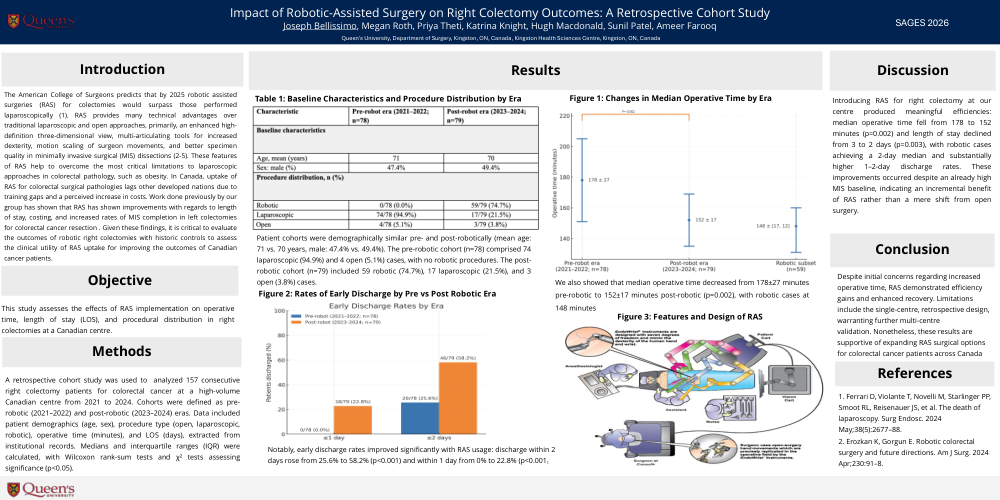
Background: Robotic-assisted surgery (RAS) has emerged as a popular approach in colorectal surgery, prompting evaluation of its impact on clinical outcomes. This study assesses the effects of RAS implementation on operative time, length of stay (LOS), and procedural distribution in right colectomies at a high-volume Canadian center.
Methods: A retrospective cohort study analyzed 157 consecutive right colectomy patients for colorectal cancer at Kingston Health Sciences Centre from 2021 to 2024. Cohorts were defined as pre-robotic (2021–2022) and post-robotic (2023–2024) eras. Data included patient demographics (age, sex), procedure type (open, laparoscopic, robotic), operative time (minutes), and LOS (days), extracted from institutional records. Medians and interquartile ranges (IQR) were calculated, with Wilcoxon rank-sum tests and χ² tests assessing significance (p<0.05).
Results: Patient cohorts were demographically similar pre- and post-robotically (mean age: 71 vs. 70 years, male: 47.4% vs. 49.4%). The pre-robotic cohort (n=78) comprised 74 laparoscopic (94.9%) and 4 open (5.1%) cases, with no robotic procedures. The post-robotic cohort (n=79) included 59 robotic (74.7%), 17 laparoscopic (21.5%), and 3 open (3.8%) cases. Median operative time decreased from 178±27 minutes pre-robotic to 152±17 minutes post-robotic (p=0.002). Median LOS declined with robotic cases at 2 days (IQR 2-4), compared to laparoscopic at 4 days (IQR 3-6) and open at 9 days (IQR 5-11). Notably, early discharge rates improved significantly with RAS usage: discharge within 2 days rose from 25.6% to 58.2% (p<0.001) and within 1 day from 0% to 22.8% (p<0.001).
Conclusion: Despite initial concerns regarding increased operative time, RAS demonstrated efficiency gains and enhanced recovery. Limitations include the single-center, retrospective design, warranting further multicenter validation. Improvements occurred despite an already high MIS baseline, indicating an incremental benefit of RAS rather than a mere shift from open surgery. These results support expanding RAS surgical options for colorectal cancer patients across Canada