816 posters, 24 topics, 3,314 authors, 1,012 institutions
ePostersLive by SciGen Technologies S.A. All rights reserved.
SAGES 2026 Annual Meeting Emerging Technology Session
March 25-28, 2026 | Tampa, FL, USA

P801
IMPACT OF MICROBREAKS ON VISUAL AND PHYSICAL STRAIN DURING SIMULATED ROBOTIC SURGICAL TASKS ON HUGO™ RAS: A RANDOMIZED CONTROLLED TRIAL
Poster Presenter
Part of Topic
Robotics / Advanced Technologies
IMPACT OF MICROBREAKS ON VISUAL AND PHYSICAL STRAIN DURING SIMULATED ROBOTIC SURGICAL TASKS ON HUGO™ RAS: A RANDOMIZED CONTROLLED TRIAL
Keywords: Robotic surgery, Ergonomics, Microbreaks, Visual strain, Musculoskeletal fatigue, Hugo™ RAS
Objective of the study:
Robotic surgery offers improved ergonomics, three-dimensional visualization, and superior dexterity compared with conventional laparoscopy. However, surgeons remain vulnerable to visual fatigue and musculoskeletal strain, especially during long procedures. Fatigue has the potential to impair eye health, decision-making, dexterity, and overall performance, thereby influencing both surgeon well-being and patient outcomes. Previous literature in laparoscopic surgery has suggested that structured intraoperative “microbreaks” — short, planned pauses of brief relaxation or stretching, can reduce visual and physical strain. However, the impact of such breaks in open-console robotic systems, particularly the Hugo™ Robotic Assisted Surgery (RAS) platform which uses polarized-glasses 3D vision, remains unclear.
Methods and procedures:
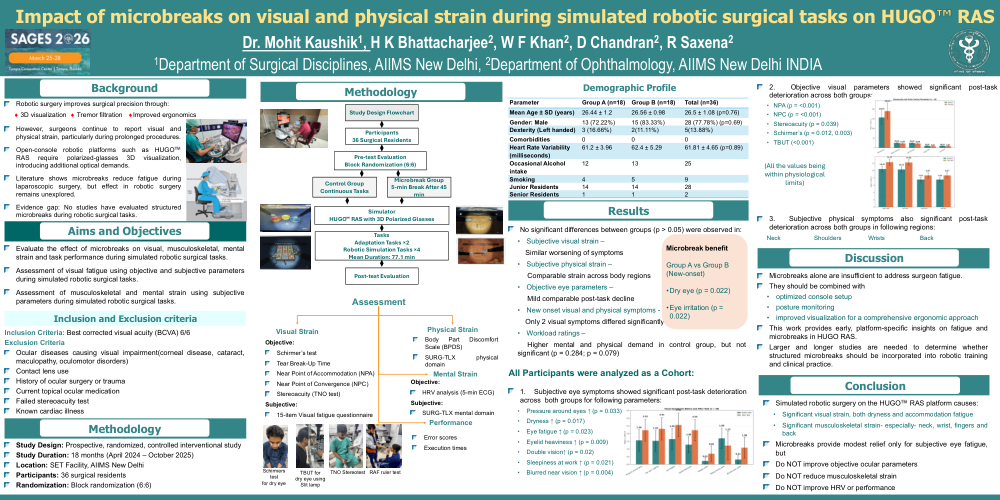
A randomized controlled trial was conducted at a tertiary centre including 36 surgical reside with no prior exposure to robotic simulation. Participants were randomized into an experimental group (n=16) and a control group (n=18). Participants performed standardized simulated robotic tasks on Hugo™ RAS platform for 44–102 minutes (mean ≈70 minutes). The experimental group incorporated a 5-minute microbreak after 45 minutes, incorporating guided stretching and visual relaxation, while the control group worked continuously. Visual strain was assessed subjectively using a 15-item validated questionnaire and objectively through near point of accommodation (NPA) and near point of convergence (NPC) using RAF ruler test, stereoacuity using TNO stereopsis test, Schirmer’s test, and tear break-up time (TBUT). Musculoskeletal strain was measured using a validated body discomfort questionnaire. Assessments were conducted at baseline and post-task.
Results:
Robotic tasks led to significant deterioration in visual parameters: pressure around the eyes (p=0.033), dryness/need to rub (p=0.017), eye fatigue (p=0.019), heaviness of eyelids (p=0.037), blurred near vision (p=0.021) and far vision (p=0.004). Objective tests worsened for NPA (p=0.026, 0.001), NPC (p=0.001), stereoacuity(p=0.001), Schirmer’s (p=0.039, 0.012), TBUT (p=0.003). Musculoskeletal strain increased for following of thee parameters: neck pain (p=0.018), neck stiffness (p=0.002), shoulder pain/stiffness(p=0.020, 0.031), hand/wrist pain or numbness (p=0.008–0.037), back pain (p=0.031). Microbreaks modestly reduced two eye symptoms (pressure around eyes, p=0.040; eye fatigue, p=0.047) but had no effect on objective visual or musculoskeletal outcomes. No significant difference was seen in performance between the groups..
Conclusions:
Simulated robotic surgery on Hugo RAS induces significant visual and musculoskeletal strain. While microbreaks reduced some eye symptoms, they did not improve objective or body outcomes. Larger studies are warranted to develop effective ergonomic strategies.