816 posters, 24 topics, 3,314 authors, 1,012 institutions
ePostersLive by SciGen Technologies S.A. All rights reserved.
SAGES 2026 Annual Meeting Emerging Technology Session
March 25-28, 2026 | Tampa, FL, USA

P079
LAPARSCOPIC INTRAPERITONEAL ONLAY MESH(IPOM+) WITH COMBINED OPEN HERNIA ORFICE DISSECTION FOR COMPLICATED VENTRAL INCISIONAL HERNIAS: A CASE SERIES
Poster Presenter
Authors
Affiliations
Part of Topic
Abdominal Wall Hernias
- Minimally invasive surgery has shown benefits and decreased length of hospital stay, postoperative pain and ileus, wound complications, and hernia recurrence, without clear benefits of long-term quality of life improvement and cost(8).
- Mesh repair has been shown in randomized controlled trials to besuperior to primary suture repair alone for prevention of recurrence(5). For this reason, most practitioners when surveyed choose mesh.
- Patients with prior surgical history and significant intra-abdominal adhesions have an increased risk of complications, specifically iatrogenic enterotomy and delayed diagnosis being challenges of minimally invasive surgery.
The authors describe a technique with open lysis of adhesions and laparoscopic mesh fixation for complicated ventral hernia repair which seeks to maximize the benefits of minimally invasive surgery while minimizing its limitations.
- One patient was enrolled prior to surgery. Nine remaining patients were identified using the CPT codes for hernia repairs performed between 2022 and 2025 by the author in a solo hospital employed practice that focuses on Colorectal Surgery.
- Review of the operative reports determined that only 5 of the patients underwent open dissection with laparoscopic mesh fixation.
- Based on authors expected adhesion burden the decision was made to begin the surgery in a minimally invasive approach or open
- Hospital and clinic electronic medical records were reviewed to determine average length of stay and postoperative narcotic use. All patients were maintained in the hospital until return of bowel function, pain was controlled diet was tolerated. All patients were reached via phone for follow-up, and routine clinic appointments were used as follow up for patients who were enrolled prospectively.
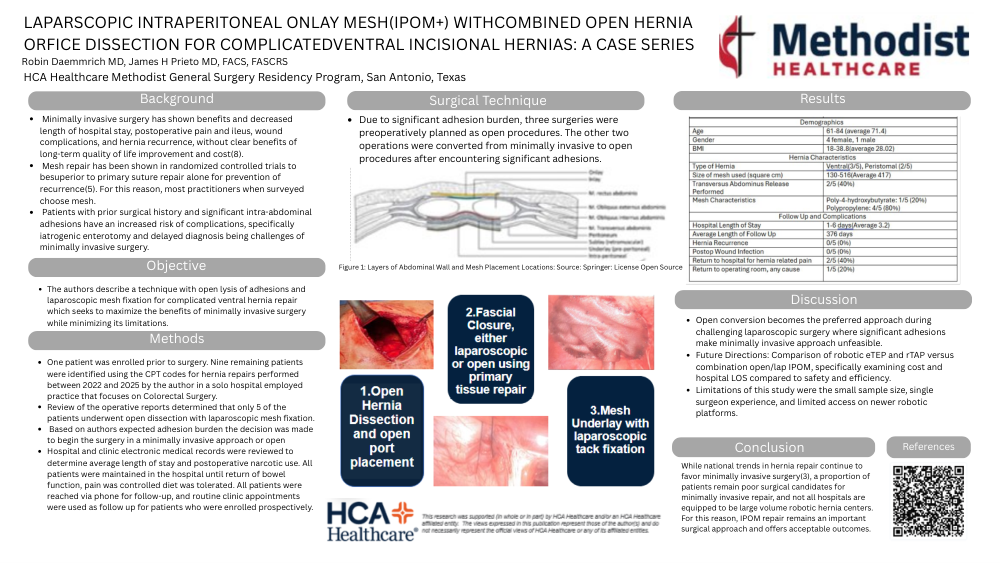
Due to significant adhesion burden, three surgeries werepreoperatively planned as open procedures. The other two operations were converted from minimally invasive to open procedures after encountering significant adhesions.
- Open conversion becomes the preferred approach during challenging laparoscopic surgery where significant adhesions make minimally invasive approach unfeasible.
- Future Directions: Comparison of robotic eTEP and rTAP versus combination open/lap IPOM, specifically examining cost and hospital LOS compared to safety and efficiency.
- Limitations of this study were the small sample size, single surgeon experience, and limited access on newer robotic platforms.
While national trends in hernia repair continue to favor minimally invasive surgery(3), a proportion of patients remain poor surgical candidates for minimally invasive repair, and not all hospitals are equipped to be large volume robotic hernia centers. For this reason, IPOM repair remains an important surgical approach and offers acceptable outcomes.