816 posters, 24 topics, 3,314 authors, 1,012 institutions
ePostersLive by SciGen Technologies S.A. All rights reserved.
SAGES 2026 Annual Meeting Emerging Technology Session
March 25-28, 2026 | Tampa, FL, USA

P742
Green Surgery Realized by Monitor-Free AR: Enhancing Surgeon Performance and Sustainability in Hepato-Biliary-Pancreatic Surgery
Poster Presenter
Part of Topic
New Technologies / Techniques
Title: Green Surgery Realized by Monitor-Free AR: Enhancing Surgeon Performance and Sustainability in Hepato-Biliary-Pancreatic Surgery
Abstract:
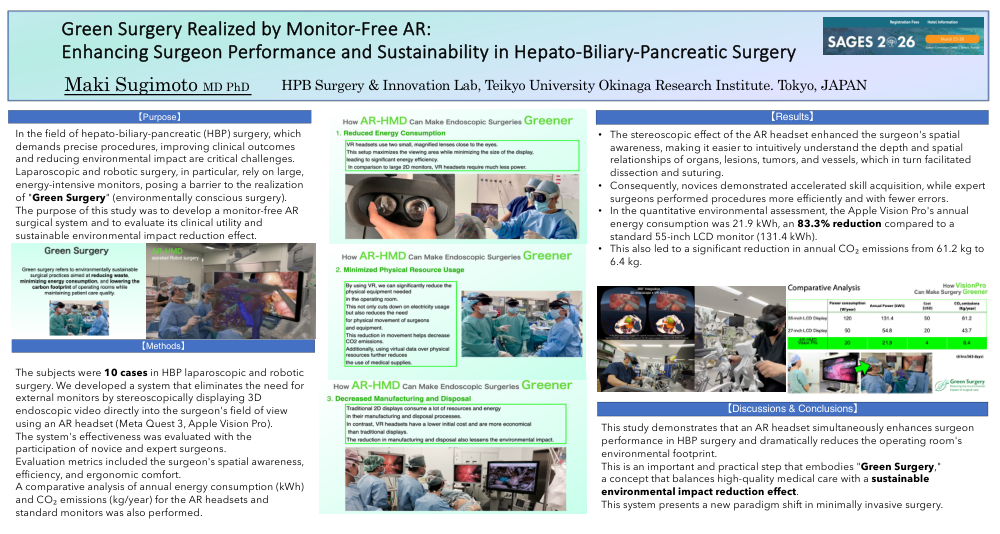
Introduction: In the field of hepato-biliary-pancreatic (HBP) surgery, which demands precise procedures, improving clinical outcomes and reducing environmental impact are critical challenges. Laparoscopic and robotic surgery, in particular, rely on large, energy-intensive monitors, posing a barrier to the realization of "Green Surgery" (environmentally conscious surgery). The purpose of this study was to develop a monitor-free AR surgical system and to evaluate its clinical utility and sustainable environmental impact reduction effect.
Methods: The subjects were 10 cases in HBP laparoscopic and robotic surgery. We developed a system that eliminates the need for external monitors by stereoscopically displaying 3D endoscopic video directly into the surgeon's field of view using an AR headset (Meta Quest 3, Apple Vision Pro). The system's effectiveness was evaluated with the participation of novice and expert surgeons. Evaluation metrics included the surgeon's spatial awareness, efficiency, and ergonomic comfort. A comparative analysis of annual energy consumption (kWh) and CO₂ emissions (kg/year) for the AR headsets and standard monitors was also performed.
Results: The stereoscopic effect of the AR headset enhanced the surgeon's spatial awareness, making it easier to intuitively understand the depth and spatial relationships of organs, lesions, tumors, and vessels, which in turn facilitated dissection and suturing. Consequently, novices demonstrated accelerated skill acquisition, while expert surgeons performed procedures more efficiently and with fewer errors. In the quantitative environmental assessment, the Apple Vision Pro's annual energy consumption was 21.9 kWh, an 83.3% reduction compared to a standard 55-inch LCD monitor (131.4 kWh). This also led to a significant reduction in annual CO₂ emissions from 61.2 kg to 6.4 kg.
Conclusion: This study demonstrates that an AR headset simultaneously enhances surgeon performance in HBP surgery and dramatically reduces the operating room's environmental footprint. This is an important and practical step that embodies "Green Surgery," a concept that balances high-quality medical care with a sustainable environmental impact reduction effect. This system presents a new paradigm shift in minimally invasive surgery.