816 posters, 24 topics, 3,314 authors, 1,012 institutions
ePostersLive by SciGen Technologies S.A. All rights reserved.
SAGES 2026 Annual Meeting Emerging Technology Session
March 25-28, 2026 | Tampa, FL, USA

P739
No place like home: Hospital at Home for Colorectal Surgery
Poster Presenter
Authors
Jason Beckermann, Sam Stumo, Margaret Paulson, Christopher Johnson, Kristine Hanson
Affiliations
Part of Topic
New Technologies / Techniques
Transforming Rural Surgical Care: Hospital-at-Home for Colorectal Surgery Samuel Stumo 1 , Margaret Paulson, D.O. 2 , Christopher Johnson, M.D. 2 , Kristine Hanson, M.P.H3 , Jason Beckermann, M.D. 2 1University of Wisconsin – Eau Claire, Eau Claire WI, 2Mayo Clinic Health System, Eau Claire WI, 3Mayo Clinic, Rochester MN
HOSPITAL-AT-HOME (HAH) CARE
• Hospital capacity constraints create accessibility barriers for patients.
• HaH programs aim to reduce hospital capacity constraints by either expediating the rate of discharge for admitted patients or bypassing inpatient stay altogether.
• HaH programs mobilize traditional inpatient care practices into the patient’s own home.
• HaH have been shown to reduce patient length of stay, improve patient-reported care satisfaction, and decrease hospital readmission rates [1,2].
ADVANCED CARE AT HOME (ACH)
• ACH is a novel HaH program that is currently implemented at three Mayo Clinic sites.
• A 20-month evaluation of ACH found no fatal outcomes, despite most patients presenting with moderate to major illness severity [3].
CURRENT GAPS IN CARE
• Accelerated discharge models [4-7] have been used successfully in colorectal surgery.
• Few, if any studies have described using HaH models for colorectal surgery patients in rural settings.
METHODS
We report a case series of retrospectively collected data for colorectal surgical patients receiving post-operative care in coordination with HaH over a 28-month period.
DESCRIPTIVE DATA
•Patient Characteristics
•Surgical Procedures
•Length of Stay (LOS)
•Medication Requirements
•Escalation Back to Brick-and-mortar (BAM) Hospital
•BAM Hospital Bed Days Saved
•Surgical Morbidity
PATIENT DEMOGRAPHICS AND MEDICAL HISTORY
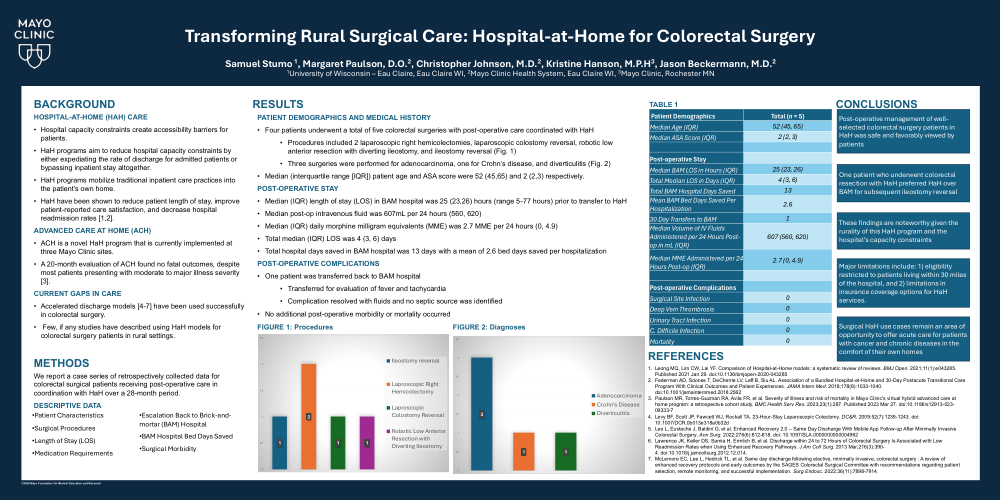
• Four patients underwent a total of five colorectal surgeries with post-operative care coordinated with HaH
• Procedures included 2 laparoscopic right hemicolectomies, laparoscopic colostomy reversal, robotic low anterior resection with diverting ileostomy, and ileostomy reversal (Fig. 1)
• Three surgeries were performed for adenocarcinoma, one for Crohn’s disease, and diverticulitis (Fig. 2)
• Median (interquartile range [IQR]) patient age and ASA score were 52 (45,65) and 2 (2,3) respectively.
POST-OPERATIVE STAY
• Median (IQR) length of stay (LOS) in BAM hospital was 25 (23,26) hours (range 5-77 hours) prior to transfer to HaH
• Median post-op intravenous fluid was 607mL per 24 hours (560, 620)
• Median (IQR) daily morphine milligram equivalents (MME) was 2.7 MME per 24 hours (0, 4.9)
• Total median (IQR) LOS was 4 (3, 6) days
• Total hospital days saved in BAM hospital was 13 days with a mean of 2.6 bed days saved per hospitalization
POST-OPERATIVE COMPLICATIONS
• One patient was transferred back to BAM hospital
• Transferred for evaluation of fever and tachycardia
• Complication resolved with fluids and no septic source was identified
• No additional post-operative morbidity or mortality occurred
CONCLUSIONS
• Post-operative management of well selected colorectal surgery patients in HaH was safe and favorably viewed by patients
• One patient who underwent colorectal resection with HaH preferred HaH over BAM for subsequent ileostomy reversal
• These findings are noteworthy given the rurality of this HaH program and the hospital’s capacity constraints
• Major limitations include: 1) eligibility restricted to patients living within 30 miles of the hospital, and 2) limitations in insurance coverage options for HaH services.
• Surgical HaH use cases remain an area of opportunity to offer acute care for patients with cancer and chronic diseases in the comfort of their own homes
REFERENCES
1. Leong MQ, Lim CW, Lai YF. Comparison of Hospital-at-Home models: a systematic review of reviews. BMJ Open. 2021;11(1):e043285. Published 2021 Jan 29. doi:10.1136/bmjopen-2020-043285
2. Federman AD, Soones T, DeCherrie LV, Leff B, Siu AL. Association of a Bundled Hospital-at-Home and 30-Day Postacute Transitional Care Program With Clinical Outcomes and Patient Experiences. JAMA Intern Med. 2018;178(8):1033-1040. doi:10.1001/jamainternmed.2018.2562
3. Paulson MR, Torres-Guzman RA, Avila FR, et al. Severity of illness and risk of mortality in Mayo Clinic's virtual hybrid advanced care at home program: a retrospective cohort study. BMC Health Serv Res. 2023;23(1):287. Published 2023 Mar 27. doi:10.1186/s12913-023- 09333-7
4. Levy BF, Scott JP, Fawcett WJ, Rockall TA. 23-Hour-Stay Laparoscopic Colectomy. DC&R. 2009;52(7):1239-1243. doi: 10.1007/DCR.0b013e318a0b32d
5. Lee L, Eustache J, Baldini G, et al. Enhanced Recovery 2.0 – Same Day Discharge With Mobile App Follow-up After Minimally Invasive Colorectal Surgery. Ann Surg. 2022;276(6):812-818. doi: 10.1097/SLA.0000000000004962
6. Lawrence JK, Keller DS, Samia H, Ermlich B, et al. Discharge within 24 to 72 Hours of Colorectal Surgery Is Associated with Low Readmission Rates when Using Enhanced Recovery Pathways. J Am Coll Surg. 2013 Mar;216(3):390- 4. doi:10.1016/j.jamcollsurg.2012.12.014.
7. McLemore EC, Lee L, Hedrick TL, et al. Same day discharge following elective, minimally invasive, colorectal surgery : A review of enhanced recovery protocols and early outcomes by the SAGES Colorectal Surgical Committee with recommendations regarding patient selection, remote monitoring, and successful implementation. Surg Endosc. 2022;36(11):7898-7914.