816 posters, 24 topics, 3,314 authors, 1,012 institutions
ePostersLive by SciGen Technologies S.A. All rights reserved.
SAGES 2026 Annual Meeting Emerging Technology Session
March 25-28, 2026 | Tampa, FL, USA

P732
Resolution of Acalculous Cholecystitis Through Endovascular Mesenteric Revascularization
Poster Presenter
Part of Topic
New Technologies / Techniques
Resolution of Acalculous Cholecystitis Through Endovascular Mesenteric Revascularization
INTRODUCTION
-
Acalculous cholecystitis (AC) is an uncommon form of gallbladder inflammation that occurs in the absence of gallstones.
-
It is typically associated with critically ill patients and systemic conditions such as sepsis or trauma.
-
AC secondary to chronic mesenteric ischemia (CMI) is a rare phenomenon.
-
The gallbladder is particularly susceptible to ischemia due to its terminal arterial supply, and reduced perfusion from mesenteric arterial stenosis can predispose patients to AC.
-
While the standard treatment for AC often involves percutaneous cholecystostomy or cholecystectomy, the role of isolated revascularization in resolving AC remains poorly defined.
-
77-year-old female with a history of atherosclerotic risk factors who developed RUQ abdominal pain, anorexia, and weight loss.
-
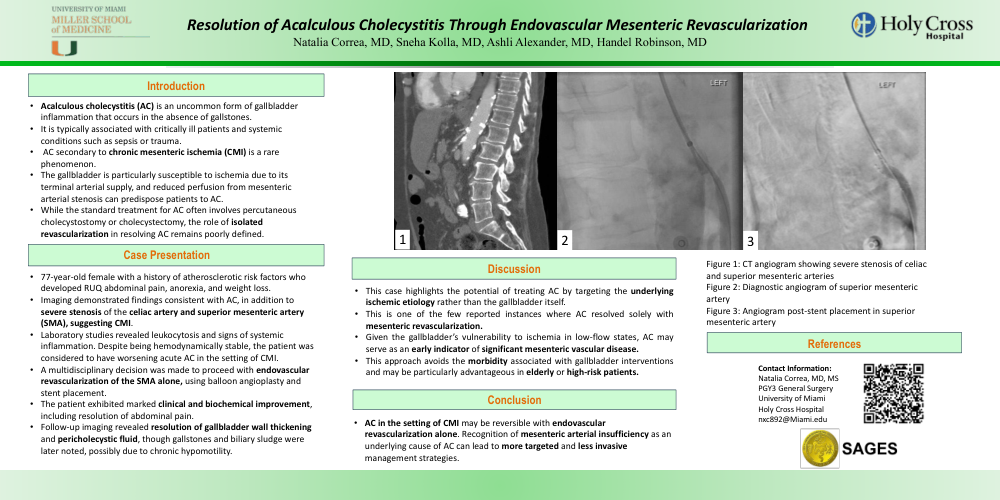
Imaging demonstrated findings consistent with AC, in addition to severe stenosis of the celiac artery and superior mesenteric artery (SMA), suggesting CMI.
-
Laboratory studies revealed leukocytosis and signs of systemic inflammation. Despite being hemodynamically stable, the patient was considered to have worsening acute AC in the setting of CMI.
-
A multidisciplinary decision was made to proceed with endovascular revascularization of the SMA alone, using balloon angioplasty and stent placement.
-
The patient exhibited marked clinical and biochemical improvement, including resolution of abdominal pain.
-
Follow-up imaging revealed resolution of gallbladder wall thickening and pericholecystic fluid, though gallstones and biliary sludge were later noted, possibly due to chronic hypomotility.
-
This case highlights the potential of treating AC by targeting the underlying ischemic etiology rather than the gallbladder itself.
-
This is one of the few reported instances where AC resolved solely with mesenteric revascularization.
-
Given the gallbladder’s vulnerability to ischemia in low-flow states, AC may serve as an early indicator of significant mesenteric vascular disease.
-
This approach avoids the morbidity associated with gallbladder interventions and may be particularly advantageous in elderly or high-risk patients.
-
AC in the setting of CMI may be reversible with endovascular revascularization alone. Recognition of mesenteric arterial insufficiency as an underlying cause of AC can lead to more targeted and less invasive management strategies.