816 posters, 24 topics, 3,314 authors, 1,012 institutions
ePostersLive by SciGen Technologies S.A. All rights reserved.
SAGES 2026 Annual Meeting Emerging Technology Session
March 25-28, 2026 | Tampa, FL, USA

P700
COMPARATIVE ANALYSIS OF LAPAROSCOPIC SPLENECTOMY OUTCOMES IN MASSIVE VERSUS MODERATE SPLENOMEGALY: A SINGLE-CENTER EXPERIENCE
Poster Presenter
Part of Topic
Miscellaneous / Other
COMPARATIVE ANALYSIS OF LAPAROSCOPIC SPLENECTOMY OUTCOMES IN MASSIVE VERSUS MODERATE SPLENOMEGALY: A SINGLE-CENTER EXPERIENCE
Saksham Gagal, MBBS1; Manjunath M Pol, MS1; Brahma K Rath, MS, MCh2; 1All India Institute Of Medical Sciences, New Delhi; 2Institute of Medical Science and Sum Hospital, Bhubaneswar
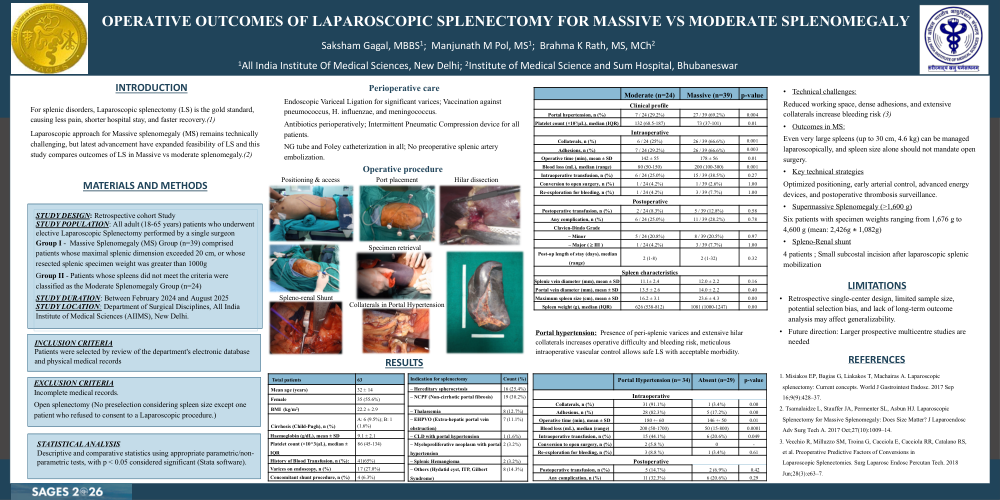
Introduction: Laparoscopic splenectomy (LS) is the standard approach for many splenic diseases, but massive splenomegaly remains challenging due to reduced working space, increased vascularity, and higher bleeding risk. The aim of this study was to evaluate perioperative outcomes of laparoscopic splenectomy in patients with massive splenomegaly compared to those with moderate splenomegaly.
Methods: A retrospective cohort study was conducted at AIIMS New Delhi, including all adult patients undergoing elective LS by a single surgeon between February 2024 and August 2025. All patients underwent laparoscopic splenectomy, with no preselection for open surgery. Patients were classified as having massive splenomegaly (MS) if the maximum splenic dimension was >20 cm or spleen weight exceeded 1000 g, while others were classified as moderate splenomegaly. Outcomes assessed included intraoperative parameters (operative time, estimated blood loss, conversion to open surgery) and postoperative outcomes (complications, length of stay, and overall morbidity). Statistical analyses were performed using the Mann-Whitney U test for continuous variables and Fisher's exact test for categorical variables.
Results: Sixty-three patients (mean age 32 ± 14 years, 55.6% female) underwent LS. Thirty-nine (62%) had MS. Median spleen weight and mean maximum spleen dimension were significantly higher in MS group (1081 g, IQR 1000–1247 g; 23.6 ± 4.3 cm) compared with moderate splenomegaly group (626 g, IQR 538–812 g; 16.2 ± 3.1 cm, p<0.001). Portal hypertension was more common in MS patients (69% vs 29%, p=0.004). The MS group had longer operative times (178 ± 56 vs 142 ± 55 minutes, p=0.01) and higher median blood loss (200 vs 80 mL, p=0.001). Intraoperative collateral vessels and adhesions were more frequent in MS patients (67% vs 25% and 67% vs 29%, p=0.001 and p=0.003, respectively). Despite these technical and ergonomic challenges, overall conversion to open surgery was low (2 patients, 3.2%), with one case in each group (p=1.00). Postoperative morbidity was similar between groups (28% vs 25%, p=0.78). Re-exploration for bleeding was the most frequent complication observed in 1 patient (4.2%) with moderate splenomegaly and 3 patients (7.7%) with massive splenomegaly (p=1.00). Median hospital stay was 2 days in both groups.
Conclusion: Laparoscopic splenectomy for massive splenomegaly was technically more demanding, with longer operative times and blood loss, but conversion rates and postoperative outcomes were comparable to those with moderate splenomegaly. These findings support using LS as a first-line approach for massive splenomegaly without compromising patient safety.
Keywords: Laparoscopic splenectomy, massive splenomegaly, portal hypertension, minimally invasive surgery, spleen size