816 posters, 24 topics, 3,314 authors, 1,012 institutions
ePostersLive by SciGen Technologies S.A. All rights reserved.
SAGES 2026 Annual Meeting Emerging Technology Session
March 25-28, 2026 | Tampa, FL, USA

P699
Prophylactic Catheter-Pexy Does Not Improve One-Year Peritoneal Dialysis Catheter Patency: Insights from a Large Single-Center Cohort
Poster Presenter
Authors
William M Rice, Austin James, Nicholas Rouck, Maren Sword, Rishab Agarwal, Fang Fang, Jessica Burgess
Affiliations
Part of Topic
Miscellaneous / Other
Introduction
Peritoneal dialysis (PD) is an increasingly popular modality of renal replacement therapy for end-stage renal disease, but catheter obstruction or migration can compromise patency. Prophylactic techniques to increase catheter patency such as catheter-pexy (CP) and omentopexy have been described as possible adjuncts but have not yet been studied in a large cohort. We hypothesized that prophylactic CP would be associated with improved 1-year PD catheter patency.
Methods
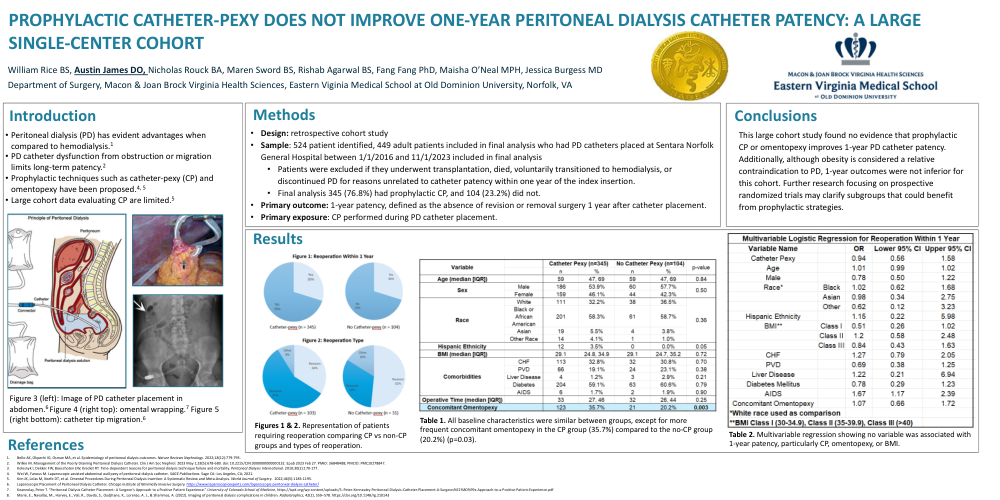
This retrospective cohort study included patients aged 18-89 who underwent PD catheter insertion at a single tertiary care facility between 2016-2023. Data were obtained via electronic medical records. Patients were excluded if they underwent transplant, died, or voluntarily switched to hemodialysis unrelated to PD catheter malfunction within 1 year of the index insertion. The primary exposure was CP during PD catheter insertion. The primary outcome was 1-year patency, defined as the absence of revision or removal surgeries within 1 year of the index insertion. Covariates included demographics, obesity classification, comorbidities, and concomitant omentopexy during PD catheter insertion. Mann-Whitney-U and chi-squared compared baseline differences between CP and no-CP groups. Multivariable logistic regression analyzed the association of CP with 1-year catheter patency. P-values <0.05 were statistically significant.
Results
Of 524 patients identified, 449 were included in the final analysis. Of those, 345 (76.8%) had prophylactic CP and 104 (23.2%) did not. All baseline characteristics were similar between groups, except for more frequent concomitant omentopexy in the CP group (35.7%) compared to the no-CP group (20.2%) (p=0.03). There was no difference in 1-year patency rates between the CP group (70.1%) and the no-CP group (70.2%) (p=0.99). When stratified by type of reoperation within 1 year, there was a trend towards more catheter removals in the CP group (17.1% vs. 9.6%, p=0.06) and more revisions in the no-CP group (15.4% vs. 10.1%, p=0.14). After multivariable regression, CP was not associated with 1-year patency (OR 0.94, 95% CI [0.56, 1.58]). Importantly, neither obesity class I (OR 0.51, 95% CI [0.26, 1.02]), class II (OR 1.20, 95% CI [0.58, 2.48]), nor class III (OR 0.84, 95% CI [0.43, 1.63]) were associated with reoperation within 1-year.
Conclusion
This large cohort study found no evidence that prophylactic CP improves 1-year PD catheter patency. Additionally, although obesity is considered a relative contraindication to PD, 1-year outcomes were not inferior for this cohort. Further research focusing on prospective randomized trials may clarify subgroups that could benefit from prophylactic strategies.