816 posters, 24 topics, 3,314 authors, 1,012 institutions
ePostersLive by SciGen Technologies S.A. All rights reserved.
SAGES 2026 Annual Meeting Emerging Technology Session
March 25-28, 2026 | Tampa, FL, USA

P066
Giant Ventral Hernia Repair After Emergent AAA Surgery Abroad Using Hybrid Robotic and Open Techniques with botulinum Toxin Adjunct
Poster Presenter
Authors
Affiliations
Part of Topic
Abdominal Wall Hernias
GIANT VENTRAL HERNIA REPAIR AFTER EMERGENT AAA SURGERY ABROAD USING HYBRID ROBOTIC AND OPEN TECHNIQUES WITH BOTULINUM TOXIN ADJUNCTAnton Simorov, MD, FACS; Laredo Medical Center
INTRODUCTION: Giant ventral incisional hernias following emergent abdominal aortic aneurysm (AAA) repair remain a reconstructive challenge. Robotic platforms and preoperative botulinum toxin A (BTX-A) may facilitate abdominal wall closure.
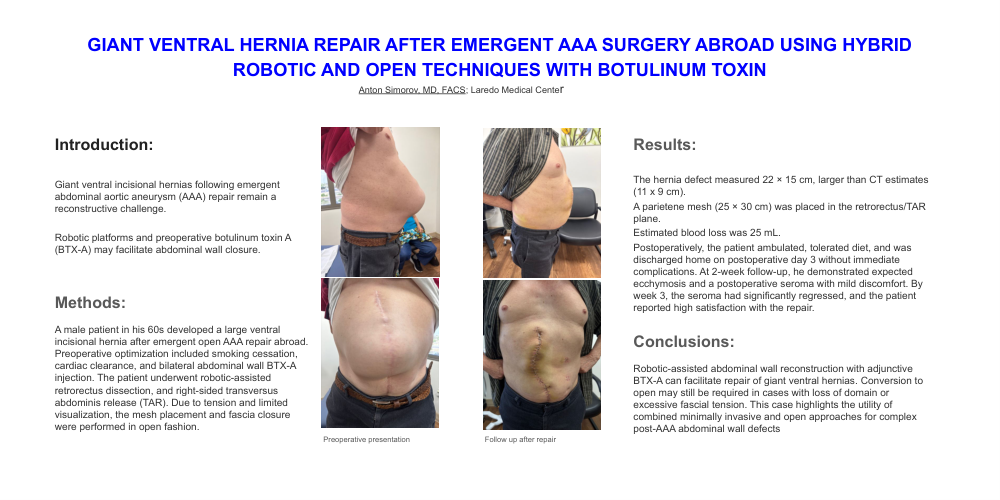
METHODS/PROCEDURES: A male patient in his 60s developed a large ventral incisional hernia after emergent open AAA repair abroad. Preoperative optimization included smoking cessation, cardiac clearance, and bilateral abdominal wall BTX-A injection. The patient underwent robotic-assisted retrorectus dissection, bilateral posterior component separation, and right-sided transversus abdominis release (TAR). Due to tension and limited visualization, the mesh placement and fascia closure were performed in open fashion.
RESULTS: The hernia defect measured 22 × 15 cm, larger than CT estimates (11 x 9 cm). A parietene mesh (25 × 30 cm) was placed in the retrorectus/TAR plane. Estimated blood loss was 25 mL. Postoperatively, the patient ambulated, tolerated diet, and was discharged home on postoperative day 3 without immediate complications. At 2-week follow-up, he demonstrated expected ecchymosis and a postoperative seroma with mild discomfort. By week 3, the seroma had significantly regressed, and the patient reported high satisfaction with the repair.
CONCLUSION: Robotic-assisted abdominal wall reconstruction with adjunctive BTX-A can facilitate repair of giant ventral hernias. Conversion to open may still be required in cases with loss of domain or excessive fascial tension. This case highlights the utility of combined minimally invasive and open approaches for complex post-AAA abdominal wall defects.