816 posters, 24 topics, 3,314 authors, 1,012 institutions
ePostersLive by SciGen Technologies S.A. All rights reserved.
SAGES 2026 Annual Meeting Emerging Technology Session
March 25-28, 2026 | Tampa, FL, USA

P633
A personalized approach to epiphrenic diverticula utilizing EndoFLIP: a case comparison
Poster Presenter
Part of Topic
Foregut
Personalized Approach to EpiphrenicDiverticula utilizing EndoFLIP
§Incidence = 3%
§Most cases are caused by increased intraluminal esophageal pressure due to dysmotility
§Surgical options: open vs MIS diverticulectomy
§Approaches: thoracic, intra-abdominal or combo with esophageal myotomy
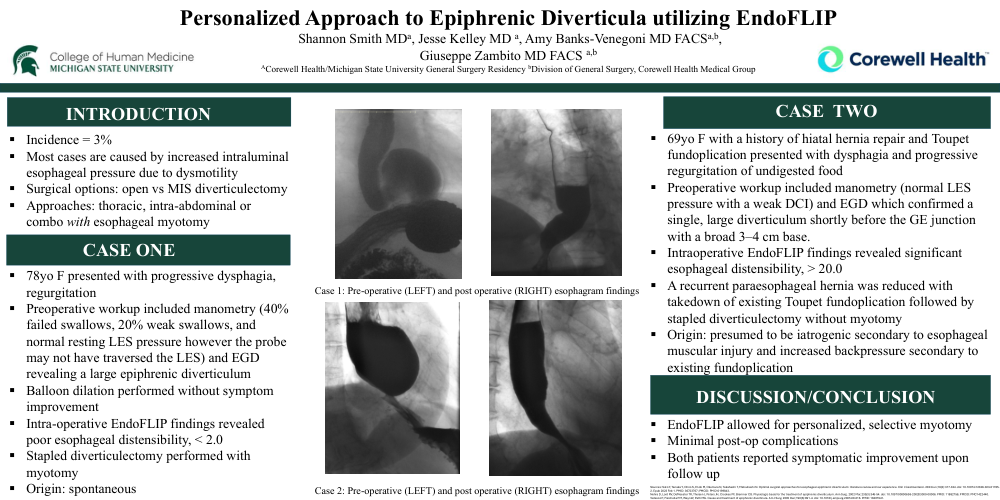
§78yo F presented with progressive dysphagia, regurgitation
§Preoperative workup included manometry (40% failed swallows, 20% weak swallows, and normal resting LES pressure however the probe may not have traversed the LES) and EGD revealing a large epiphrenic diverticulum
§Balloon dilation performed without symptom improvement
§Intra-operative EndoFLIPfindings revealed poor esophageal distensibility, < 2.0
§Stapled diverticulectomy performed with myotomy
§Origin: spontaneous
§69yo F with a history of hiatal hernia repair and Toupet fundoplication presented with dysphagia and progressive regurgitation of undigested food
§Preoperative workup included manometry (normal LES pressure with a weak DCI) and EGD which confirmed a single, large diverticulum shortly before the GE junction with a broad 3–4 cm base.
§Intraoperative EndoFLIPfindings revealed significant esophageal distensibility, > 20.0
§A recurrent paraesophageal hernia was reduced with takedown of existing Toupet fundoplication followed by stapled diverticulectomy without myotomy
§Origin: presumed to be iatrogenic secondary to esophageal muscular injury and increased backpressure secondary to existing fundoplication
§EndoFLIP allowed for personalized, selective myotomy
§Minimal post-op complications
§Both patients reported symptomatic improvement upon follow up