816 posters, 24 topics, 3,314 authors, 1,012 institutions
ePostersLive by SciGen Technologies S.A. All rights reserved.
SAGES 2026 Annual Meeting Emerging Technology Session
March 25-28, 2026 | Tampa, FL, USA

P060
Which Is More Important in Hernia Repair - Optimization or Timing? An ACHQC Analysis
Poster Presenter
Part of Topic
Abdominal Wall Hernias
Background:
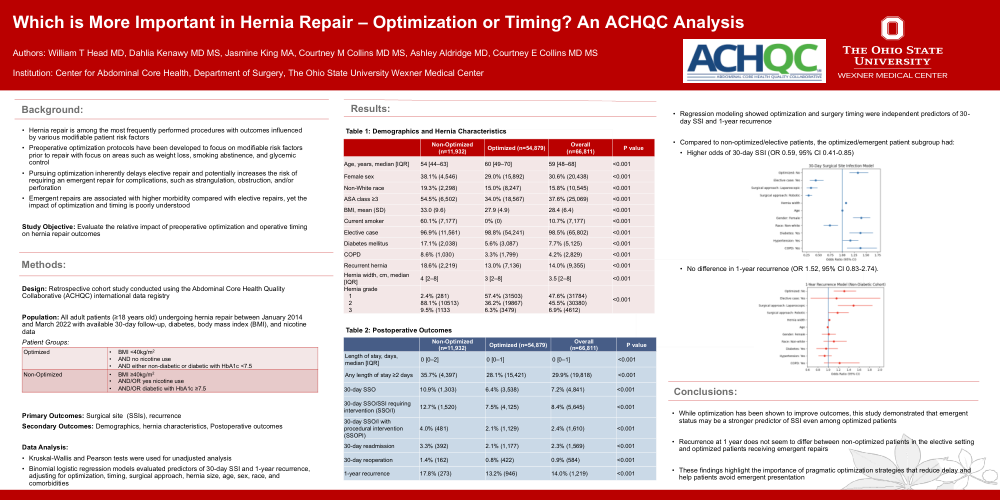
Hernia repair outcomes are influenced by multiple factors with much focus on preoperative optimization. Various optimization criteria have been established; however, not all patients may meet these metrics before requiring emergent repair. This study evaluates the relative impact of optimization and timing on hernia repair outcomes.
Methods:
A retrospective cohort study was conducted using the Abdominal Core Health Quality Collaborative (ACHQC) registry. All adult (≥18 years old) patients undergoing hernia repair between 1/2014-3/2022 were included if 30-day follow-up, diabetes, body mass index (BMI), and nicotine data were complete. Patients were categorized as Optimized (BMI<40kg/m2, no nicotine use, and either non-diabetic or diabetic with HbA1c<7.5) and Non-Optimized (BMI≥40kg/m2, and/or nicotine use, and/or diabetic with HbA1c ≥7.5). The primary outcomes were surgical site infections [SSIs] and recurrence. Demographics, hernia characteristics, and outcomes were also compared. Kruskal-Wallis and Pearson tests were used for unadjusted analyses. Binomial logistic regression models evaluated independent predictors of 30-day SSI and 1-year recurrence, adjusting for optimization, timing, surgical approach, hernia size, age, sex, race, and comorbidities.
Results:
66,811 patients were included: 54,879 Optimized (82%) and 11,932 Non-Optimized (18%). Non-Optimized patients were more often female (38% vs 29%, p<0.001), minority (19% vs 15%,p<0.001), had higher median BMI (33kg/m2, vs 28kg/m2, p<0.001), and larger median hernia widths (4cm vs 3cm, p<0.001). They had higher 30-day readmission (3.3% vs 2.1%, p<0.001), reoperation (1.4% vs 0.8%, p<0.001) SSOs (10.9% vs 6.4%, p<0.001), SSIs (2.8% vs 1.5%, p<0.001), and 1-year recurrence rates (18% vs 13%, p<0.001).
Regression modeling demonstrated that both optimization and timing of surgery wereindependent predictors of 30-day SSI and 1-year recurrence. Compared to non-optimized/elective patients, the optimized/emergent patient subgroup had significantly higher odds of 30-day SSI (OR 0.59, 95% CI 0.41-0.85). However, the odds of 1-year recurrence were not significantly different between these two subgroups (OR 1.52, 95% CI 0.83-2.74).
Conclusions:
The balance of optimization and timing of repair proves challenging for hernia management. While optimization has been shown to improve outcomes, this study demonstrated that emergent status may be a stronger predictor of SSI even among optimized patients. Recurrence at 1 year does not seem to differ between non-optimized patients in the elective setting and optimized patients receiving emergent repairs. These findings highlight the importance of pragmaticoptimization strategies that reduce delay and help patients avoid emergent presentation.