816 posters, 24 topics, 3,314 authors, 1,012 institutions
ePostersLive by SciGen Technologies S.A. All rights reserved.
SAGES 2026 Annual Meeting Emerging Technology Session
March 25-28, 2026 | Tampa, FL, USA

P602
BURDEN OF IBS-LIKE SYMPTOMS AT MID-TERM FOLLOW-UP AFTER ANTIREFLUX SURGERY
Part of Topic
Foregut
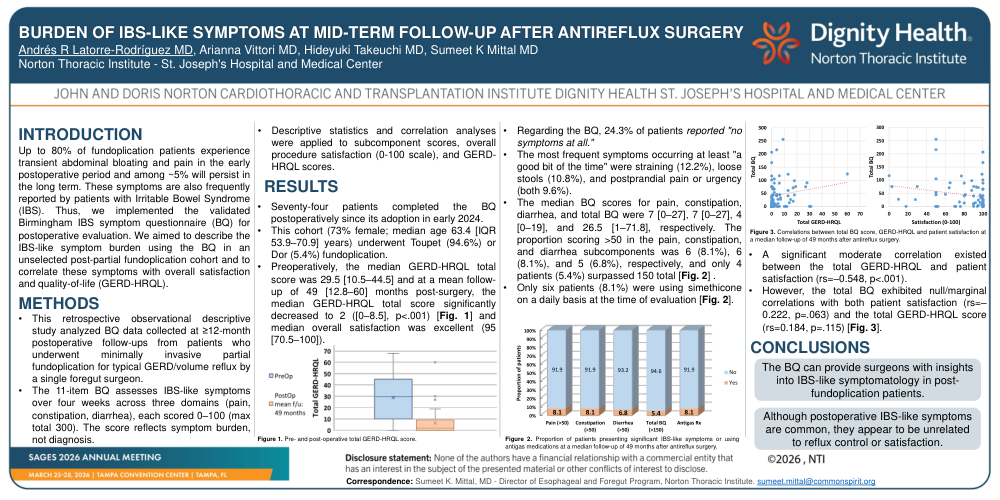
INTRODUCTION: Up to 80 of fundoplication patients experience transient abdominal bloating and pain in the early postoperative period and among ~5% will persist in the long term These symptoms are also frequently reported by patients with Irritable Bowel Syndrome (IBS). Thus, we implemented the validated Birmingham IBS symptom questionnaire for postoperative evaluation We aimed to describe the IBS like symptom burden using the BQ in an unselected post partial fundoplication cohort and to correlate these symptoms with overall satisfaction and quality of life (GERD-HRQL).
METHODS: This retrospective observational descriptive study analyzed BQ data collected at 12 month postoperative follow ups from patients who underwent minimally invasive partial fundoplication for typical GERD/volume reflux by a single foregut surgeon. The 11 item BQ assesses IBS like symptoms over four weeks across three domains (pain, constipation, diarrhea), each scored 0 100 (max total 300). The score reflects symptom burden, not diagnosis. Descriptive statistics and correlation analyses were applied to subcomponent scores, overall procedure satisfaction (0-100 scale), and GERD-HRQL scores
RESULTS: Seventy four patients completed the BQ postoperatively since its adoption in early 2024. This cohort 73 female median age 63 4 [IQR 53.9-70.9] years underwent Toupet (94.6%) or Dor (5.4%) fundoplication. Preoperatively, the median GERD-HRQL total score was 29.5 [10.5-44.5] and at a mean follow
up of 49 [12.8-60] months post surgery, the median GERD HRQL total score significantly decreased to 2 ([0-8.5], p<.001) (Fig. 1) and median overall satisfaction was excellent 95 [70.5-100]. Regarding the BQ, 24.3% of patients reported "no symptoms at all." The most frequent symptoms occurring at least "a good bit of the time" were straining (12.2%), loose stools (10.8%), and postprandial pain or urgency (both 9.6%). The median BQ scores for pain, constipation, diarrhea, and total BQ were 7 [0–27], 7 [0–27], 4 [0–19], and 26.5 [1–71.8], respectively. The proportion scoring over 50 in the pain, constipation, and diarrhea subcomponents was 6 (8.1%), 6 (8.1%), and 5 (6.8%), respectively, and only 4 patients (5.4%) surpassed 150 total. Six patients (8.1%) were on antigas medications (e.g., simethicone) at the time of evaluation. A significant moderate correlation existed between the total GERD-HRQL and patient satisfaction (rs=–0.548, p<.001). However, the total BQ exhibited null/marginal correlations with both patient satisfaction (rs=–0.222, p=.063) and the total GERD-HRQL score (rs=0.184, p=.115).
CONCLUSION: The BQ can provide surgeons with insights into IBS-like symptomatology in post-fundoplication patients. Although postoperative IBS-like symptoms are common, they are unrelated to reflux control or satisfaction. Further paired analyses are warranted to elucidate temporality and causality.