816 posters, 24 topics, 3,314 authors, 1,012 institutions
ePostersLive by SciGen Technologies S.A. All rights reserved.
SAGES 2026 Annual Meeting Emerging Technology Session
March 25-28, 2026 | Tampa, FL, USA

P572
Revisional Robotic-Assisted Surgery for Median Arcuate Ligament Syndrome: Is There a Role?
Poster Presenter
Authors
Affiliations
Part of Topic
Foregut
Revisional Robotic-Assisted Surgery for Median Arcuate Ligament Syndrome: Is There a Role?
Gabriela V Lozano, BS; Nevyn A Santillan, BS; Elliot I Shiwota; Steve Chen, MD; Daniel Shouhed, MD
Providence Saint John's Health Center
INTRODUCTION
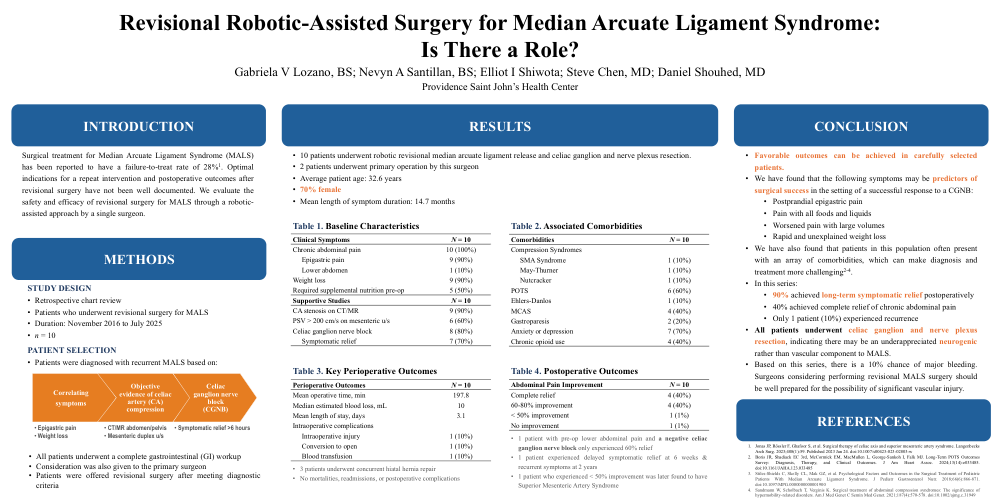
Surgical treatment for Median Arcuate Ligament Syndrome (MALS) has been reported to have a failure-to-treat rate of 28%1. Optimal indications for a repeat intervention and postoperative outcomes after revisional surgery have not been well documented. We evaluate the safety and efficacy of revisional surgery for MALS through a robotic-assisted approach by a single surgeon.
METHODS
STUDY DESIGN
• Retrospective chart review
• Patients who underwent revisional surgery for MALS
• Duration: November 2016 to July 2025
• n = 10
PATIENT SELECTION
• Patients were diagnosed with recurrent MALS based on:
Correlating symptoms, Objective evidence of celiac artery (CA) compression, Celiac ganglion nerve block (CGNB)
• All patients underwent a complete gastrointestinal (GI) workup
• Consideration was also given to the primary surgeon
• Patients were offered revisional surgery after meeting diagnostic criteria
RESULTS
• 10 patients underwent robotic revisional median arcuate ligament release and celiac ganglion and nerve plexus resection.
• 2 patients underwent primary operation by this surgeon
• Average patient age: 32.6 years
• 70% female
• Mean length of symptom duration: 14.7 months
CONCLUSION
• Favorable outcomes can be achieved in carefully selected patients.
• We have found that the following symptoms may be predictors of surgical success in the setting of a successful response to a CGNB:
• Postprandial epigastric pain
• Pain with all foods and liquids
• Worsened pain with large volumes
• Rapid and unexplained weight loss
• We have also found that patients in this population often present with an array of comorbidities, which can make diagnosis and treatment more challenging2-4.
• In this series:
• 90% achievedlong-term symptomatic relief postoperatively
• 40% achieved complete relief of chronic abdominal pain
• Only 1 patient (10%) experienced recurrence
• All patients underwent celiac ganglion and nerve plexus resection,indicating there may be an underappreciated neurogenic rather than vascular component to MALS.
• Based on this series, there is a 10% chance of major bleeding.
• Surgeons considering performing revisional MALS surgery should be well prepared for the possibility of significant vascular injury.