816 posters, 24 topics, 3,314 authors, 1,012 institutions
ePostersLive by SciGen Technologies S.A. All rights reserved.
SAGES 2026 Annual Meeting Emerging Technology Session
March 25-28, 2026 | Tampa, FL, USA

P565
Open, Laparoscopic, or Robotic? Defining the Short-Term Tradeoffs in Gastric Cancer Surgery
Poster Presenter
Authors
Paul Wisniowski, Sienna Wong, Desmond Huynh, Yufei Chen, Kulmeet Sandhu, Scott Cunneen, Miguel Burch
Affiliations
Part of Topic
Foregut
Introduction:
Minimally invasive techniques are increasingly utilized in gastric cancer surgery, yet the optimal operative approach remains under debate. Laparoscopic and robotic gastrectomy may offer advantages in visualization, precision, and recovery compared to the open technique, but their impact on perioperative outcomes and oncologic adequacy remains uncertain. While prior studies suggest short-term benefits of minimally invasive approaches, few large-scale analyses have directly compared open, laparoscopic, and robotic gastrectomy. This study evaluates outcomes across these three strategies to better define their relative safety and effectiveness.
Methods and Procedures:
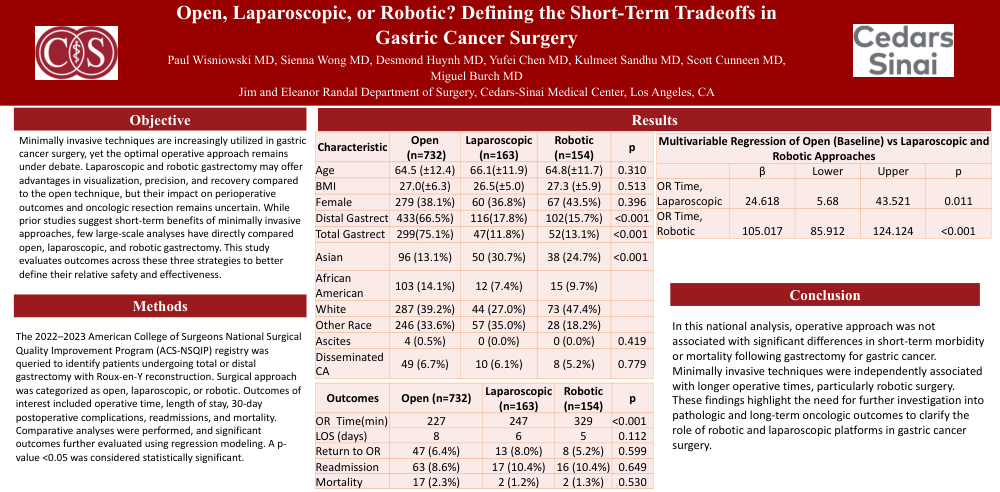
The 2022–2023 American College of Surgeons National Surgical Quality Improvement Program (ACS-NSQIP) registry was queried to identify patients undergoing total or distal gastrectomy with Roux-en-Y reconstruction. Surgical approach was categorized as open, laparoscopic, or robotic. Outcomes of interest included operative time, length of stay, 30-day postoperative complications, readmissions, and mortality. Comparative analyses were performed, and significant outcomes further evaluated using regression modeling. A p-value <0.05 was considered statistically significant.
Results:
A total of 1,049 patients were included; most procedures were performed via an open approach (69.8%), followed by laparoscopic (15.5%) and robotic (14.7%). Unadjusted analysis demonstrated higher rates of hospital stay >30 days for open compared to laparoscopic and robotic cases (3.7% vs 0.6% vs 1.3%), though this was not significant on logistic regression. Operative time differed significantly: open 227 minutes, laparoscopic 247 minutes, and robotic 329 minutes. On linear regression, both laparoscopic and robotic approaches were independently associated with prolonged operative time (β 24.6, CI 5.7–43.5; and β 105.0, CI 85.9–124.1, respectively). Median length of stay was longest after open procedures (7 days) compared to laparoscopic (6 days) and robotic (5 days), though this difference was not significant on linear regression. There were no significant differences among approaches in 30-day complications, readmissions, or mortality.
Conclusions:
In this national analysis, operative approach was not associated with significant differences in short-term morbidity or mortality following total or distal gastrectomy for gastric cancer. Minimally invasive techniques were independently associated with longer operative times, particularly robotic surgery. These findings highlight the need for further investigation into pathologic and long-term oncologic outcomes to clarify the role of robotic and laparoscopic platforms in gastric cancer surgery.